
This story was originally published by South Dakota Searchlight.
John Hult
South Dakota Searchlight
PIERRE — The official figures are flawed, the lists incomplete.
The officials know that, but can only do so much to address it on their own.
That’s why the work of the community organizers who swarm social media with news of missing and murdered Indigenous people is so critical, said Tanya Grassel-Krietlow, a Pierre-based advocate for Native American victims of sexual assault, domestic violence and human trafficking.
“It will always be grassroots moving the envelope,” the Lower Brule Sioux tribal member told a small crowd at the Capitol Lake Visitors Center on May 12.
The reasons are legion, Grassel-Krietlow has learned. She spent her formative years on the reservation and has family members on her tribe’s MMIP list. She’s also put in time as a federal probation officer, and she now spends her days connecting nonprofits to grant sources and victims to services.
Law enforcement and nonprofit databases don’t always share information, she said. Reports submitted to a national database designed for the general public’s use, meanwhile, can be slow to receive official approval from the local law enforcement agencies that lead missing persons investigations.
And those agencies may not see every report as equally worthy of immediate follow-up, she said — particularly if the missing person has a history of substance use or a habit of periodic disappearances.
Figuring out which agency ought to take a report or lead a search can be a challenge, too. Missing people may cross the jurisdictional lines that separate tribal land from state land, counties from counties and states from states. That can slow response times.
And then there’s another kind of agency to consider: human agency. Adults have the right to “ghost their friends” and not return phone calls, Grassel-Krietlow said, or to not come home at all. Police might find a missing person based on a family’s report, only to hear the allegedly missing person say they’d rather their family not know where they are.
That can be true, Grassel-Krietlow said, but it can also be that a person who says that is being trafficked, and that their handlers have pressured them to stay out-of-touch with those closest to them.
Agency plays a role in what gets reported on the front end, as well. Those who worry about a lost loved one may not trust that law enforcement will take their reports seriously, and could choose to share their concerns on social media or with family and friends instead.
“It will always be the community deciding what to share with law enforcement,” Grassel-Krietlow said. “It will always be the community remembering who’s gone, who needs to come home, who died and how they died.”
Activism guides investigations
The work of those communities has made a difference, in spite of those difficulties.
The day before Grassel-Krietlow spoke, U.S. Attorney Ron Parsons told South Dakota Searchlight that the work of activists to bring names and unsolved cases to light over the past two decades has informed the work of federal prosecutors.
The grassroots lists of the missing in South Dakota’s tribal communities that are shared with police and circulated online, he said, were “put together by people who needed to bring the issue to light.”
“The FBI has gone through the lists,” said Parsons, whose office oversees the prosecution of major crimes on tribal land in South Dakota.
The U.S. Attorney’s Office has a prosecutor, Troy Morley, who is devoted to MMIP cold cases across the Midwest. Morley, a member of the Turtle Mountain Band of Chippewa, led the case against Jay Adams, who pleaded guilty to manslaughter two years ago for killing an infant in Sisseton in 1992.
Building trust with tribal communities is key to the U.S. Attorney’s Office’s efforts, Parsons said, so families need to see prosecutors follow through on leads from the “courageous” witnesses who share what they know.
“When they see that there are results, that can’t help but make people feel comfortable coming forward,” Parsons said.
Evolving movement
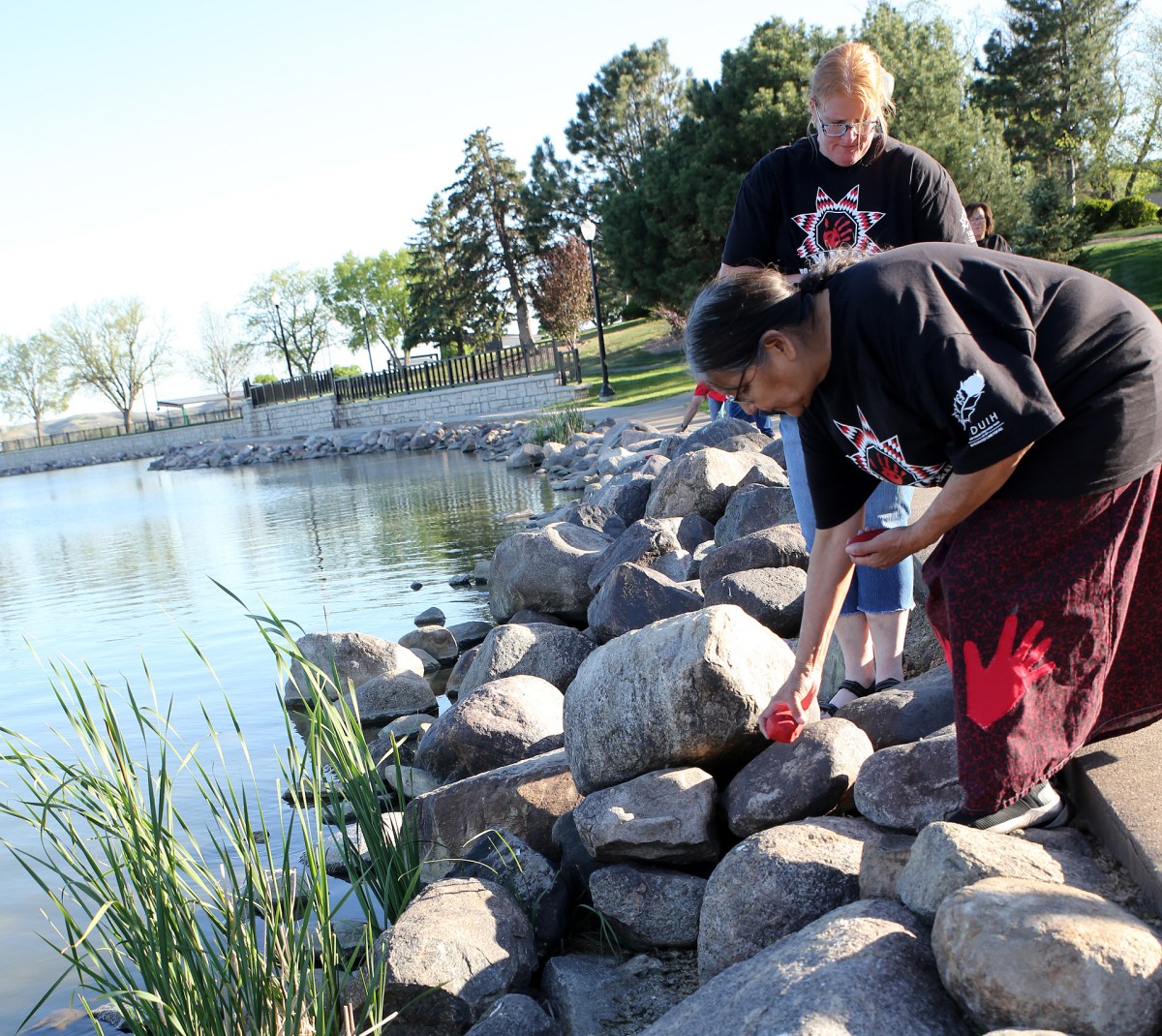
Grassel-Krietlow spoke at one of two MMIP vigils hosted last week by South Dakota Urban Indian Health. The first took place May 12 in Pierre, the second on May 14 in Sioux Falls. Attendees in Pierre wrote the names of missing loved ones on red rocks and placed them on the shores of the lake outside the visitors center, which is located on the grounds of the state Capitol.
The clinic tagged the vigils with the acronym “MMIR,” which stands for missing and murdered Indigenous relatives.
The adjustment is part of an ongoing evolution in the MMIP conversation, according to Ellen Durkin, the chief behavioral health officer for South Dakota Urban Indian Health and a member of the Lower Brule Sioux Tribe.
The move toward MMIR by some organizations, Durkin said, is meant to signal kinship as much as personhood.
“It’s a closer-knit, ‘we are all related’ kind of thing,” she said.
MMIP remains the term attached to May 5, a date established nationally as MMIP Day of Remembrance in 2017 through a resolution introduced in the U.S. Senate by Montana’s congressional delegation. The date corresponds with the birthday of Hannah Harris, a 21-year-old member of the Northern Cheyenne Tribe in that state.
A search team of volunteers found her body five days after she was last seen on July 4, 2013, near Lame Deer, Montana. Local law enforcement hadn’t taken her disappearance seriously. Frustration over the response and outcome would eventually spur both the U.S. Senate resolution to establish an MMIP Day of Remembrance and the state-level passage in 2018 of Hannah’s Law, which cleared the way for the Montana Department of Justice to assist in missing persons cases.
Changes, imperfections
The homicide rate for Native Americans is five times higher than for whites, according to a 2025 fact sheet from the Centers for Disease Control. It’s the fourth-leading cause of death for Native American men between 1 and 44 years old, and the sixth leading cause of death for women in that age group.
Native Americans are also more likely to go missing than non-Natives, both nationally and in South Dakota.
As of May 15, South Dakota’s missing persons database listed 110 people. Sixty-nine of them are Native American. Of the 59 women listed in the database, 42 are Native American.
The South Dakota database, operated by the state Attorney General’s Office, is six years old. It was created in 2020 after an endorsement by state lawmakers in 2019 — two years before they authorized the creation of an MMIP coordinator for the Attorney General’s Office – and the database automatically logs missing persons cases reported by state or tribal agencies to the National Crime Information Center. The NCIC is a centralized law enforcement database for all manner of incidents.
But the NCIC database doesn’t have every missing persons case, Grassel-Krietlow said during the Pierre vigil. It also doesn’t cross-reference its data with data from the International Centre for Missing and Exploited Children.
Grassel-Krietlow sometimes helps family members enter information into another database that was created in 2007 to act as a centralized repository of all missing persons cases. It’s called the National Missing and Unidentified Persons System and is funded by the Justice Department.
Anyone with an account can enter information into NamUs, as Grassel-Krietlow does, but the local agency to which a report was made must approve the report before it goes live.
As a result, she said, names may appear in the South Dakota database, but not NamUs.
On Friday, NamUS listed 20 Native Americans missing in South Dakota — 49 fewer than there were in the state’s database on the same day.
With either database, law enforcement is responsible for removing a name once a person is found. That doesn’t always happen quickly.
“Sometimes we have a wait time of up to a month on getting accurate data into NamUs, and then getting that data pulled if we find the person,” Grassel-Krietlow said. “And so we still have inconsistencies, even with the best intentions.”
Suspicious deaths
Lists of the Indigenous murdered may not reflect suspicious deaths, she said, particularly if initial autopsies miss or gloss over signs of violence.
A botched initial autopsy was a factor in one of South Dakota’s most famous cold cases.
The body of Annie Mae Aquash, a Mi’kmaq activist who worked with the American Indian Movement in the 1970s, was found in the Badlands in February 1976, months after her death. The initial autopsy concluded she’d died from exposure to the elements. A second autopsy found a bullet hole in the back of her head and a bullet lodged in her left eye socket, sparking a homicide investigation and series of trials that stretched across four decades and inspired books, documentaries and, most recently, a miniseries on the streaming service Hulu.
Lackadaisical death investigations are still an issue, Grassel-Krietlow said.
Using his first name only, she told the story of a young man who went missing after a party in winter. His body was bruised and battered when he was found, she said, but law enforcement “ruled it an accidental death, because he had been drinking, so he must have passed out outside and then died.”
“The broken bones, the evidence of a meeting and the missing clothing, it was inconsequential,” she said.
Grassel-Krietlow would like to see a federal commission convened to review unattended deaths where families are left with questions.
Her own uncle went missing the day she was born, she said. His body was found two weeks later, on the opposite side of the river where he’d gone fishing. His 1970 death was never investigated as a homicide, she said, so “he’ll never appear on any missing and murdered list.”
Leta Wise Spirit, who also works for South Dakota Urban Indian Health, spoke at the vigil of losing a family member to a homicide that went unsolved. Too often, she said, cases that occur on reservations are “swept under the rug,” or kept quiet by people more interested in protecting those responsible for a killing than bringing a killer to justice.
But Native Americans are also overrepresented in homicides in urban areas of South Dakota.
Wise Spirit referenced the recent death of 14-year-old McKenna Wendel in Sioux Falls. Her body was found in Brookings County in March, sparking a multi-state investigation.
“She went somewhere to babysit and she never came home,” Wise Spirit said, speaking through tears. “When they found her, she was murdered. Stuff like that really goes on.”
No charges have yet been filed in Wendel’s death. Attorney General Marty Jackley told South Dakota Searchlight on Friday that the investigation is active and ongoing, and that charges are expected soon.

