
Dan Ninham
Special to ICT
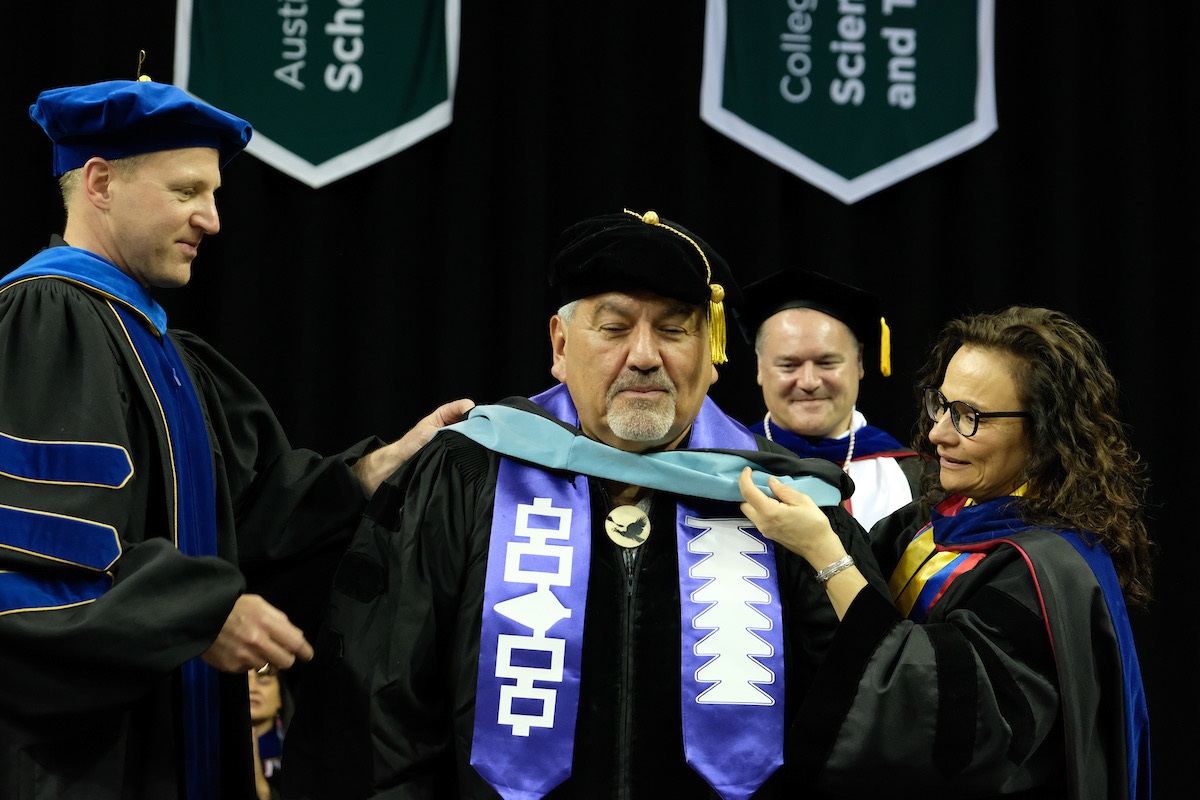
They crossed the stage one by one to collect a diploma like no other – the nation’s first-ever doctoral degree in First Nations Education.
After studying Indigenous issues, conducting oral histories with tribal leaders, elders and youth, and helping devise ways to improve the educational system for Indigenous students, four Native educators became the nation’s first graduates of a new program at the University of Wisconsin-Green Bay.
They also took the first steps at providing a new base of knowledge for Indigenous education.
“Community members told us they wanted students working on projects that addressed real-life needs while collaborating with elders and working with youth and the next generations,” said Dr. Lisa Poupart, a citizen of the Lac du Flambeau Band of Chippewa and an associate professor who heads the First Nations Studies Department at UWGB.
“It is a scholarly project that impacts the tribal world,” she told ICT.

The Spring graduates — Artley Skenandore, Vicki Young, Rosa Yekuhsiyo King and Crystal Lepscier — are the first to earn the degree, but another cohort of students is set to graduate in Spring 2023. Applications are being accepted for a group to begin classes in Fall 2023.
SUPPORT INDIGENOUS JOURNALISM. CONTRIBUTE TODAY.
Skenandore, principal and athletic director for Oneida Nation High School in Oneida, Wisconsin, told ICT that the program will impact education in tribal communities for years to come.
“Learning is a lifelong journey, embracing the relevance of our cultural teachings and understanding the context of how they are applied to the challenges of learning today,” he said.
“Our responsibilities, relationships, reciprocity, and respect are the foundational guide for renewing our cultural framework.”
A traditional approach
The academically rigorous, four-year program was created in 2017 at the university, after listening sessions that took officials into nearly every reservation in Wisconsin. It is the only doctoral degree offered at the University of Wisconsin-Green Bay.
“One of the things that makes our program unique in particular is that we held listening sessions across the state and met with tribal leaders, community members, and others interested in our program,” said Dr. J.P. Leary, who is of Cherokee, Scottish, Irish and other descent, and a faculty member in First Nations Studies, history and humanities at UWGB.
“We asked them, ‘If our graduates are to be useful to you, what should they know and be able to do?’” he said. “They reinforced the importance of certain elements of our program, including the importance of Indigenous knowledge, the role of elders, and the need for a high level of academic rigor. They also highlighted other needs that were not in our initial program design, particularly the need for statistics and grant-writing courses. We incorporated what we learned to build the curriculum for the program.”
The result is a program designed to prepare transformational leaders through oral scholarship, officials said.
Students are required to complete a dissertation project in their third and fourth years that is developed in collaboration with First Nations governments, communities, and individuals. They are also required to work with tribal youth and elders, and with other local leaders, Poupart said.
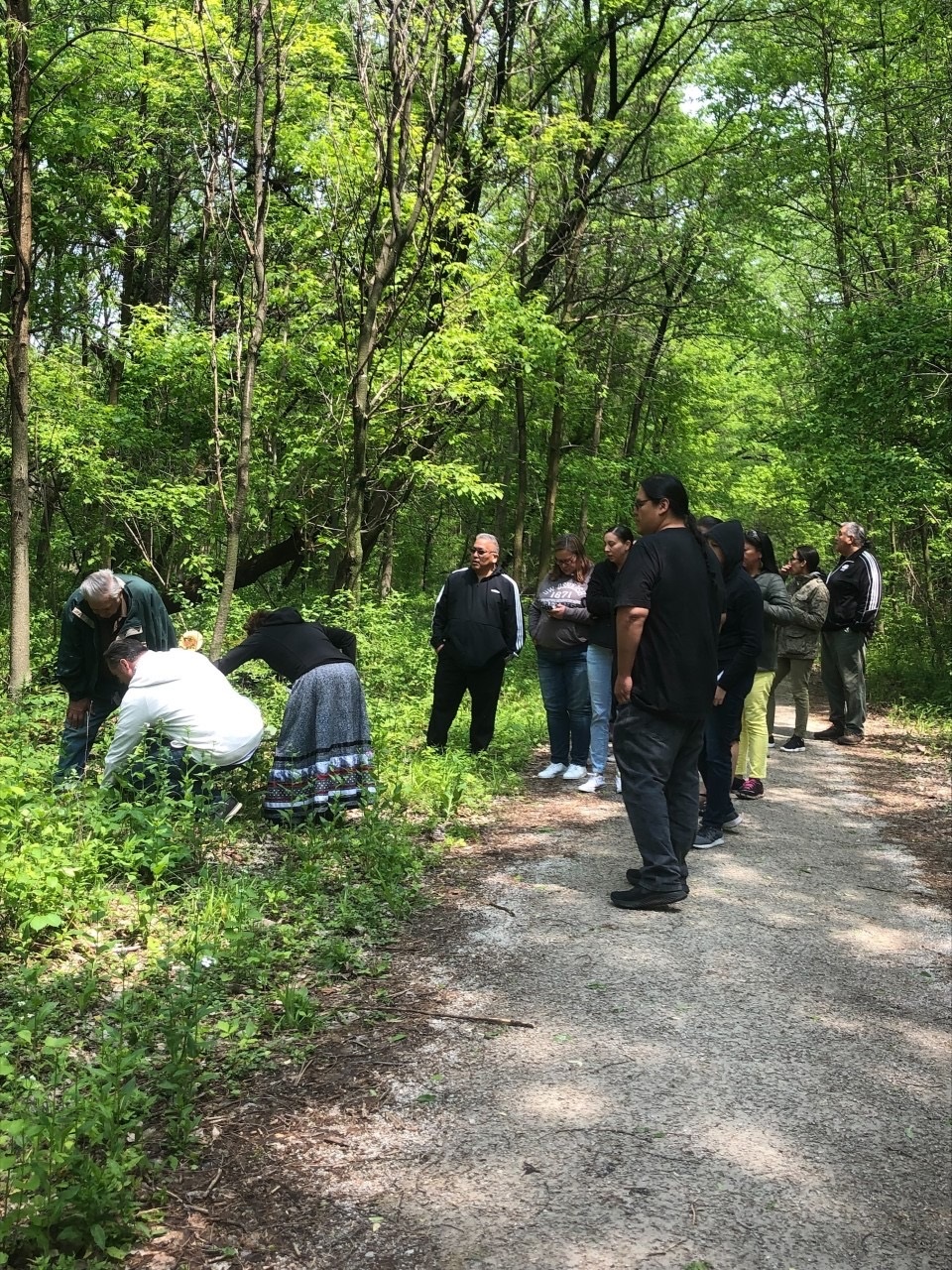
“The projects are aimed at meeting community needs in practical, real-life contexts,” Poupart said. “Students often work with community partners to design the project focus and outcomes.”
The program is rooted in the use of traditional oral teaching and scholars, who work with the university faculty and co-teach classes, helping students learn with a traditional First Nations approach.
“The program is centered in Indigenous knowledge systems and draws upon Indigenous teaching and learning methods for the purpose of promoting and protecting the sacredness of the Earth and all living things,” Poupart said.
“Acknowledging the role of tribal elders and oral scholars and incorporating their knowledge is essential to First Nations education.”
This inaugural class tackled a range of subjects, including research on arts-based expression, identity, the impact of trauma and the role clans can play in tribal decisions.
Artley Skenandore
Skenandore, a citizen of the Oneida Nation, started as a culture and language teacher before moving into vice principal and principal positions within the Oneida Nation School System in Oneida, Wisconsin.
He also served as general manager for the Oneida Nation in the development and implementation of economic development projects such as gaming, hospitality, housing, and community infrastructure.
The past 11 years have been devoted to building educational programming for the Oneida Nation High School as principal and athletic director.
Skenandore’s dissertation, “The Oneida Nation Learning Journey: Learning to be, Learning to Learn, and Learning to Do,” was based on an oral history of Oneida stories about schooling and examined the return to a clan system for making decisions for the community.
“It is a very intergenerational project that documents how previous generations of Oneidas have thought about schooling and the thinking of the present generation for use by future generations,” Leary said. “His research will directly inform the development of the new Oneida Nation High School.”
Skenandore said community elders have shared their stories for generations and worked for their communities.
“I learned from watching the untiring spirit of (the late) Amos Christjohn and Maria Hinton, siblings who both worked into their nineties to ensure Oneida language revitalization today,” he said. “Our spirit of resilience to strive to make a difference for the future generations is embedded in our cultural teaching and our job is to contribute to the future.”
He praised the First Nations program at UWGB, saying officials created an environment “that encouraged us as individuals to share our learning stories and create a new learning community with a deep well of experiences to draw upon as colleagues as we all step into the future.”
He continued, “Learning is a responsibility to serve our Indigenous communities of Individuals, families, clan families and our Indigenous nations.”
Skenandore has an undergraduate degree from St. Norbert College in De Pere, Wisconsin, and master’s degree from the University of Wisconsin-Milwaukee.
Vicki Young
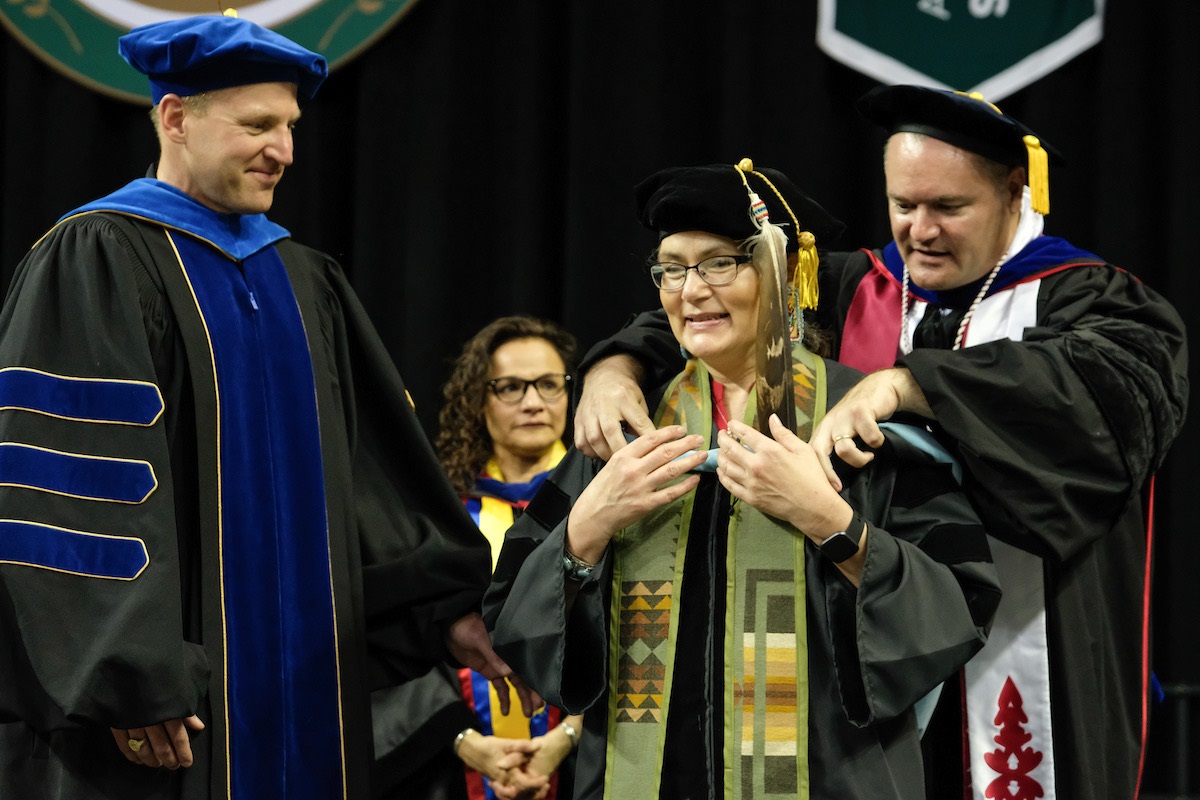
Young, a citizen of the Lac Courte Oreilles Band of Lake Superior Chippewa, has worked for the Menominee tribal educational systems for 25 years, teaching students from kindergarten to college. For the past 16 years, she has taught at the College of Menominee Nation in the liberal studies department.
Young’s dissertation, “Indigenous Story Methodology as a Pathway to Tribal Identity Development: Considerations for Praxis,” addressed the disconnection from tribal identity in response to trauma, and how elements of Indigenous stories can help reconnect people with their tribal identity.
“My doctoral research will influence the remainder of my career,” she told ICT in an email. “There is a wealth of evidence that engaging in expressions of one’s tribal identity supports holistic wellness and can improve academic performance; however, there is little that addresses what this means for those who have been disconnected from their tribal identity.”
She continued, “It is a complex, multi-layered issue often experienced in silence. This is a critical area that needs our care and attention, and it is one that I plan to make the focus of my future work, both as a teacher and a researcher.”
A course on generational healing had the most impact for her, Young said.
“I not only learned about the impacts of generational and intergenerational trauma, but it also required that I engage in a deep, introspective process to identify experienced trauma in my life and to begin the healing process,” she said.
“We are taught that in order to be effective educators and support healing in our communities, we must start with ourselves,” she said. “It was a powerful, life changing course.”
Leary said the results have changed perceptions.
“Vicki Young wrote a powerful auto-ethnography around Native and tribal-specific identity development, drawing upon stories from her own life and putting them in a broader theoretical context,” he said. “Her praxis involves creating and holding space in a classroom by using personal stories to foster a context where others can be similarly vulnerable, open, and connected.”
Young has a bachelor’s degree in secondary English education from UW-Madison, and a master’s in English from UW-Milwaukee.
Rosa Yekuhsiyo King
King, a citizen of the Oneida Nation of Wisconsin, has likewise taught across many generations. She was a teacher for six years at the Oneida Language Program in a grade K-12 public school district, and taught three years at the College of Menominee Nation-Green Bay.
She’s a licensed American Indian Language Teacher by the Wisconsin Department of Public Instructor, and currently is lead instructor in the TehatiwʌnákhwaɁ Language Nest Immersion Program that serves students three to seven years old.

Her dissertation, “Ukwakala: My Relational Journey of Reclaiming the Oneida Language,” examined the teaching and learning experiences of three Oneida language educators in her community, including herself, and identified key practices that can help students learn language.
“Since I’m a teacher, this study greatly helps my work and helps me to share and teach these helpful practices identified in my dissertation,” she said.
A course that provided an introduction to Indigenous education introduced her to works by Vine Deloria Jr. and Daniel Wildcat, she said.
“Their work from the book, ‘Power and Place,’ truly impacted me and gave me so much knowledge and insight into the current state of Indigenous education and how to shape and change it to better benefit our students and their future,” she said.
Leary said King broke ground in understanding how to teach and learn language.
“Rosa King developed a collective auto-ethnography where she used her own story of being an Oneida language learner and teacher. and placed it alongside similar stories … [from] two previous generations of Oneida language teachers,” Leary said. “From this collective story, she developed ideas about culturally rooted habits and actions learners can draw upon as they enter into a relationship with language.”
In addition to her doctorate from UWGB, she has a master’s degree in tribal administration and governance from the University of Minnesota-Duluth and a bachelor’s degree in American Indian studies from the University of Minnesota-Twin Cities.
Crystal Lepscier
Lepscier, a citizen of the Little Shell Tribe and a descendant of the Menominee and Stockbridge Munsee Band of Mohicans, has served in various public positions connected to her art and education background.

She worked in visitor services at the National Museum of the American Indian in Washington, D.C., before returning Wisconsin to attend graduate school. During that time, she worked in human resources for UW-Madison and became a multicultural advisor at UWGB, a financial aid manager at the College of Menominee Nation and a 4-H youth advisor for the UW Extension Service.
She also served as an adjunct faculty for the College of Menominee Nation and as an instructor for UWGB in First Nations Studies.
Her dissertation, “Listening for the Canaries: Addressing Racial Battle Fatigue in First Nations Students in Higher Education,” examined how so-called Racial Battle Fatigue (RBF) surfaced among First Nations researchers and reviewed the use of creative expression to address it, she said.
“Since I have an arts background,” she said, “I tapped into my knowledge and skills with designing and making moccasins, and walked co-researchers through those important discussions on centering self and identity in design and art work.”
Her findings found that RBF showed up in four categories – internalized fatigue, externalized fatigue, intergenerational responsibility, and what she called “the sole voice.” A fifth category was cultural nourishment, which she said “signified how important it is to center ourselves in our identities as First Nations people to address RBF.”
Lepscier said her research will influence her work for years to come.
“My future work is aligned with this topic, as it’s my everyday lived reality as someone who supports First Nations students on campus at UWGB,” she said.
Poupart, her current supervisor and longtime mentor, said Lepscier’s work reached important conclusions.
“She is an amazing scholar, leader, and Anishinaabekwe who has a fire and passion for the work she does,” Poupart said. “She pushes me to challenge my understanding of the way things are and aim for the way things could be.”
Another researcher, Dr. Heather Kind-Keppel, Ed.D., a faculty member at Rosalind Franklin University of Medicine and Science in North Chicago, Illinois, likewise praised her work.
“Dr. Lepscier’s dissertation was extraordinary,” she said. “It was grounded in her and the co-researchers’ voices and all of their lived experiences while incorporating art as an aspect of the research process. I truly believe her research is beautiful and groundbreaking. It is a true reflection of Indigenous research and will serve as a guide for future generations to come.”
Lepscier earned a bachelor’s degree in fine arts/studio arts at UW-Madison and a master’s of science in educational leadership and policy analysis at UWGB before receiving her doctorate in education at UWGB.
Looking ahead
Leary said the goal of the new First Nations Education doctorate is to produce research that can help tribal communities.
A doctorate in education, the Ed.D., is intended as an “applied degree,” he said, putting theory into practice rather than a research-focused Ph.D.
That impact is already being felt, he said.
“Our students engage in rigorous research with the goal of addressing a particular issue or problem facing tribal communities (either) their own, one, multiple, reservation, rural, or urban,” he said.
“Each of our students has already been making significant positive impact on the well-being of their communities,” he continued. “This degree gives them additional tools to use in their ongoing work.”

Our stories are worth telling. Our stories are worth sharing. Our stories are worth your support. Contribute $5 or $10 today to help Indian Country Today carry out its critical mission. Sign up for ICT’s free newsletter.
