Editor’s note: This is one in an occasional series on ‘forgotten’ ancestors who may not be fully recognized today for their achievements.
Raymond Wilson
Special to ICT
Native activist, Bureau of Indian Affairs employee, Society of American Indians officer, lawyer, and women’s suffrage advocate Marie Louise Bottineau Baldwin, Ojibwe/French, was born on Dec. 14, 1863, in Pembina, North Dakota. She was proud of her blended heritage.
Her grandfather Pierre Bottineau — an explorer, founder of settlements, and diplomat — helped negotiate treaties between the United States and the Ojibwe. Her father, Jean Baptiste Bottineau, a lawyer and justice of the peace, wed Marie Renville, her mother, in 1862.
Marie Louise, Métis and Turtle Mountain Chippewa, married Fred Baldwin, a non-Native businessman in 1887, when she was 24. The marriage was short-lived, and the couple divorced in 1889.
Baldwin attended schools in Minneapolis, St. Joseph’s Academy in St. Paul, and St. John’s Ladies College in Winnipeg, Manitoba, Canada. She then became a clerk for her father’s law firm. In 1914, Baldwin graduated with a law degree from Washington College of Law, completing the three-year program in just two years and becoming one of the few Native American females in the United States to be an attorney.
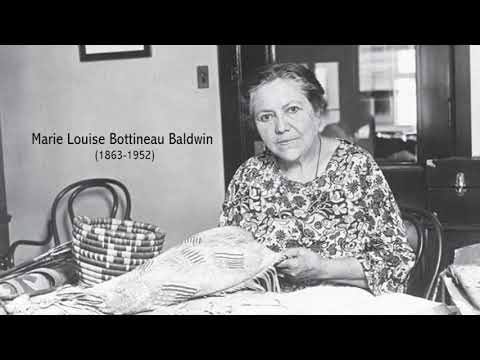
In the early 1890s, Baldwin moved with her family to Washington, D.C., and assisted her father in his efforts to represent the Turtle Mountain Ojibwe land claims. The Ojibwe had not received a fair price for their land, and the reservation that was created was too small. The federal government resolved the issue in 1904, but it fell short of what the Ojibwe had wanted.
Baldwin became a Bureau of Indian Affairs employee in Washington, D.C. in 1904. She was one of the few Native office workers and even though she became the highest-paid Native American woman in the BIA at $900 a year, her salary was lower than other non-Native employees. Baldwin worked with Natives who visited Washington, D.C., to discuss Indigenous issues.
The BIA supported Baldwin’s attendance at meetings of the Lake Mohonk Conference of Friends of the Indian and at Carlisle Industrial Indian School graduate ceremonies.
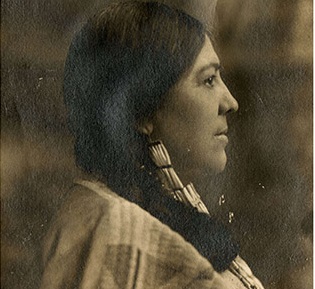
Baldwin was proud of her Native heritage, and for the BIA picture in her personnel file, she wore traditional Ojibwe attire.
Baldwin was among the founding members in 1911 of the Society of American Indians, a Native-run organization seeking needed reforms. She served on the executive council, on the general committee, as chair of the board of trustees, and as the organization’s treasurer. In 1914, Baldwin and others met with President Woodrow Wilson to discuss Native issues.
Known for her dynamic oratory, she presented several speeches on Native societies to diverse audiences, and among citations on her in The Quarterly Journal of the Society of American Indians are “Modern Home-Making and the Indian Woman” in 1911, where she stressed the important roles played by Native women and their gender equality.
Indeed, Baldwin played a major role in the Society of American Indians, but tensions regarding her BIA employment caused others to question her membership in the organization. Either abolishing the BIA or drastically changing its role was a major issue among SAI members.
In 1915, the SAI separated the offices of secretary-treasurer. Baldwin became SAI treasurer and initially worked well with Gertrude Bonnin, a Lakota activist who became an important SAI member in 1915. Bonnin was elected SAI secretary.
The two Native American officers engaged in heated arguments, however, regarding the location of the offices and other issues. Moreover, Bonnin supported those who questioned the loyalty of BIA employees as SAI members. SAI leadership supported Bonnin, which resulted in Baldwin leaving the society. Bonnin became secretary-treasurer in 1918, when the offices were again combined.
Regarding the women’s suffrage movement, Baldwin was a staunch supporter of granting women the right to vote. She declared that Native women often voted on major political, economic, and social matters in their nations.
In 1913, a major suffrage parade was held in Washington, D.C. Baldwin, who had been asked by the parade’s organizers to supervise the building of a float that emphasized the suffrage movement, instead marched with other female lawyers down Pennsylvania Avenue in support of granting women the right to vote.
Baldwin retired in 1932 and received a government pension. There is little information on her activities before her death at age 88 from a cerebral hemorrhage in Los Angeles, California, on May 17, 1952.
Sources: Bureau of Indian Affairs files, Society of the American Indian papers, National Park Service, and New York Historical Society.