
You can help elevate meaningful stories from Indigenous nations when you support ICT during Arizona Gives Day! ICT is headquartered in Arizona, and covers the Indigenous world across North America. Help us reach our goal to raise $10,000 for reliable, compelling, Indigenous-led journalism in Arizona and beyond.
Felix Clary
ICT + Tulsa World
TULSA, Okla. — The queer and Native communities are questioning the recent ruling of suicide in the death of nonbinary teen Nex Benedict and the decision not to press charges against their attackers.
The Oklahoma medical examiner’s office has ruled 16-year-old Nex’s death a suicide, concluding the death was caused by a lethal combination of two drugs – the antidepressant Prozac and the allergy medicine, diphenhydramine, the key ingredient in Benadryl, according to a summary report of the findings.
The Owasso Police Department has said no charges are being filed by the Benedict family against the teens who attacked Nex during an altercation in a high school girl’s bathroom. Nex, who was of Choctaw descent, was conscious and talking after the Feb. 7 altercation, but was found unconscious the next day at home and died later at a hospital.
The U.S. Department of Education has launched an investigation into the bullying, and the Benedict family is performing its own, private investigation.
ICT will refer to Nex with he/they pronouns interchangeably, as this was his preference, according to his close family and friends.
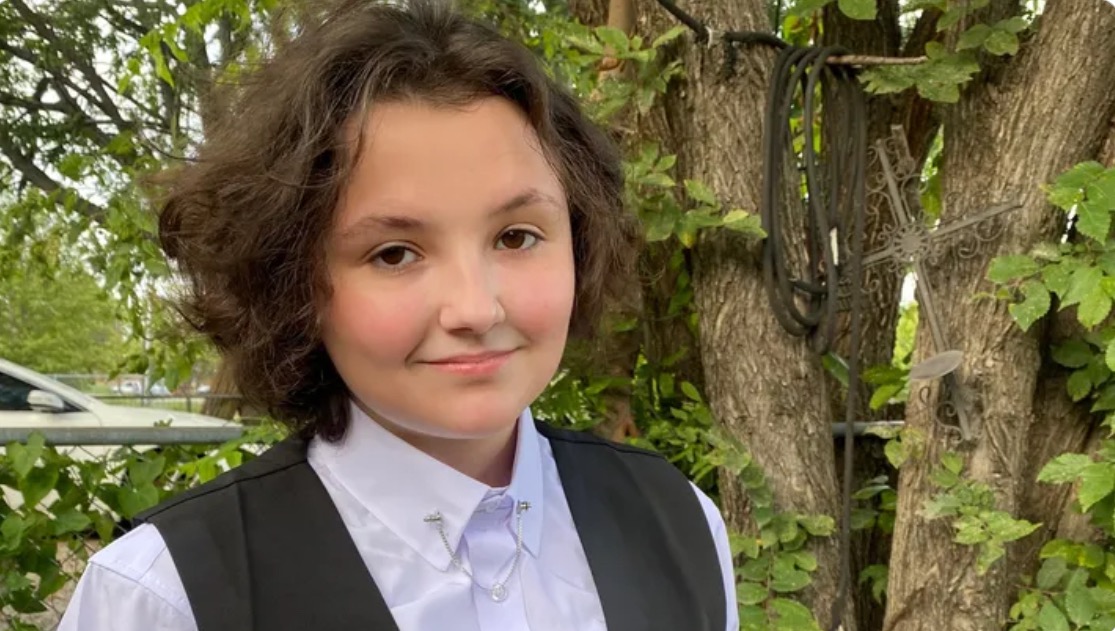
Nex’s mother, Sue Benedict, said the teen had been bullied over identity for more than a year, and was using the girl’s bathroom because of an Oklahoma law that requires trans students to use the bathroom for the gender they were assigned at birth.
Most LGBTQ2+ leaders indicated they believe Nex died as a result of bullying at the school, whether by suicide or from the assault in which their head was slammed repeatedly against the floor.
“I do feel like suicide is a definite possibility, but regardless if it was caused by the fight or suicide, Nex died from bullying. Period,” said Olivia Carter, administrative coordinator for Oklahomans for Equality, who graduated from Nex’s high school in 1996. Carter identifies as non-binary and uses she/they pronouns.
Others questioned why Nex would have used a prescribed medication and an over-the-counter allergy medicine that can cause sleepiness.
The medical examiner found that Nex suffered bruising to the brain, and abrasions on the right cheek and ear.
A report from the Tulsa County District Attorney’s office, however, found notes with self-destructive language in Nex’s room. The DA’s report did not describe the writings as suicide notes, but said they may indicate that the death was a suicide.
“Honestly, the autopsy results, trying it say it was a suicide, is baffling to me,” said Mari BlackSnow, a mother with a young relative who attended school with Nex in Owasso. BlackSnow is two-spirit and uses they/she pronouns.
“Considering that Nex was bullied, that they were beaten, and then passed away, it doesn’t make sense to me,” BlackSnow said. “It feels like they are trying to paint him as a mentally ill trans Native. It’s sickening.”
National spotlight on Oklahoma
Well-known Osage, two-spirit licensed family and trauma therapist Marx Cassity said complex reactions such as confusion and skepticism would not be unusual, given the grief and stressors caused by the anti-queer language and legislation from Oklahoma lawmakers.
“I don’t think people in the community are closed-minded about this being a suicide,” Cassity said. “We know that is possible and common in our community, especially in the context we are living in in Oklahoma…. his is a traumatic death, whether it was from suicide or a head injury. We have to put this into context with the issues we are having in Oklahoma.”
Nex told police that three girls attacked him after the teen squirted one of them with water when she verbally harassed Nex and a trans-gender friend for the way they were dressed, according to a police video released by authorities. Police were called to the hospital by Nex’s grandmother and guardian.
At the hospital, Nex’s mother said they were questioned by a police officer who continually misgendered him and described the altercation as a mutual fight that Nex started by pouring water on one of the three, older girls.
Sue Benedict said that Nex told her his head was bashed into the floor, and she saw visible cuts on their face and neck. The medical report indicates wounds consistent with a physical altercation.
Nex collapsed in the family living room the next day and died later in hospital. The medical reports show that resuscitative methods were performed on Nex but could not revive him.

The initial police report stated that Nex did not die of trauma, which likely meant they did not die from head trauma caused by the fight. The levels of diphenhydramine and Prozac found in Nex’s system were at levels that can be lethal, especially when combined.
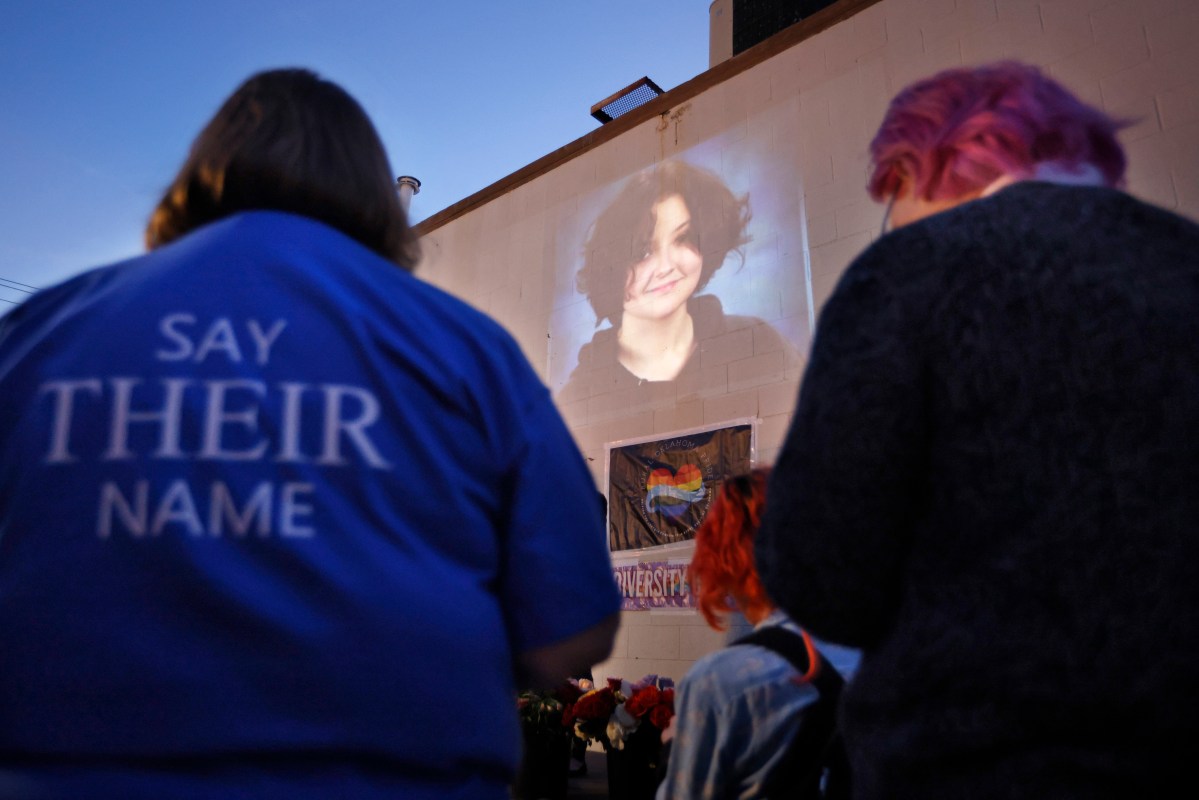
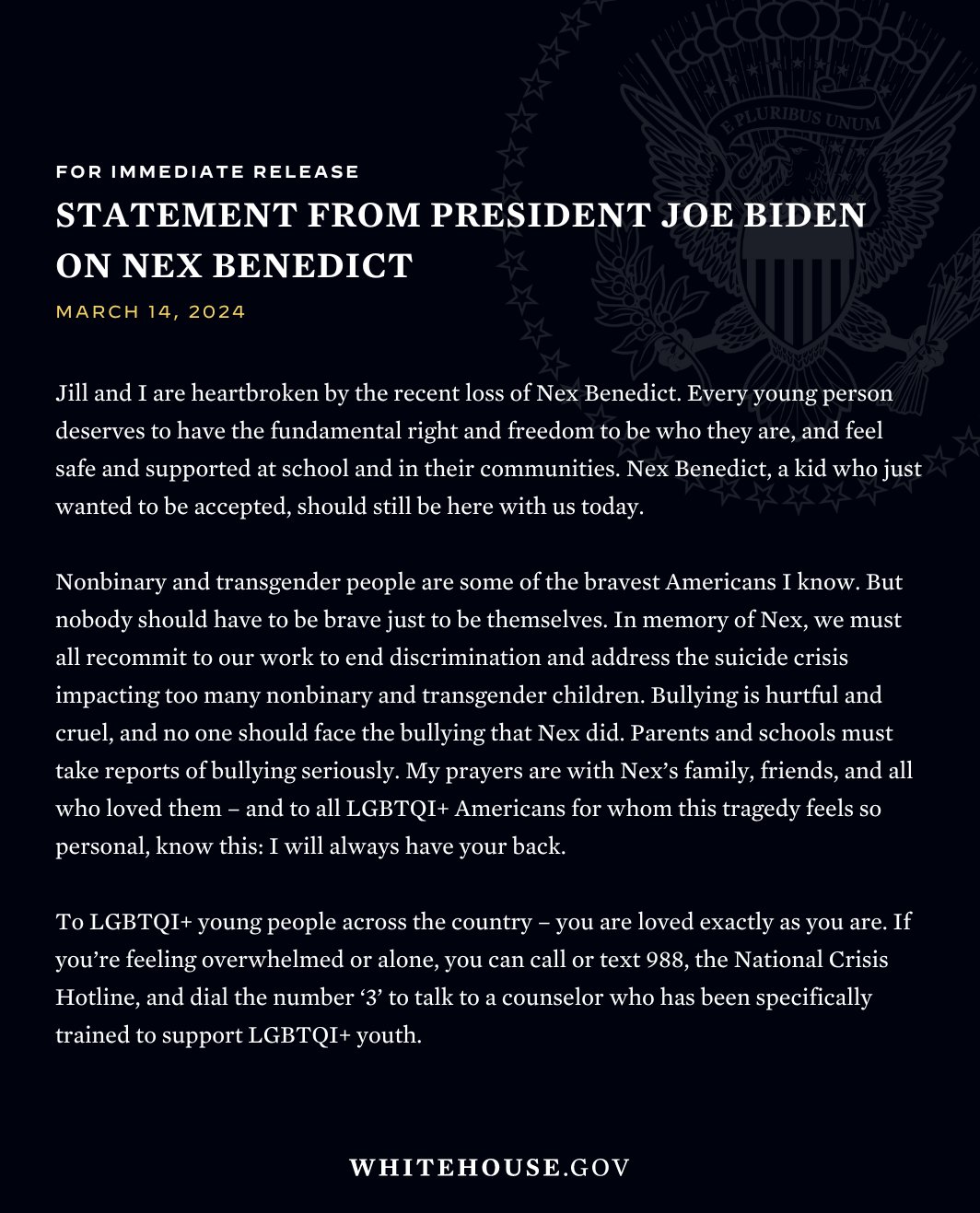
The death has brought national pressure on local authorities with vigils and social media uproar since Nex’s death, including an official statement from President Joe Biden about Nex’s death, encouraging LGBTQI+ youth to seek help for bullying.
Nex’s family issued a statement March 13 that encourages further investigation into his death.
“With each passing day, the numerous ongoing investigations surrounding Nex’s untimely passing yield additional information,” the family said in the statement. “Yesterday [March 13], a summary report from the medical examiner was released, simply stating that Nex’s death was caused by suicide. As the media and the public await the release of the full report, the Benedicts want to ensure that other pertinent portions of the report are not overshadowed by the ‘classification’ of Nex’s death.”
The family continued, “Rather than allow incomplete accounts to take hold and spread any further, the Benedicts feel compelled to provide a summary of those findings which have not yet been released by the Medical Examiner’s office, particularly those that contradict allegations of the assault on Nex being insignificant. As outlined in the full report, the Medical Examiner found numerous areas of physical trauma over Nex’s body that evidence the severity of the assault.”
Creating hate
Carter, who graduated from Nex’s high school in 1996, said the school has a history of treating trans, queer or nonbinary students harshly.
Carter said in high school they described themself as bisexual, but discovered their non-binary, pansexual identity later in life.
“It was really bad in the ‘90s,” Carter said. “We didn’t have a whole lot of language for the queer community that we do now, so a lot of my friends weren’t necessarily out. We were all just labeled as gay, whether we were or not.”
Carter said one friend was punched in the face and knocked down a flight of stairs in school. Their group of friends were tailgated by cars that would flash lights at them, and once a driver flashed a gun at them and sped away.
Carter said they and their friends were once approached at a club by a group of students holding baseball bats, ready to beat them.
Carter says this was the typical Owasso high school experience for queer kids in the ‘90s.
“When we talked to the principal, he said it’s our fault for being different,” Carter said. “My mom said I was just being sensitive. No one would believe us, so we didn’t go to the police.”
Carter found haunting the comments from Nex that they didn’t go to school authorities over the bullying because they didn’t see a reason to.
“I feel like people are using that against him, but in that situation, telling more people can make things worse,” Carter said. “Or sometimes the adult or staff person is also hateful and can create more harm or danger.”
Carter questions the amount of progress Owasso has made since the 1990s, particularly with Oklahoma legislators setting examples for students to be transphobic and homophobic in public schools.
“I thought Owasso had made some progress, but to be honest, I never felt fully safe going back there,” they said.
Seeking help for bullying
The two-spirit community is upset not only by those who invalidate Nex’s identity but also his Native identity, saying the case is still relevant to the missing and murdered Indigenous people epidemic.
According to the recent survey on LGBTQ Youth Mental Health fromThe Trevor Project, Native American LGBTQ youth, ages 13-24, have both the highest rate of considering suicide, at 44 percent, and of attempting suicide, 21 percent, Cassity said.
They also represent the highest demographic being bullied, at 48 percent, the survey found.
“We must be aware of the broader context in which this tragedy occurred,” Cassity said, calling on all tribal nations to “take an immediate stance against bullying and create safe spaces that actively value and protect their 2SLGBTQ citizens and their families.”
Lance Preston, the founder and director of the Rainbow Youth Project USA, said calls from Oklahoma to a national queer hotline spiked by more than 500 percent after Nex’s death.
Accustomed to 87 calls a week, the hotline received 474 calls from Oklahoma in the week after Nex’s death.
“We have seen crises increase with school board policies or where school boards are considering policies like forced outing … bathroom policies, ban on athletics, all those things,” Preston said. “Because it makes these kids feel like: ‘I’m not wanted. My government hates me. I’m not wanted here.’”
Cassity stated that the skepticism surrounding the reports likely stems from the fact that the officials prematurely released information when they said Nex did not die from trauma.
“They even admitted that the initial report was released to head off national tension,” Cassity said. “This does not build trust in the community for true facts to be released. The way they report and the timing of their reports are very important to trust building … We need authorities to be honest and transparent in the state.”
Cassity pointed out that Nex’s overdose could have been a suicide, but it also could have been a “suicidal gesture,” which essentially is a cry for help with a low-risk suicide attempt.
When patients are in intense physical and emotional pain, taking a higher-than-recommended dose of medication is sometimes an attempt to feel better and numb the pain, Cassity said.
Most LGBTQ advocates blame the growing political tensions in Oklahoma for the sharp rise in bullying.
Last year, U.S. District Court Judge John Heil III, declined to stop a new law that prohibits minors from receiving gender-affirming care. This includes gender therapy, gender-reassignment treatments, and gives medical professionals the ability to refuse affirming a patient’s gender identity.
In 2022, Oklahoma Gov. Kevin Stitt signed a bill that banned nonbinary gender markers on birth certificates, which requires people who do not identify as male or female to choose one or the other for their birth certificate. The same year, he also prohibited transgender women from participating in female sports, and prevented transgender children from using their preferred bathrooms at school.
Oklahoma Superintendent of Public Schools Ryan Walters has also supported anti-trans policies and faced criticism for appointing a right-wing social media influencer, Chaya Raichik, known for posting anti-LGBTQ+ rhetoric online, to a state library panel.
Walters was recently quoted in the New York Times as saying there is a “civil war” in Oklahoma over the state’s recent legislation.
Cassity said that the queer community does not want a civil war, but rather is asking for the right to live as their authentic selves.
“The language that comes down from the top,” Cassity said, “is making this hard for people in the community to process and feel safe and trusting.”

This story is co-published by the Tulsa World and ICT, a news partnership that covers Indigenous communities in the Oklahoma area.
ICT is a nonprofit news organization. Will you support our work? All of our content is free. There are no subscriptions or costs. And we have hired more Native journalists in the past year than any news organization ─ and with your help we will continue to grow and create career paths for our people. Support ICT for as little as $10. Sign up for ICT’s free newsletter.

