ICT is working to shape the future of journalism and stay connected with readers like you. A crucial part of that effort is understanding our audience. Share your perspective in a brief survey for a chance to win prizes.
Kolby KickingWoman
ICT
“Strong and on the rise.”
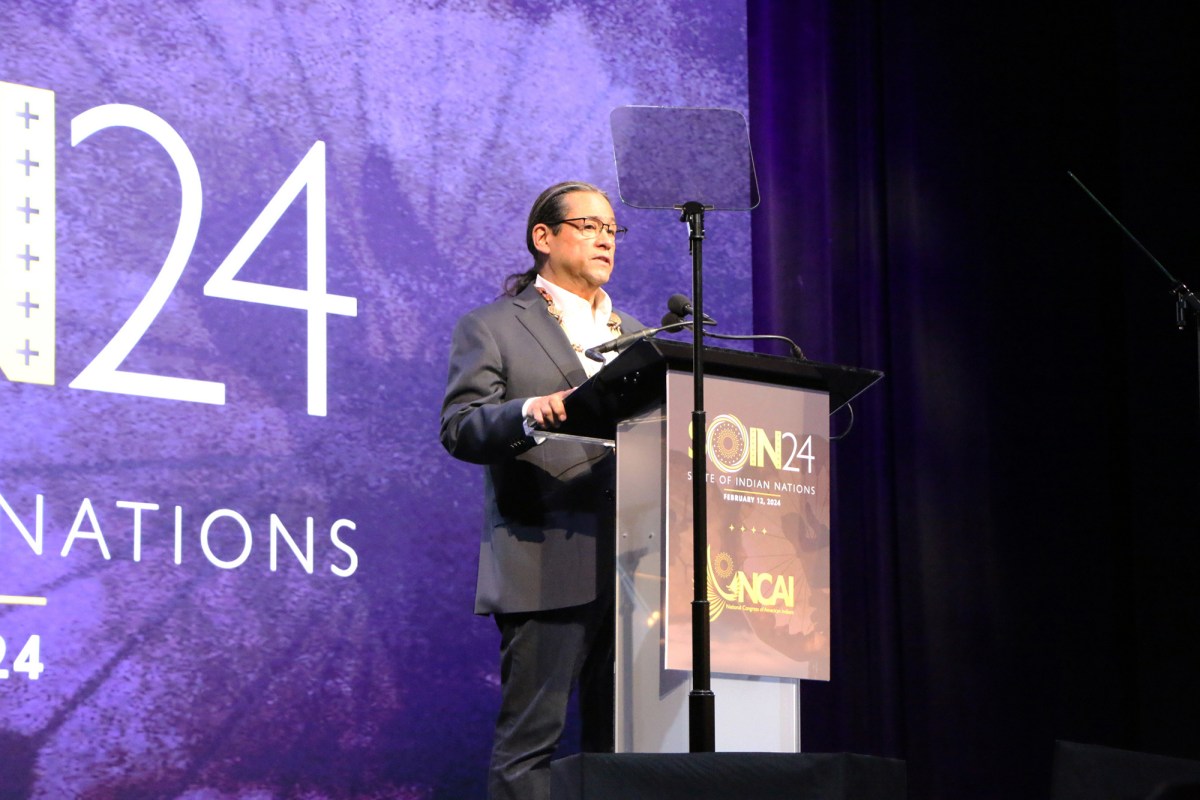
In his first State of Indian Nations address as president of the National Congress of American Indians on Monday, Mark Macarro highlighted recent accomplishments and progress made across Indian Country.
Perhaps the biggest win for tribes in the last year was the Supreme Court affirming the Indian Child Welfare Act in its decision in Haaland v. Brackeen.
Macarro, Pechanga Band of Luiseño Indians, has been the tribe’s chairman for nearly 30 years. He noted the historic fashion in how tribes came together and “the power of our collective voice has never been more evident.”
“Four hundred and eighty-six tribal nations and 59 Native organizations were instrumental in supporting the constitutionality of the Indian Child Welfare Act. People listened, the courts listened and the United States listened. Together tribal nations stood shoulder to shoulder to protect our children,” he said. “This is the unity of collective action that propels us forward. It’s our job to build on this legacy.”
The event was held at the Warner Theater in Washington, D.C. and kicked off the organization’s Executive Council Winter Session, which brings tribal leaders from around the country to the nation’s capital.
Macarro called for Congress to honor promises made to tribes through treaties and that the needs of Indian Country “are not entitlements, Indian Country’s needs are non negotiable, they are imperative and they must be met.”
“Let me be clear, the wellbeing and the future of tribal nations should never be overshadowed by political agendas,” he said. “Our needs and rights must rise above partisan politics.”
He also announced three actions the organization will undertake in the coming year. First, Macarro wants NCAI to host a National Public Safety and Justice Summit and have meaningful discussions about jurisdictional and law enforcement needs.
The second item was the announcement of a task force within NCAI that will focus on the integrity of tribal membership and foster education within NCAI.
Lastly, with 2024 being an election year, Macarro said it is important for Indian Country to remain politically engaged.
“Every vote we cast has the power to shape the future,” Macarro said. “I intend to convene a Native vote roundtable to ensure Indian Country’s voting voice is amplified and our access to the ballot is ensured.”
Every year a member of Congress is invited to give a congressional response. Re. Mary Peltola, Yup’ik, was selected to do so. Peltola, a Democrat, was the first Alaska Native elected to Congress.
Similar to Macarro, she said Indian Country has a lot to be proud of in recent years but there is always more work to do.
“We are only beginning to find our full strength,” Peltola said in taped remarks. “These victories should inspire us for the work that lies ahead, because there’s so much to be done and significant challenges in our path that we will only be able to tackle together.”
Macarro wasn’t the only speaker to demand that the federal government live up to its obligations to tribes: Caleb Dash, NCAI Youth Commission co-president and a citizen of the Salt River Pima–Maricopa Indian Community, called for increased funding across the board. He said tribes have been put “at the far end of the table” for too long.
“We must receive more funding from the federal government to support all our nations and efforts to build infrastructure that is vitally needed such as roads, hospitals, gas stations, schools, fire departments and so much more,” Dash said. “As Indigenous people we are neglected by the federal government,” as reported by Cronkite News.
Dash also called on the federal government to formally apologize for its past wrongdoings.
“We ask the United States government to acknowledge on the record the genocide of our people … as they continued to attack our freedom and our nation and efforts to destroy our ways of life,” he said.
The full speech can be watched back on YouTube.

Like this story? Support our work with a $5 or $10 contribution today. Contribute to the nonprofit ICT. Sign up for ICT’s free newsletter
Cronkite News contributed to this report