Joaqlin Estus
ICT
ANCHORAGE, Alaska — Quannah Chasinghorse, Han Gwich’in and Sicangu/Oglala Lakota, works internationally as a model. She uses her public platform to advocate for climate justice, and for the protection of Indigenous lands and rights.
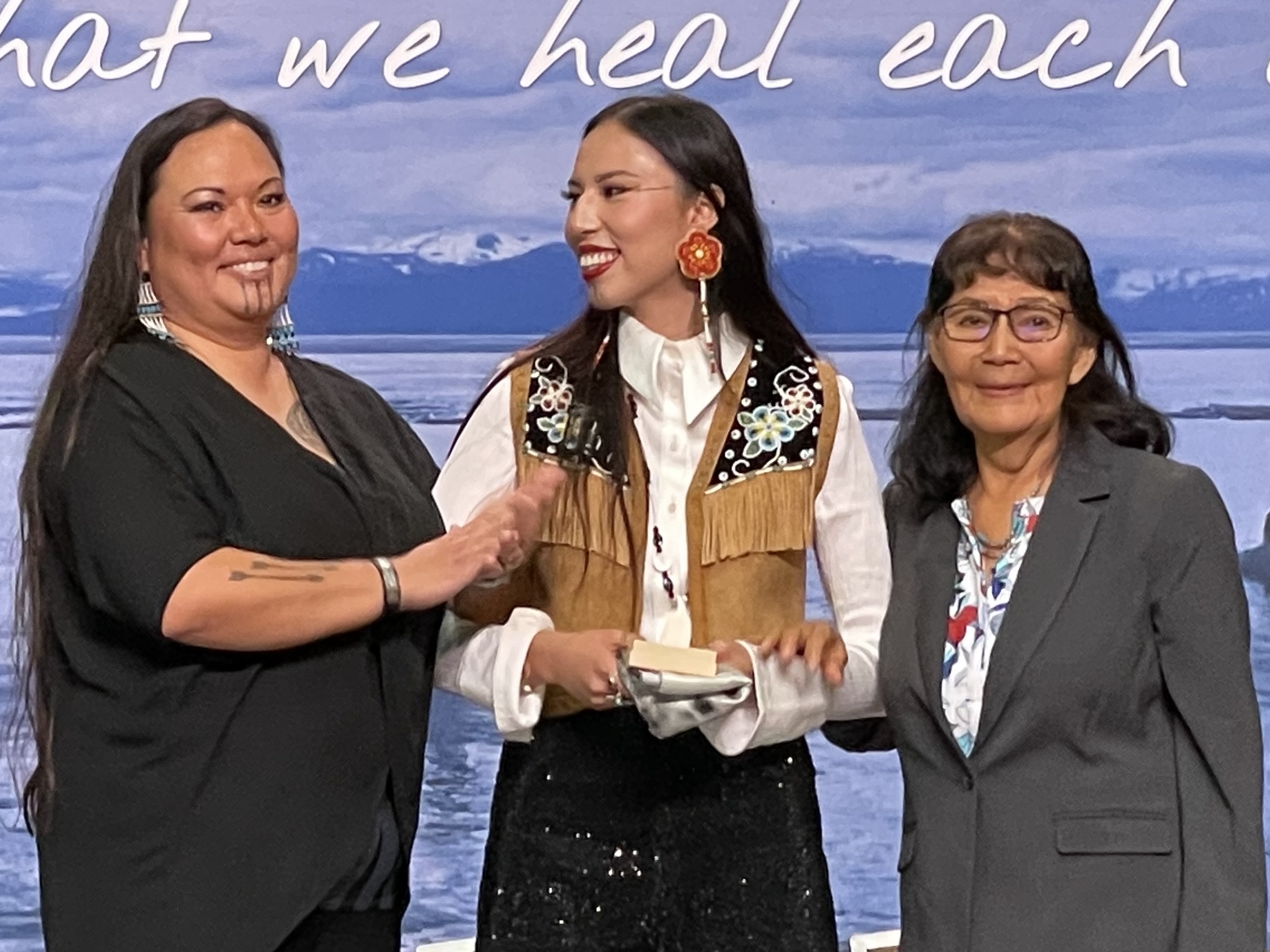
Tuesday, she spoke to a room packed with hundreds of people at the Elders and Youth Conference hosted by the First Alaskans Institute in Anchorage.
Chasinghorse has appeared on the covers of Vogue, Elle, and National Geographic, modeling for the likes of Chanel, Gucci, and Calvin Klein. She said travels from her Los Angeles base to modeling jobs in New York and Paris sometimes get lonely. To get grounded, she thinks back to times growing up in Eagle, a village in Interior Alaska near Canada.
She said her favorite childhood memory is when her mother would come home from work and hook up the dog team for a run. “We’d just be talking away, talking about our day, talking about what I learned in school,” Chasinghorse said.
“Just close your eyes for a minute and imagine this with me,” she continued. “The white noise of the dog sled just gliding through the snow, the pitter patter of the dog’s feet. You hear the dogs breathing. And then you’ll hear a little relative, a critter in the woods, and sometimes we get afraid. Then we have to remember that those are our relatives and those are our teachers,” Chasinghorse said. “Those sounds, those moments (are) what brought me here today. I would not have survived some of the hardships I went through without…remembering those moments.”
(Related: Elders and youth conference focuses on healing)
She credits her accomplishments to “all my aunties, my mom, my grandma, all my other grandmas and aunties. Y’all have given me strength that I didn’t even know I had in my body, that I possessed. I had no idea I had that kind of strength.
“But when I show up in these spaces, I’m reminded of that strength because a lot of us have a really hard time showing up and owning our space because we’re taught to be ashamed,” Chasinghorse said. “But there’s no room for that anymore. Be proud of who you are and where you come from,” she said.
Being with her people and engaging in cultural traditions are also healing for Chasinghorse.
“Singing our songs, coming together, gathering, talking, learning, listening to one another, giving each other space—that is awesome medicine. Beading, sewing, hunting, fishing—that is medicine. That is healing,” she said.
Chasinghorse said such healing tactics are important with the climate crisis Indigenous people are going through. Due to declining fish stocks and changed migration patterns, “a lot of us can’t fish. A lot of us can’t hunt or a lot of us aren’t getting caribou running through our territory like my people.
“That lack of food security is scary for us as a people because I know that is what also keeps us connected to mother Earth—to nature, to who we are as a people—going hunting, harvesting, learning those ways, but also knowing that the love is there and that when we’re eating the foods, our traditional foods that our ancestors ate for millennia, we’re nurturing our bodies. That is healing,” Chasinghorse said.
She said despite trauma and hardships, Indigenous people have joy, beauty, pride, and resilience. Those, she said, were handed down from ancestors and elders.
“I know some of our elders went to residential school and experienced trauma and pain that we can’t even fathom today. And here they are continuing our ways of life, continuing to teach when they were told that it was wrong, that it was demonized. And there’s so many traditions and parts of our culture that were taken from us, our languages,” Chasinghorse said.
“Take the time to learn from your elders, to learn from culture bearers within their community, because they’re there and they’re still living in this life. Learn from them because they carry so much wisdom and we want our future generations to carry these things,” she said.
Chasinghorse said speaking out against stereotypes and advocating for climate justice is also rewarding, “I remember why I do what I do, and that is what heals me. It’s showing up for my community. What heals me is seeing my hard work being paid off and knowing that no matter what I do, it’ll always be in favor of my community.”
Chasinghorse was recently featured in a film, “Walking Two Worlds,” and has appeared in the series, “Reservation Dogs.” After her presentation, Chasinghorse spent a few hours shaking hands, signing autographs and talking with people in a meet-and-greet. Her 539,000 Instagram followers also reflect her popularity.
The 2023 Elders and Youth conference featured presentations and workshops on the theme: Woosht Guganéix, which means “Let it be that we heal each other” in Tlingit.
The conference wraps up Wednesday. Thursday the annual Alaska Federation of Natives (AFN) Convention kicks off. It draws thousands of people to discuss policy and issues and vote on resolutions guiding AFN, a public advocacy nonprofit.

ICT is a nonprofit news organization. Will you support our work? All of our content is free. There are no subscriptions or costs. And we have hired more Native journalists in the past year than any news organization ─ and with your help we will continue to grow and create career paths for our people. Support ICT for as little as $10.