

Renata Birkenbuel
ICT
Matika Wilbur, Swinomish and Tulalip, is an undeniable force. Listening to her is like trying to track a whirling dervish who’s had too much coffee. Her joyous laughter carries like the wind and needs no mic.
Exuberant, truth-telling, spiritual, hilarious, Wilbur – a former teacher and the keynote speaker at the annual National Indian Education Association conference recently – slayed her audience of 500 educators with a synopsis of her book, “Project 562: Changing the Way We See Native America.”
Home is Tulalip, Wash., but Wilbur traveled 600,000 miles to federally recognized tribal nations across the United States, a storytelling-collecting journey started in 2012 with a Kickstarter campaign, to showcase the diversity and richness of varied Indigenous cultures.
Wilbur may be on the New York Times bestseller list with her stunning oversized coffee table book replete with extensive photos capturing 562 tribal people across the United States and long-listed for the prestigious Andrew Carnegie Medals for Excellence in nonfiction.
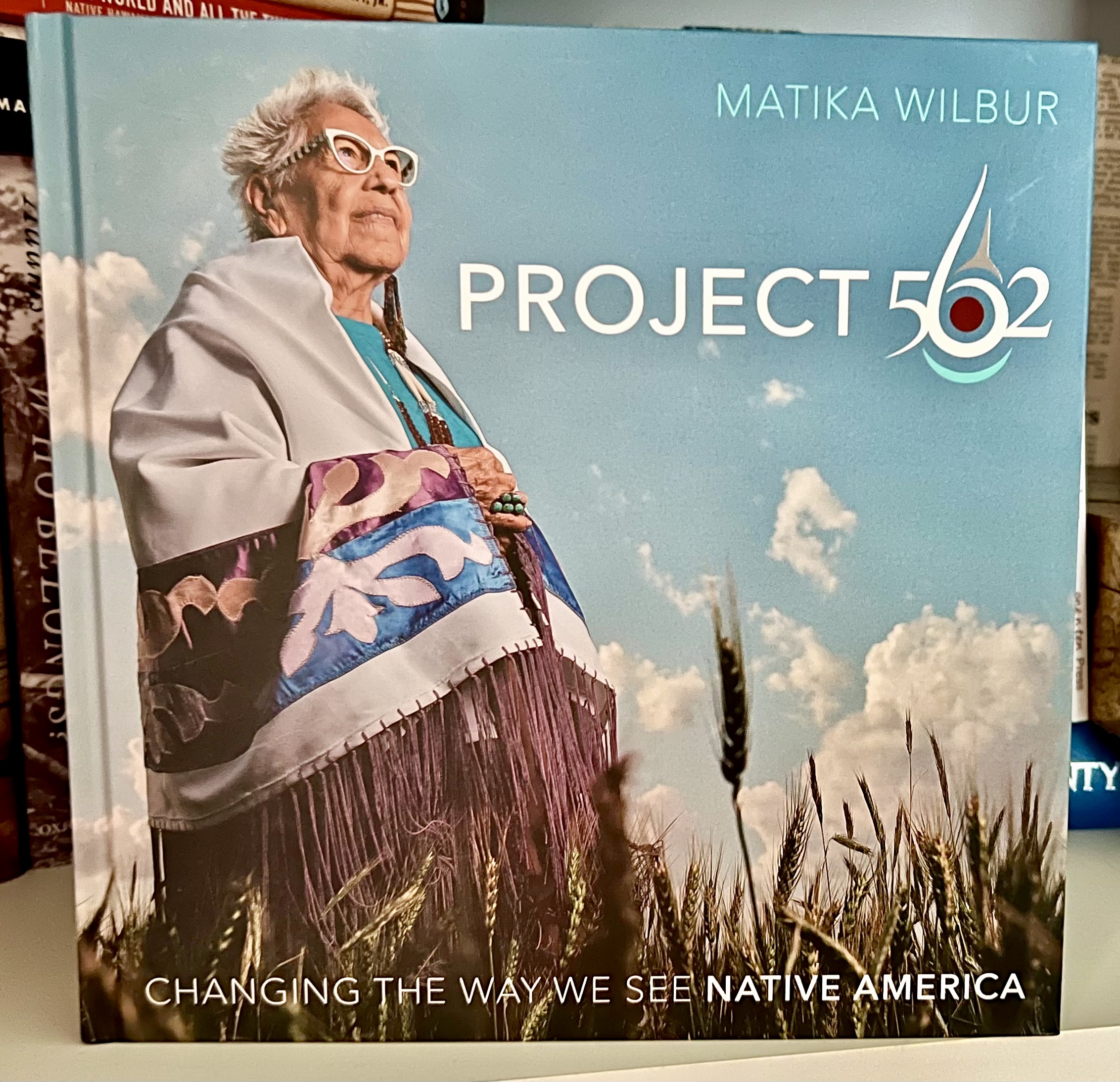
But those accolades do not faze her, as she has more important work to do: share her visual learning guide and well-traveled wisdom with educators-turned-fans in Kiva Auditorium of the Albuquerque Convention Center recently.
Her curriculum for K-12 teachers is a work in progress. She implores teachers to fill in the gaps of her curriculum – and leans toward “narrative correction” of Indigenous history and culture.
SUPPORT INDIGENOUS JOURNALISM. CONTRIBUTE TODAY
The core of her teachings span a broad spectrum across Indigenous subjects as she refines her curriculum.
Based on the learning guide, students can study authentic Indigenous culture, history and languages while exploring everything from health and wellness, business, arts, media and entertainment, people and society, STEM topics and of course education.
Students may engage quickly, as she suggests thought-provoking questions that contemporary kids may like, such as: “How are body modifications (dress, tattoo, hairstyles) linked to culture?” It links Western approaches with thought-provoking questions, such as, “Do you see Native representation in your life?”
With the popularity of Native hip-hop artists like Frank Waln and Kunu Bearchum, Native fashion influencers like Jamie Okuma and “Reservation Dogs” and “Rutherford Falls” streaming series, she asks students to watch a show or listen to a Native-created song. Hooking student interest in learning more about Indigenous culture and history lies in her soul, as she grew up among Coast Salish Tribes in Northwestern Washington and can speak from experience.
A media influencer herself, Wilbur heads a podcast, “All My Relations,” playing to one of her many talents. She encourages students and teachers to listen to her podcast and ponder identity through clothing choices and discover the meaning of “cultural appropriation.”
A trained, gifted photographer who graduated from the Brooks Institute of Photography whose stunning photos capture the tribes she visited, she worries that mainstream awareness of Indigenous culture and history still lags.
“It’s hard to know,” she told ICT News after her keynote speech. “There’s these cultural icons that have been working towards paradigm shifts and education and representation in television and books and media for decades. Right? But, certainly, ‘Reservation Dogs’ is the first television show that’s ever been broadcasted on a network made by native crew. Written by a native crew.”
She acknowledges an increased media awareness of “native showrunners,” but cautions those in Indian Country who may hope for broader understanding: “But we are certainly not dominating the industry by any means.”
Sign up for ICT’s free newsletter
Even though the American Federation of Teachers gave away a large collection of Indigenous authors’ young adult and children’s books based on Native stories and history at the conference, Indigenous art and artists have yet to become mainstream in the Western sphere.
Like a solid teacher, Wilbur relies on statistics to measure standards.
“Eighty-four percent of Americans say that they’ve never encountered a Native person or that they know very little about a native person. I mean, I think to us, because we’re in Indian Country, maybe it feels like there’s a tremendous amount of movement and change.”
For example, her book, published last April, has sold 13,000 copies – not astounding, but it’s a solid start.
“It hasn’t sold 10 million copies,” she said. “I mean, my podcast has a hundred thousand listeners. It doesn’t have a million listeners.”
Still, with time maybe current Native Instagram and TikTok influencers popular among youth and adults will take center stage on the national and maybe even international landscape.
“When you put it into perspective in terms of the media influencers like who are these? Trevor Noah or Oprah? We don’t have one of those,” she added.
“We don’t have a native Michael Jackson. We aren’t dominating the pop and culture industry, nor are we dominating the literary industry or textbooks. But yes, we’re on the scene, but not in the way that I would hope for.”
Following a 36-city book tour last Spring, Wilbur embarked on a whirlwind of speaking engagements – for public and private audiences at high-profile institutions like Harvard University, Yale University, University of California-Berkeley, Google and the National Education Association. Her first-ever TED talk in 2014 sparked her gift for public speaking.
But now she’s on a new crusade: selling the idea of her curriculum for students to educators.
“This (tour) is simply for the curriculum. I am working on a new book about the ways that parents push back against colonialism in their parenting practices. There aren’t any native parenting books. What are all of our new parents doing when they want to read about parenting? They have to read books written primarily by white women. That’s a terrible disservice to our parents.”
Becoming the face of a generation of Native mothers, students or teachers humbles her.
But if anyone can become the Native version of Oprah Winfrey, it’s Wilbur.
“Sure, I’m down,” she said, jokingly. “I would love to represent our people in whatever capacity possible. But, my role, I think, in this book is really very much about narrative correction work.”
The flip side of humor contains pain – and Wilbur’s storytelling, photos and published narratives strikingly convey emotions. One minute teachers at the education conference howled at her personable witticisms; the next minute they gasped in awe of her prayerful singing and heartfelt respect for the people she friended and photographed.
But resting on her laurels or past Indigenous injustices is not in her game plan. She does about 30 speaking engagements in the fall, but as the mother of a young girl, she aims to schedule only one per week while looking forward.
“I would like to move into futurisms instead,” she said. “But narrative correction work was certainly a huge part of what I had to do because of the absence, just like the work with the parenting. Our work as creatives has to fill the void in the gap, not necessarily push the envelope. Does that make sense? I think that’s a terrible injustice.”

Our stories are worth telling. Our stories are worth sharing. Our stories are worth your support. Contribute $5 or $10 today to help ICT carry out its critical mission. Sign up for ICT’s free newsletter

