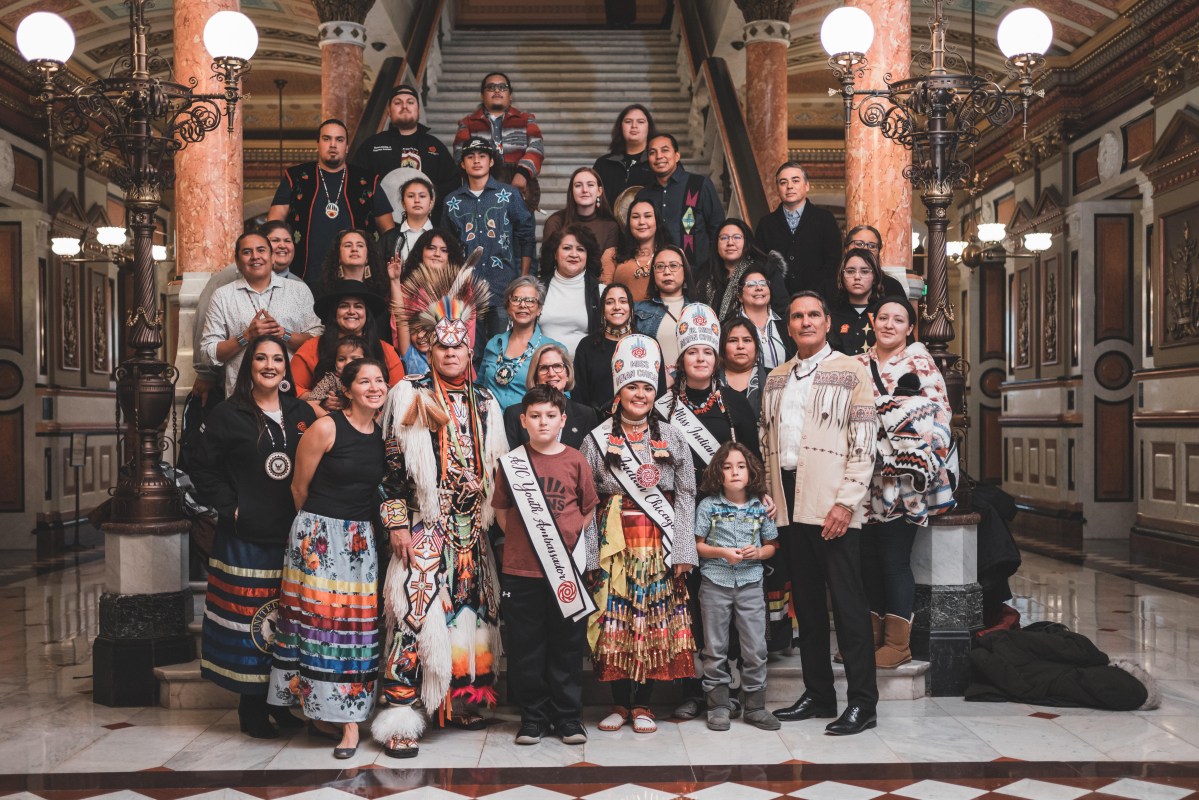
Help ICT make strides in 2024. Our goal is to raise $150,000 by the end of the year with generous contributions from funding partners and collaborators like you. We’re thankful for your support, and we’re thriving because of it. DONATE TODAY!
Dan Ninham
Special to ICT
Illinois public schools will no longer be silent on Native history. Graduates can now wear feathers on their graduation caps. And ancestral remains will be carefully returned to their families and tribes or provided a proper burial.
These policies are among the sweeping changes enacted in Illinois this year with three new laws that provide added protections – and representation – for Native people in the state.
The laws won approval after intense efforts from tribal leaders in Illinois and across the country to address Indigenous issues in schools and beyond.
For Megan Bang, Ojibwe, who helped pass the Native history and regalia laws, it was personal. Her son, Nimkii Curley, who is Ojibwe and Navajo, was not allowed to walk at his graduation because he was wearing symbols of his Native culture, including an eagle feather on his cap.
Related story:
— Chicago group puts spotlight on Indigenous issues
“Being able to graduate with these cultural items is not just about decoration,” said Bang, a professor at Northwestern University and director of the Center for Native American and Indigenous Research, in a release by the university after the vote.
“It’s a very powerful act of cultural resistance and survival in the face of the genocide that was inflicted upon Native people.”
The three bills were signed into law by Illinois Gov. J.B. Pritzker on Aug. 4, drawing praise from state and tribal leaders. Steps are now underway to develop the curriculum while including a number of Indigenous voices in the process.
“While these legislative efforts help make education better for Native students, I think it is important for us to also say that knowing this history is important for all citizens in Illinois, if justice and democracy have even a remote shot of being achieved,” Bang told ICT.
Pritzer said in a statement released after the signing that the bills provide a roadmap for the future.
“Today, we take another step forward in repairing generations of harm and building a brighter future for our state’s Native American and Indigenous peoples,” Pritzker said in the statement.
“At its core, this legislation is about respect,” Pritzker said. “Respect for those who came before us and those who will come after — and that is why we want to teach our children this history, to avoid the mistakes of the past and to instill that respect from an early age.”
A place in history
Although the regalia bill perhaps caught the most public attention, the Native history law, known as HB1633, will reach every student in Illinois public schools at some point.
The law requires that Native American history be added to the curricula for public schools in Illinois, including teaching about cultural genocide and forced relocation as well as details about tribes in the Midwest and across the nation.
Pritzker had previously signed laws mandating instruction on Asian-American and LGBTQ history in Illinois schools, according to the release from the governor’s office.
To help get Native history into the classrooms, a working group began meeting in October to develop the curriculum and instructional resources for teachers, while working closely with Native people, said working group chair Josee Starr, a citizen of the Three Affiliated Tribes of the MHA Nation, and a descendant of the Omaha and Odawa.
Starr is director of operations for the Mitchell Museum of the American Indian in Evanston, Illinois. She also chairs a committee for the Chicago American Indian Community Collaborative and sits on a working group for the Illinois State Board of Education.
Starr said she helped follow the bills as they moved through the Legislature on their way to the governor’s desk. Among the lawmakers she worked with was Democratic state Rep. Maurice West, who authored and was chief House sponsor of the Native history legislation.
West said the history law and the others are important for all Illinoisans.
“We must understand the history and experience of Native Americans if we want to truly understand our home state, but too many students miss out on this important aspect of our nation’s past and present,” West said in the statement released after the signing.
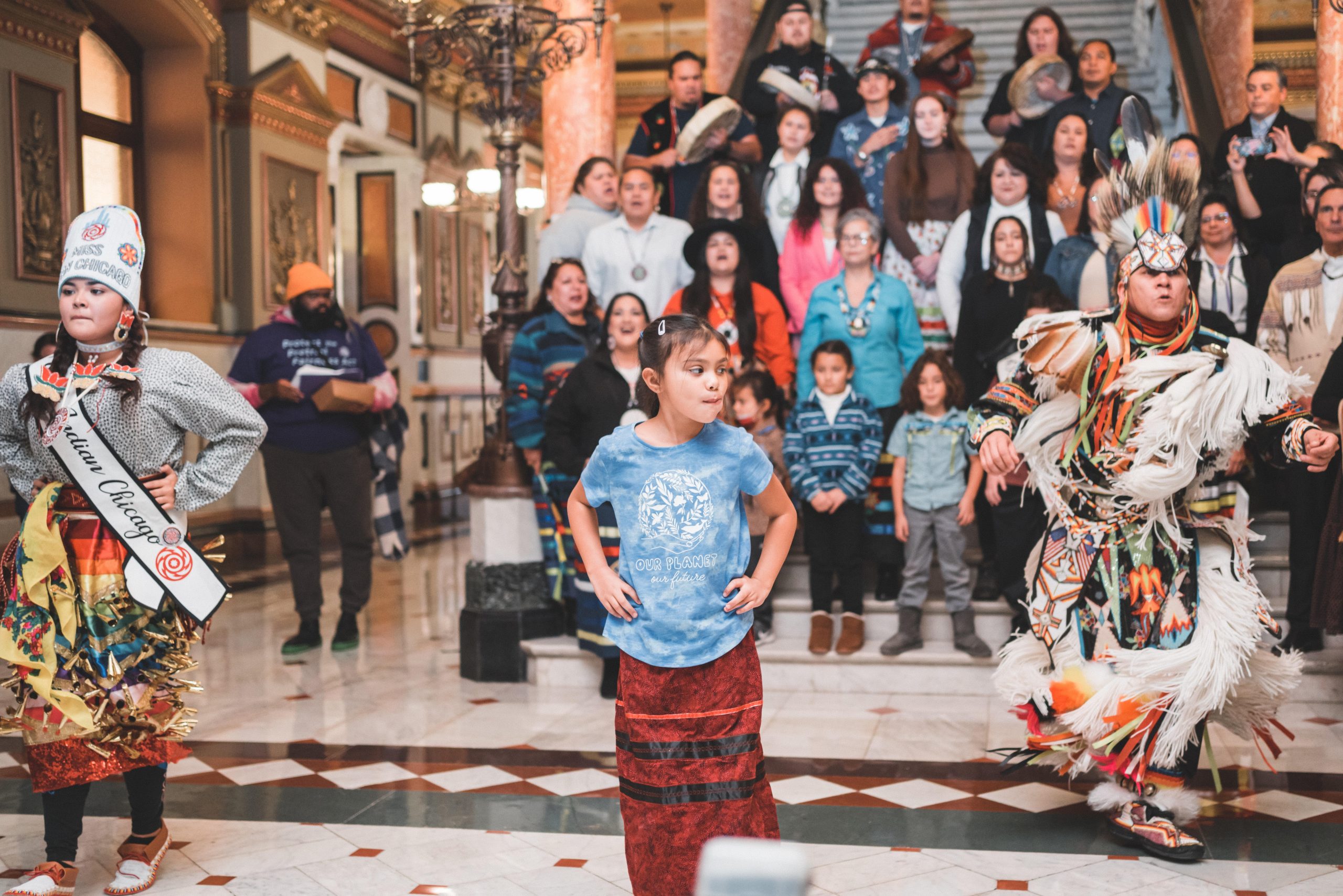
The education bill also requires the establishment of a seat for a Native American on the equity commission of the Illinois State Board of Education. It will be the first time a Native person is represented on state education committees, according to local leaders.
Bang said only about 25 states have some requirements in place for teaching Native history, and most of those require teaching about Native people before 1900. There is no requirement to teach about modern-day lives and experiences, she said.
Bang helped write both the education bill and the regalia bill, and testified several times in the Legislature. She said she initially had started work on a bill in 2019 on Native mascots, but soon learned there were other priorities.
“Members of federally recognized tribes reached out to thank me, but [also] to educate me on what is a top priority — true Native American history being taught in our schools,” she told ICT. “I immediately put my mascot reform bill on ice and created the Native American History Working Group, and we spent three years to get this legislation passed.”
A key provision is including Native representation on state committees, she said.
“I was pretty insistent that we needed legislation that required Native people to have a seat on the state committees,” she said. “Illinois has none of the state-level Indian Education offices that most other states have, so I hope this legislation opens up new positions and infrastructure in the state. We need it desperately.”
The education bill requires the new history units to begin in the 2024-2025 academic year. The Illinois State Board of Education will provide learning materials and guidance.
Feather in the cap
The regalia bill, known as SB1446, protects the rights of Illinois students to wear accessories that reflect culture, religious or ethnic heritage at graduation ceremonies. It’s not just for Native students.
Bang worked to win passage of the regalia bill as well.
Her son, Nimkii, had been looking forward to his high school graduation, and had added symbols that were important to his Ojibwe and Navajo cultures, according to a Northwestern University release.
They included a sash with a traditional floral design, a beaded cap, a traditional necklace and an eagle feather. All were gifts from community elders and family.
He was pulled out of the procession at Evanston Township High School, however, and told that he couldn’t participate in graduation unless he took them off. He refused.
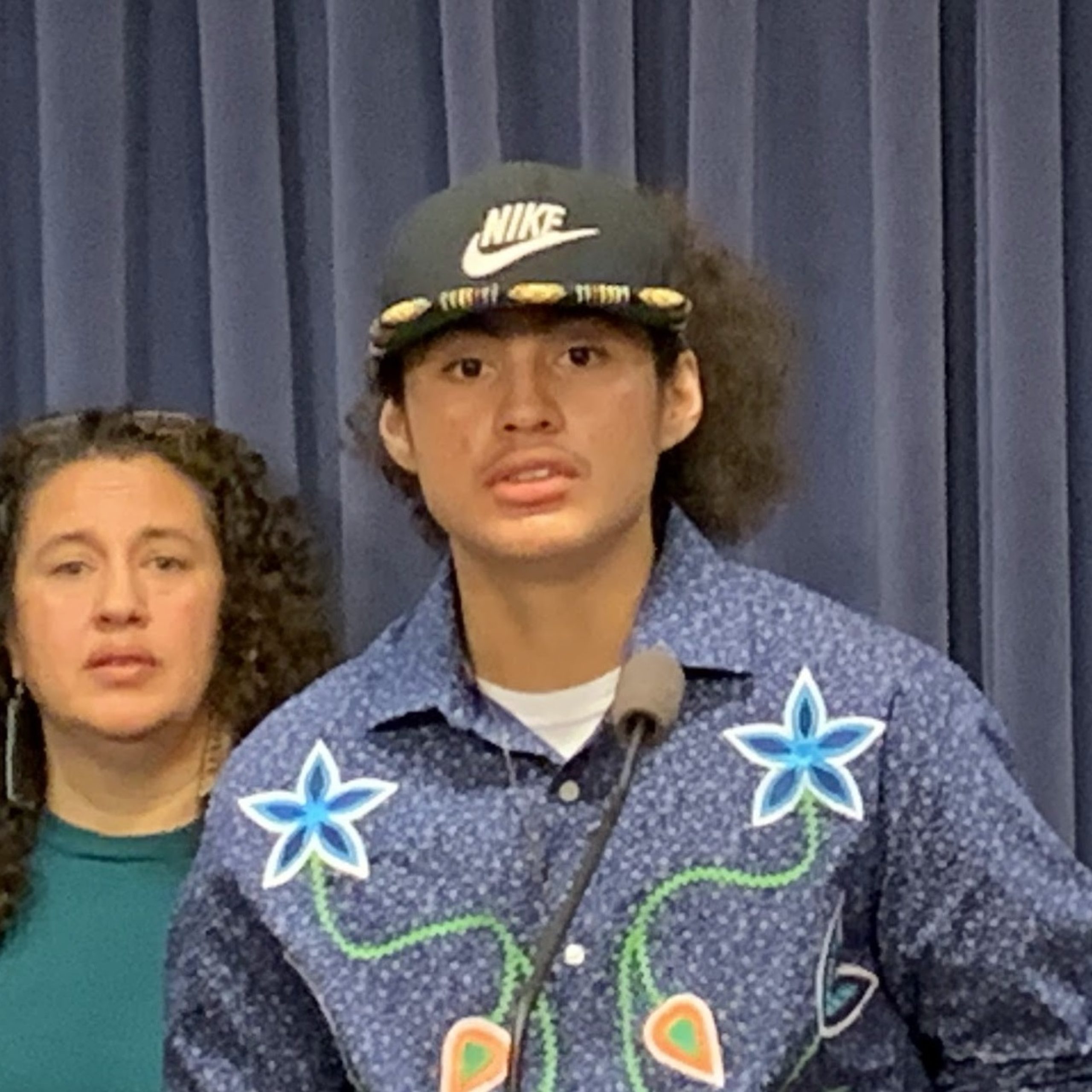
He soon was involved, along with his sister, Miigis Curley, in efforts to pass the new laws. Although Evanston officials later apologized, Nimkii went to the statehouse to advocate for the education and regalia bills, and his sister collected 15,000 signatures on a petition in support of the legislation.
“What was beautiful about my kids’ reaction was that they didn’t just want to protect their own rights,” Bang said. “The bills protect the rights of all children to express their cultural and racial identity.”
Illinois joins a number of other states with bills protecting culturally significant regalia. According to the Native American Rights Fund, 14 states have laws allowing tribal regalia or culturally significant items to be worn at graduation ceremonies.
“Every spring, Native American students from across the country contact NARF because they are being prohibited from wearing eagle feathers at graduation ceremonies,” according to the NARF website. “Once schools come to understand the religious, cultural, and academic significance of eagle feathers, most make accommodations and exceptions for Native American students.
“Unfortunately, each year some school districts persist in restricting Native American religious liberty and viewpoints,” the site states. “This singling out of Native students puts them in the position of having to choose between participating in the celebration of a great accomplishment with their classmates or following their Native religious and cultural traditions.”
Burial with dignity
The repatriation law, HB3413, the Human Remains Protection Act, streamlines efforts to return ancestral remains and artifacts to their nation of origin, and calls for creation of a cemetery for remains that cannot be identified.
“We’ve longed for the day we can bring respect to our history and our ancestors the way they should’ve been respected centuries ago. Today means that can finally happen,” said Prairie Band Potawatomi Nation Chairman Joseph “Zeke” Rupnick, on the day the bill was signed into law. “This new law puts Illinois on a path to free the remains of our ancestors so they can be buried with the dignity they always deserved.”
Illinois is believed to have the second-largest collection of unrepatriated remains in the U.S., and the Illinois State Museum has committed to the largest repatriation effort in the state’s history, officials said.
The new law upends a 1989 law that had made most Native remains the property of the state, and requires the state to work with tribal nations in repatriating remains or cultural items.
The law adds a state component to the federal Native American Graves Protection and Repatriation Act, known as NAGPRA, which requires museums, universities or other institutions that receive federal funds to identify and return remains and items.
The law also allows tribes for the first time to rebury remains in Illinois, their homelands before the federal government forced more than two dozen tribes to relocate to territories that are now outside the state.
The Illinois State Museum holds about 7,000 individual remains, and is working to return more than 1,000 of them to their tribes. Illinois institutions have identified nearly 13,000 individuals that must be repatriated, according to The Associated Press.
Looking ahead
Officials are now working to set the laws in motion.
For the education bill, the Native community has held summits to gather input, and a state committee meets regularly, Bang said. About 12 curriculum projects are in the works.
Bang said she is also working to develop a new civics curriculum to support efforts to educate Illinois citizens about issues of sovereignty and self-determination. The Prairie Band of Potawatomi has been involved, as have other Native leaders, she said.
“It is important to connect the Prairie Band’s story to this legislation,” Bang told ICT. “Prairie Band has legal rights to a reservation in Illinois that was upheld by the McGirt case. ‘Land back’ should happen in this state in a timely manner.”
Andrew Johnson, a citizen of the Cherokee Nation, worked closely with lawmakers to win passage of the education and regalia legislation. He is executive director of the Native American Chamber of Commerce of Illinois and is also an executive board member of the Chicago American Indian Community Collaborative.
He said the policy and advocacy committee of the collaborative has been meeting regularly with members of the Illinois State Board of Education in developing the curriculum.
“I have spoken to friends in the school system that have expressed appreciation for the passage of HB1633,” Johnson told ICT. “We and members of our community have been able to confront school administrators when Native American rights have been challenged in the wearing of regalia at events.”
The bills are also educating the non-Native population, he said.
“People in our state have a better recognition and understanding that there is a vibrant Native American community in Illinois,” he said. “We shall continue our fight for representation and recognition.”

Our stories are worth telling. Our stories are worth sharing. Our stories are worth your support. Contribute $5 or $10 today to help ICT carry out its critical mission. Sign up for ICT’s free newsletter.