
Lyric Aquino
Underscore Native News + Report for America
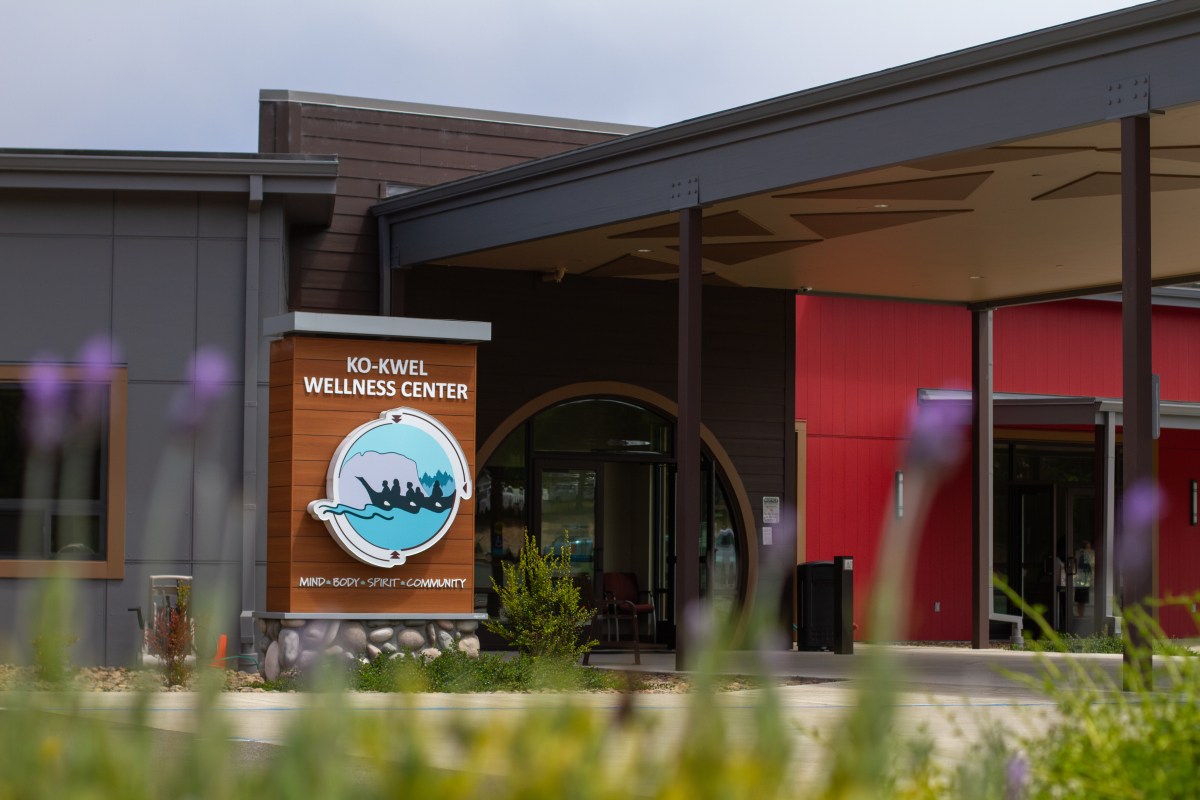
In Coos Bay, Oregon, the Ko-Kwel Wellness Center, a tribally run and operated health clinic, is at the center of Kilkich, the Coquille Indian Tribe’s modern-day village on Cape Arago. Fauna Hill, executive director of strategic operations for the Coquille Indian Tribe, sat in the clinic’s gathering space with her ankles crossed while breathing deeply and gathering her thoughts. After a long pause, she opened her eyes and began to explain the chronic health issues she faced that stole over a decade of her life.
In November 2002, Hill, an enrolled member of the Coquille Indian Tribe, was 22 and working in Columbus, Ohio for AmeriCorps, a federal agency for national service and volunteerism, clearing trees to make space for native plant growth. In her steel-toed boots, Hill walked across the snowy ground and tossed logs wet from the snow into the back of a truck with her fellow corps members. A colleague behind her lost their grip and their hand slipped, causing the log to slam into Hill’s head, knocking her to the ground.
Hill said she told everyone she was okay despite having a headache. In the ensuing days, her headaches worsened while pain developed in her back and began to take over her day-to-day life. She sought out medical help and, per a doctor’s suggestion, got an MRI. As part of AmeriCorps, Hill’s medical costs were supposed to be covered during the program — a large portion of the reason she agreed to the MRI scan — but Hill said she ended up footing the bill.
“That experience made me really hesitant to access care unless I knew what the follow-up cost was going to be,” Hill said. “Over time, through grad school and then starting as a consultant, my pain just got worse and worse. There was a point where I thought I would only be able to work part time because I was in so much pain.”
The medical care costs followed Hill for two years after the program ended. Like millions of Americans, she struggled with access to healthcare, but as an Indigenous woman enrolled in a federally recognized sovereign tribe, Hill is entitled to healthcare through the federal government’s treaty and trust responsibility.

Hill, who has a master’s degree in public health, spent more than a decade trying to navigate the healthcare system in search of care to end her pain. She finally found relief at the Coos Bay Ko-Kwel Wellness Center, which, like other health clinics in Indian Country, is now grappling with an uncertain future because of federal budget cuts. With funding slashes to direct partners like the Centers for Disease Control and Prevention (CDC) and Medicaid cuts looming, these clinics are preparing for the worst. Many of them are responsible not only for the healthcare for their sovereign citizens, but rural non-Natives as well.
The Ko-Kwel Wellness Centers house an array of essential and culturally rooted health services at their two tribal health clinics, and yet, as the budget cuts loom, it’s uncertain how much revenue will be lost, which may cause alterations in their day-to-day operations — an interruption Hill says Indigenous people can’t afford.
Dried up federal funds
Across the nation, the Indian Health Service provides three kinds of health clinics rooted in free, culturally grounded and specific services for American Indians and Alaska Natives. These clinics make up the ITU system of care and include: IHS-run facilities, which are fully funded and operated by the Indian Health Service; tribal health programs, which are partially or fully operated by the tribes; and urban facilities, which are part of the Urban Indian Health Program and are funded through IHS, local, state, and federal grants and contracts.
IHS is divided into 12 regional offices, each responsible for various tribal health programs and IHS services that serve tribes in their respective geographic areas. Urban Indian Health Programs, which still operate under IHS, serve Indigenous people who live in urban areas and are not near a reservation.
But for many of these clinics and programs, which regularly serve nearly 3 million American Indian and Alaska Natives across 574 federally recognized sovereign tribes in 37 states, funding has been a longstanding issue. For fiscal year 2025, IHS received a budget of $8 billion despite the IHS National Tribal Budget Formulation Workgroup recommending the agency receive $73 billion.
Those gaps in funding trickle down and lead to staffing shortages and service limitations, making care for many Indigenous people difficult to navigate — and yet, for many, it’s the only access to healthcare they have.
“Our programs are often the only ones that Native people have access to, both in rural and urban America, and our culturally specific services have been the only way that we’ve seen any decreases in the health disparities experienced by Native people,” said Abigail Echo-Hawk, a citizen of the Pawnee Nation, executive vice president of the Seattle Indian Health Board and the director of the Urban Indian Health Institute. “We know, and the science shows us, that the only way to truly interrupt and to make a difference in creating better health and wellness for Native people is through culturally specific programming, which is what the tribes and the urban programs do.”
Due to consistent underfunding of IHS, clinics and programs within the ITU system of care often try to subsidize the missing funds with federal grants — which were gutted by the Trump administration — and third-party reimbursements from Medicare, Medicaid and private insurance companies.
According to a letter from the National Indian Health Board to the U.S. Secretary of Health and Human Services Robert F. Kennedy Jr., tribes have lost $6 million in funding from Health and Human Services. But with Medicaid cuts taking hold throughout the country, it’s uncertain how much money the ITU system of care will be losing.

Unlike many tribes and nations, the Coquille Indian Tribe does not use the income generated from its tribal enterprises to make “per capita” payments to tribal members. Instead, the tribe uses the funds to invest in benefits and programs for elders, youth, education, and healthcare. But these funds don’t nearly cover the entire operational costs of the facilities, leaving third-party revenue and grants to make up the rest of the centers’ budgets.
About 30% of Native American and Alaska Native people younger than 65 are enrolled in Medicaid, which helps IHS, tribal health programs and urban health programs stay afloat. In 2023, Medicaid accounted for nearly two-thirds of third-party revenue for the ITU system of care.
Under President Trump’s “One Big Beautiful Bill,” Medicaid will face almost $1 trillion in cuts over the next decade. While Indigenous people are exempt from the work requirements that need to be met and verified twice a year, non-Indigenous patients who use the ITU system of care facilities are facing the loss of insurance coverage.
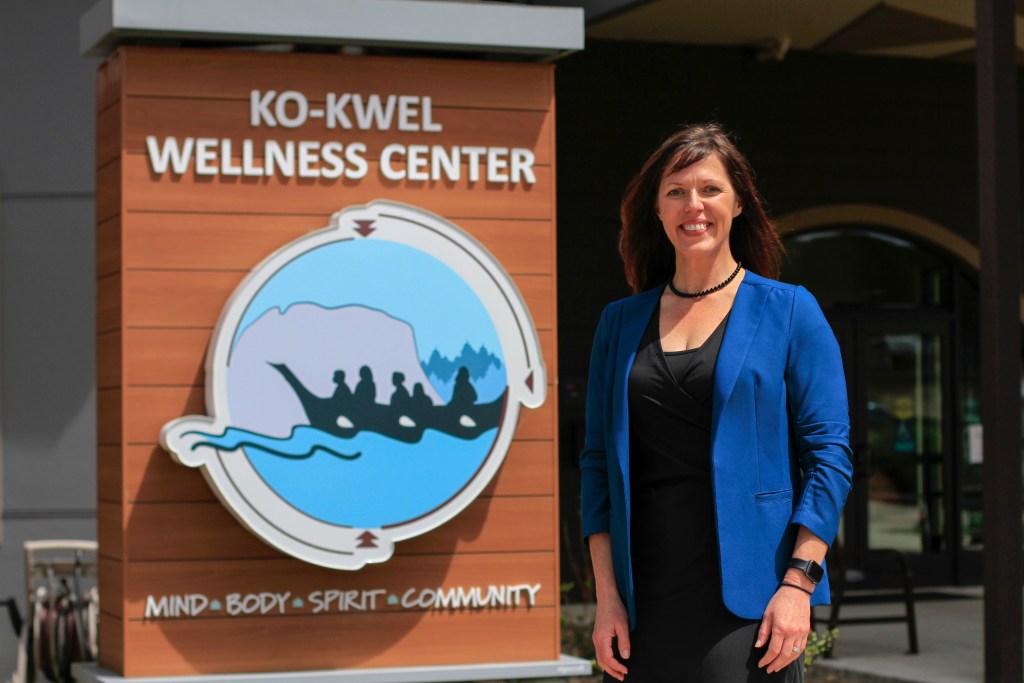
“While it appears that there are some protections for Indigenous people in a lot of the proposed bills when you’re part of a rural community, your ecosystem of healthcare isn’t just your clinic and what you offer, it’s the ecosystem of everything that’s around you as well,” said Caryn Mickelson, CEO of the Coquille Indian Tribe’s Health and Wellness Division.
Mickelson said rural communities and Indigenous communities are often intertwined in a health ecosystem. The Ko-Kwel Wellness Centers in Coos Bay and Eugene serve the local Native American community as well as non-tribal members. In some cases, especially in Coos Bay, Mickelson said the centers are the only healthcare non-tribal members have access to.
“Even if the tribe is not directly impacted by any type of federal funding or state funding adjustments, if our community health system is affected, that reduces access for our tribal clients as well,” Mickelson said. “So I think we just always have to be really cognizant of this delicate balance within the healthcare ecosystem. “
According to Echo-Hawk, there’s still a possibility that Indigenous people can lose their access to Medicaid, because Medicaid is administered differently in each state. Some states may have restrictions and requirements put in place, in addition to the federal guidelines for states that are reducing their Medicaid coverage overall.
“For people who wouldn’t be affected by other reductions and restrictions in their state, the exemption from the work and community service component was essential,” Echo-Hawk said. “But there’s going to be a considerable number of Native people who when these new Medicaid restrictions and cuts come in, depending on the state, we’re going to see people lose their Medicaid coverage.”
The CDC reports that life expectancy for American Indians and Alaska Natives is only 65 years — 10.9 years less than the national average.
Echo-Hawk said routine health checkups in the Native population will decline without Medicaid coverage, resulting in long-term issues that were preventable with primary care.
“Native people are going to die as a result of what’s going to happen. We have a lot of children and elders with significant comorbidities. They may have diabetes and high blood pressure, and something else,” Echo-Hawk said. “We know when you decrease services to folks who need it more, it ends up costing you more because they end up in ERs, and an ER visit is significantly more expensive than a primary care visit.”
Holistic wellness

For nearly 20 years, the Coquille Indian Tribe has served tribal members and the surrounding community through the Ko-Kwel Wellness Center in Coos Bay and its predecessor, the community health center. What started off as a small health clinic turned into two health clinics in a five-county service area with comprehensive services that most tribal clinics don’t offer.
Brenda Meade, Coquille Indian Tribe Chairwoman, said the clinic offers services that are vital for her people and the local communities.
“We as tribal nations are serving some of the most vulnerable populations in our nation. We’re doing very good work,” she said. “We’re very efficient with our dollars, and we’re getting out to rural Oregon, where a lot of services are needed not just for Indian people, but community members.
The Ko-Kwel Wellness Centers serve as one-stop shops for community members to address multiple needs at once. Between the two centers, in Coos Bay and Eugene, there are laboratories, primary care physicians, pharmacies, dental services, mental health services, behavioral health services, community resources, an opioid treatment program and a rehabilitation and fitness center.
In 2021, the Coos Bay location was upgraded to a 22,000-square-foot facility to fit the medical needs of the community, with every detail in the facility well thought out.
Each section of the building has a color for its service so those who are illiterate or struggle with reading can find their way to their appointments without having to feel embarrassed. Thick triangles, a Coquille symbol for wealth, can be found throughout the building. Large windows bring in natural light to make people feel welcome. Hill, who served as one of two project managers for construction of the facility, said the minute details are what makes the centers so healing.
“It’s this idea that is baked into the care that we’re giving and the facility itself, that we have a connection to our traditional culture and it lives here with us, and we’re practicing it every day, and we do it in different ways,” she said. “This is not a generic Native facility. We want people to know what it means to be Coquille.”
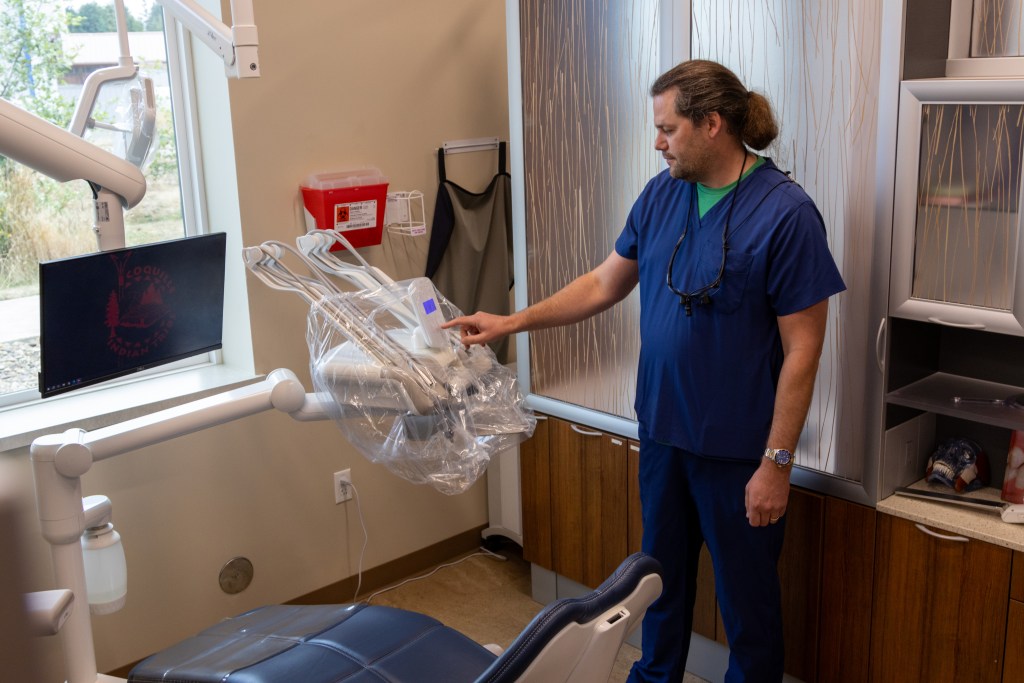
Services at the Ko-Kwel Wellness Centers are holistic, meaning they treat the whole person. For Jason Mecum, a Coos Bay Ko-Kwel Wellness Center dental therapist and Coquille tribal member, providing dentistry services for his community is rewarding. Mecum, who spent time working as a dental therapist in rural Alaska, said access to dental care is critical and not enough tribes are supplying it. Throughout his career, Mecum said he’s seen small tooth decay turn into massive issues, which can lead to death due to not having regular dental checkups.
“The mouth is the gateway to the body. If you got bad teeth, you can’t eat, can’t think, can’t drink water,” he said. “With dental care, people think it’s not that important. But it really is. If you come in twice a year and see us, we can get you these little things taken care of so they don’t get out of hand.”
Ko-Kwel Wellness Centers’ Coos Bay dental team does a lot of outreach with the local early learning center and education programs. Staff visit the children when they come in for regular dental checkups and become familiar faces. For adults who have fears about visiting dentists, Mecum said those concerns can be addressed with a counselor right then and there.
“The cool thing about this place is really to have everything here and it’s connected,” Mecum said. “So if you have patients who have fear, you go grab a counselor.”
In many ways, the Ko-Kwel Wellness Centers are unique, said Carly Blemmel, a member of the Choctaw Nation of Oklahoma and the behavioral health executive director for Ko-Kwel Wellness. Blemmel said the Coos Bay facility creates a sense of kinship, or kanomi, in her Choctaw language.

When patients walk into the health facilities, they’re met with regalia made by Coquille members in the hallway. Adorned with abalone shells, pine nuts, furs and beads, the regalia is fully functional and, twice a year, is worn by Coquille dancers during ceremonies for the summer and winter solstices. In another hallway, a large river canoe made by a tribal member an estimated 100 years ago sits in an open-top glass case. The canoe, which was donated back to the tribe from a non-tribal community member, serves as a reminder to Coquille citizens that, like the canoe, these health facilities belong to them.
“When people enter the facility they feel like they’re home. They feel like they’re amongst friends, family and community,” Blemmel said. “So when people come to get services, they feel like they’re not treated as a collection of body parts. They’re a whole person. And that gets addressed wherever they present in the clinic.”
As part of the behavioral health services at the Ko-Kwel Wellness Centers, patients can receive traditional outpatient therapy for mental health and substance use disorders without having to stay in a hospital, participate in the opioid treatment program and receive integrated behavioral health, addressing issues related to both medical and behavioral healthcare together in one setting.
Blemmel said the behavioral health services at Ko-Kwel are rooted in modern day medicine and practices while emphasizing cultural care.
“Culture is not something that you can bring in or take out. Culture is something that is not an optional thing. It’s not an add on,” Blemmel said. “It’s something that you do from the moment you walk into a room. It’s something you carry with you. It’s how you speak to people, it’s the words that you use. It’s beyond just the different modalities that you use.”
In her work, Blemmel focuses on treating mental wellness by addressing systems in place that may have led to the maladjustment of her patients, including nutrition, emotional well being, physical health and familial structures.
“We put more of an emphasis on helping people learn how to deal with the systems that they’re living in, rather than treating them like there’s something wrong with them that they need to fix,” Blemmel said.
As Indigenous people, Blemmel said the ongoing legacy of colonialism is ever present in the maladjustments in many of her patients. With ongoing climate change and the impacts of loss of land, Blemmel said the patient’s brains are having normal responses to colonization.
“One of the things that we would consider like a diagnosis in the medical world is really just a response to the trauma that people have endured. I think as Indigenous people, a lot of these diagnoses are just normal responses to colonization,” she said. “My approach to behavioral health is that we’ve had the same brains for tens of thousands of years and our brains did not all of a sudden stop working. Our brains are having normal responses to the society in which we live. So we help people develop skills to be able to optimize their functioning within the systems that they live in.”
Full circle healing
After her logging incident in 2002, Fauna Hill signed up for another year with AmeriCorps, this time in Portland. But her ongoing pain made the service year of 2003-2004 difficult. Doctors were constantly telling her that she was fine or suggesting that her pain was in her head, leading Hill to go on a medical scavenger hunt to find practitioners and answers she needed but couldn’t figure out how to do, let alone afford.
“People would suggest that I see a counselor or another medical professional, but there was no connection or communication. If I went to see someone, they might refer me to someone for pain management, but that person isn’t connected so they aren’t talking to each other,” Hill said.
In the midst of her full-time job, Hill would try to schedule appointments but couldn’t figure out what services were needed, and as time passed, she had to start all over again.
Tears fell down Hill’s freckled cheeks as she talked about her health issues. The clinic’s gathering center, which was used later that day for a baby shower, served as a space for Hill to share her story amongst her colleagues.
By fall 2004, Hill was attending Berkeley for a joint master’s degree program in public health and public policy. During her 20-hour class week, Hill was in so much pain that she needed to lie down during class.
“I was at Berkeley in graduate school, and 25 years old, it was really hard to be like, yeah, actually, today I can’t do my dishes. I just have to lie on the floor,” Hill said.
She lived with pain on and off for another 11 years. It wasn’t until she accepted a job with the Coquille tribe in 2015 that Hill started to see results.
Hill’s diagnosis wasn’t just one issue. It was a combination of bodily adaptations her body did to protect her during her healing process and remained even when it was finished. But without integrated care, Hill was shuffled around until she received care from the Ko-Kwel Wellness Center, where she was matched with a healthcare provider and began receiving integrated health services.
Over time, through a combination of exercise, physical therapy and alternative medicine treatments with massage and chiropractic work, she made a recovery in 2017.
“The system worked, the integrated care worked, the care of come back and return, the follow up and the focus on quality, the embeddedness in the community is what worked,” she said.
Hill knows just how important getting access to healthcare is for Indigenous people, and any cuts made to health access, either federal or state, are an abdication of responsibility.
“Every Indigenous person, by treaty, by sovereignty, by government to government relations, is owed access to wellness in order to have a vibrant, thriving community, family and self,” Hill said. “Regardless of whether they’re able to get a PhD or they are unable to work. It doesn’t matter. That’s the agreement.”
When Hill reflects back on her health journey, she’s thankful that she’s received care at the Ko-Kwel Wellness Center, but she worries about the fate of health in her own community and across Indian Country.
“There is a cost to our communities, the cost to our Indigenous communities in the time that you spend not well,” Hill said. “When you aren’t well, you can’t pass on your knowledge or teach people. It means you don’t go to the next tribal event where people are looking to you as their elder, to be there or to teach something or to share. The entire community loses out on that — the human cost and the communal cost and the intergenerational cost, to me, is not outweighed by the budget savings.”

