

Leslie Logan
Special to ICT
SYRACUSE, N.Y. – When Tadadaho, Sid Hill, recites the Ganonyok – the traditional opening words that come before all else – for a community cultural day in conjunction with your solo art exhibit, you know your “homecoming” show is fully embraced and supported by your own Nation.
That’s what happened Saturday, Aug. 20 at the Everson Museum of Art in Syracuse, which is showcasing Frank Buffalo Hyde’s work in the exhibition, “Native Americana.” Tadadaho, the spiritual leader of the Onondaga Nation, and the “chief among chiefs” of the Grand Council of the Haudenosaunee, gave not only the traditional opening, but also gave a nod and a blessing to Hyde’s artistic contributions.
Hyde has talked about how meaningful it is to have not just a piece in the Everson, but an entire show dedicated to his work. “When I was just a kid, I visited the Everson and was in awe,” he said. “I never thought in my wildest dreams I would ever have a solo exhibition there.”
The Everson Museum, six miles north of the Onondaga Nation where he grew up, is showcasing the culmination of 25 years of his artistic expression. Hyde’s work questions, criticizes, embraces and rejects pop culture’s influences on Native people, while also providing non-Natives with insights into the contemporary Indigenous experience. His work has been described as Native art, without the fluff of feathers, flutes and fringed leather.
Hyde, Onondaga/Nez Perce, explained that the exhibit is an investigation of where “American” and “Native American” begin and end, and where they intersect. His paintings and mixed media installations merge pop culture and Indigenous knowledge, with a shot of social commentary and sharp criticism thrown in.
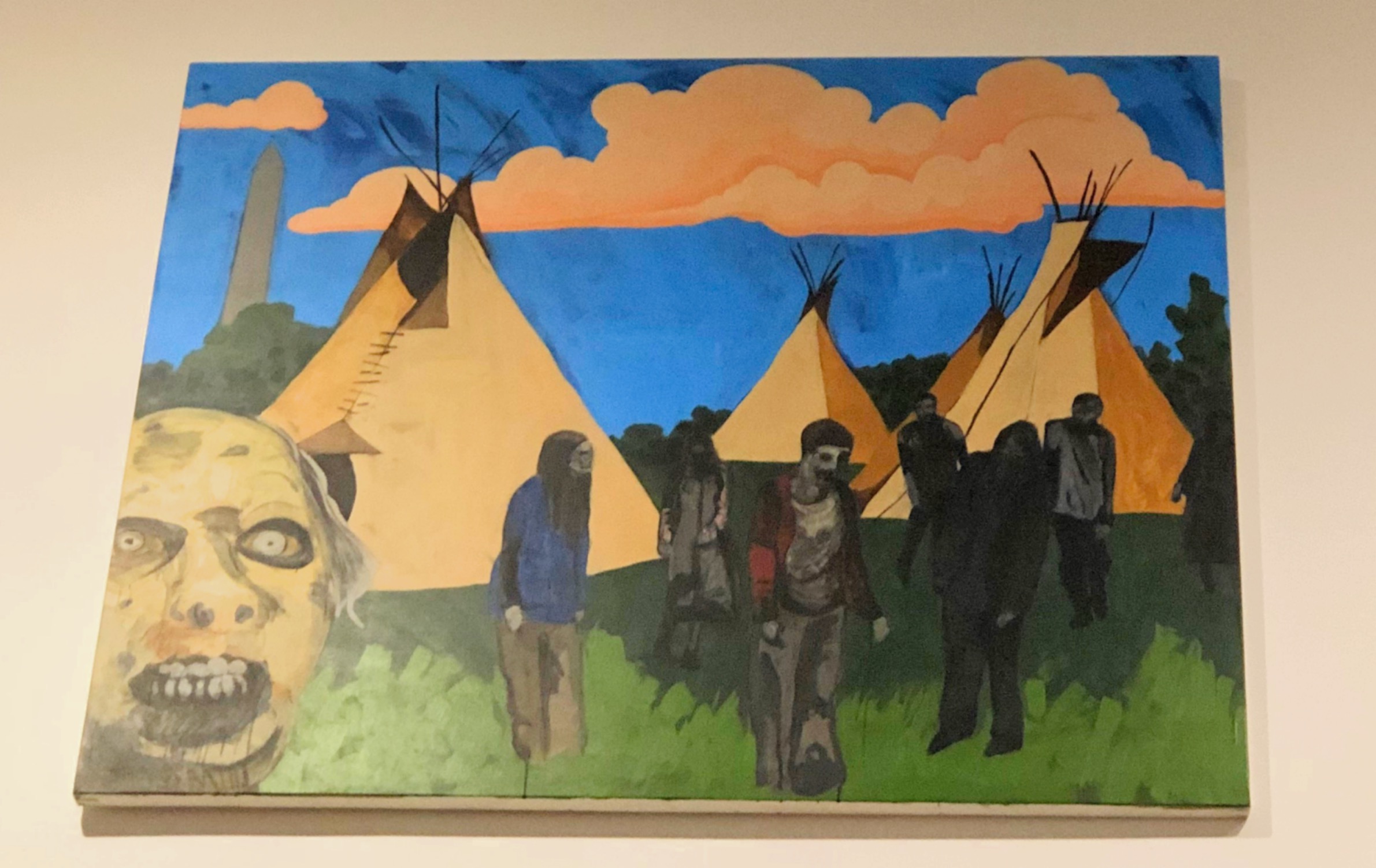
Hyde’s prism tilts the social landscape with both humor and derision, hope and anguish. His art includes familiar characters and products that are as much a part of Native culture as the mainstream with Pee-wee Herman, “The Walking Dead” and Corn Flakes. It’s the same, but different. In Hyde’s zombie apocalypse, the walking dead take over a tipi camp. The powerful, overt, yet painful and punny message presumably suggests that Native people – or at least the stereotypical tipi dwelling, horse-riding Indians – are forever dead and no longer resemble their former selves and ancestors.
Hyde pays tribute to family, contemporary Native people, traditions and values that reinforce Indigenous significance. He depicts his cousin Heath Hill in several paintings that have him dancing in Seneca regalia as a contestant on “American Idol.” In another, he mingles Native lacrosse players with the larger-than-life restaurant chain Bob’s Big Boy and proclaims Syracuse “Onondaga Nation Country” – eschewing Syracuse University’s claim this is “Orangemen Country.” In Hyde’s Central New York Americana, Natives are the area icons and images most recognizably associated with Syracuse. In canvas after canvas, Hyde’s Natives stick a landing that firmly plants Indigenous footing in the Americana landscape, as if to say: “We’re resilient, we’re still here and we got game.”
With every brushstroke, Hyde boldly asserts that Native people will not be burnished in sepia tone, ensconced in worn and wilting feathers of the past, or stuck in amber.
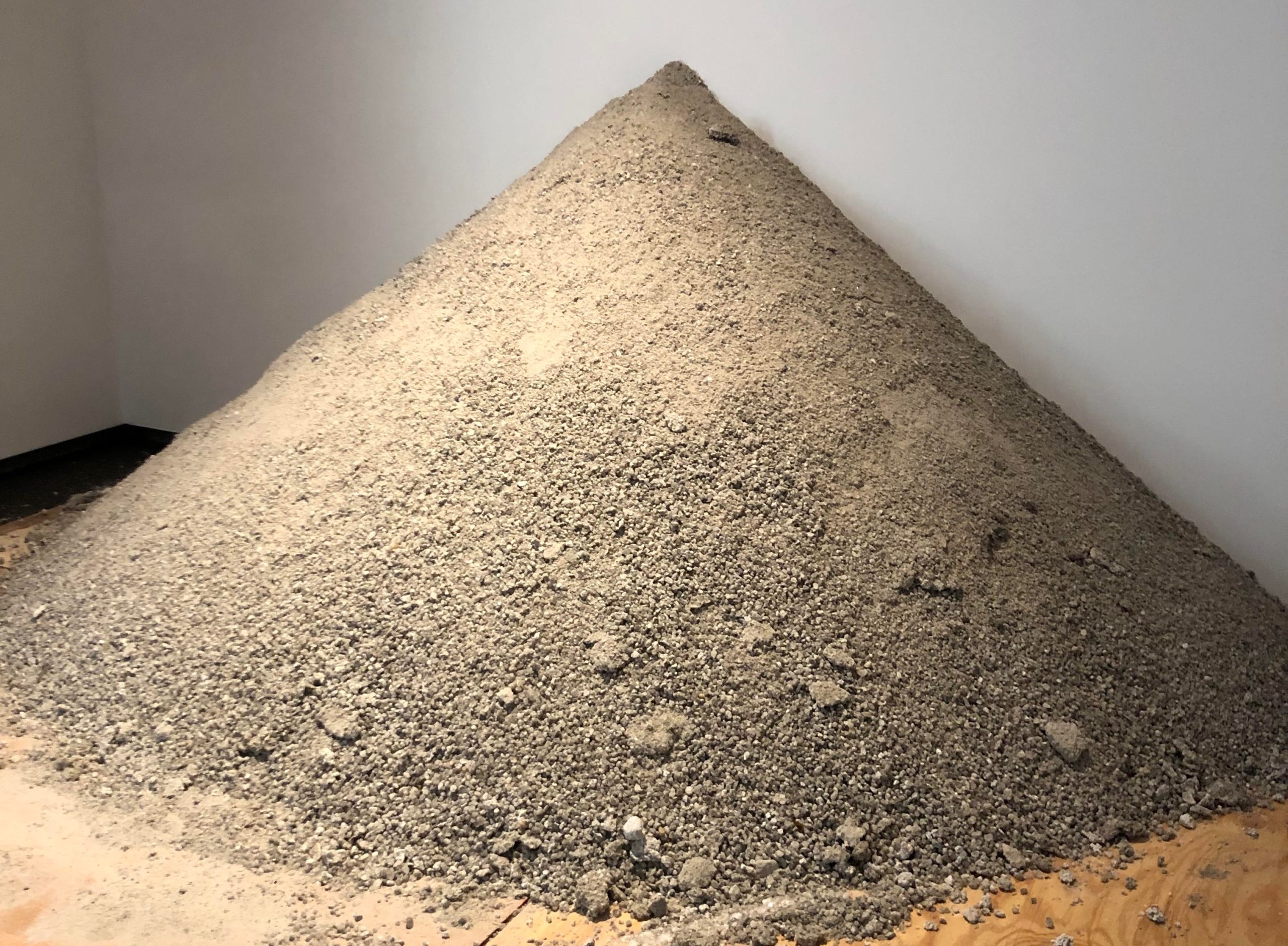
Hyde details the discord between tribes, states and the federal government with “Your Lease is Up,” a more than five-foot, one-ton pile of salt that represents the 1795 “treaty” agreement between New York state and the Onondaga Nation. The Onondaga Nation was annually paid a paltry sum of a little more than $2,400 and seven tons of salt in return for leasing Onondaga Lake and the land that became the city of Syracuse. According to Hyde the lease expired in the 1990s. Onondaga Lake became grossly polluted in the 1970s, was eventually declared a Superfund Site, and over the past 30 years has made strides in environmental health and restoration. But Hyde’s salt pile installation is complemented with a pervasive audio water drip – harkening back to the lake that was taken from the people for which it is named. The salt pile and the drip, drip, drip is a visual and auditory reminder of the theft of land, lake, and resources, and the debt still owed to the Onondaga people. “Once the lease was up, the land should have reverted back to the Onondaga people,” said Hyde.
His pieces paint out the commodification of land, Native culture and resources, pointing out how song, dance, symbols, and cultural objects are marketed for tourism. He is always hyper aware of the pervasive and meandering lens of the phone camera and proliferation of social media messages. His paintings incorporate, with recurring frequency, images captured in the frame of a cell phone – a selfie of him, depicted as a buffalo, and tourists snapping pics of Native dancers.
During a gallery walk, he stands next to a monitor running a 30-minute loop of segments of a reality TV show in which he was one of six featured artists on MTV and the Smithsonian channel. Hyde competed on the show, “The Exhibit: Finding the Next Great Artist,” which ran in early Spring 2023. The moment is classic Frank on Frank talking about his art, like a mise en abyme – a recurring abyss of images where he recursively appears in images upon images within themselves like a visual echo.
When I arrive at the museum, I catch Hyde mid-recording a video with his arm outstretched, cell phone trained on a group of Seneca dancers sharing Haudenosaunee song and dance in traditional attire. He is as much a subject of his own art and a living testament himself on the social realities of Natives in 2023. “I see all my compositions and commentary through a digital filter,” said Hyde. “I had an idea for a new painting as I was recording; work is meta.”
Hyde talked about the significance of the reality show competition and how important it was for mainstream America to see a Native artist on TV who wasn’t painting warriors on horseback. “Artistically I want to make it easier for other Native artists to not have to paint feathers, to not be pigeon-holed,” said Hyde. “We get beaten down by the expectation of stereotypes. I hope my work helps to expand Native artistic freedoms.”
It was also important to Hyde to represent for other Native artists. “There are just a few Native artists that have gotten elevated in the art world,” said Hyde. He doesn’t go to Santa Fe Indian Market, which was going on the day we talked at the Everson. When asked why he doesn’t show at the annual Native art mecca he said, “I suppose I could have been a ‘legacy artist,’ but I didn’t want to be Miss Santa Fe. I feel obligated to tow the line and make space for other Native artists.”
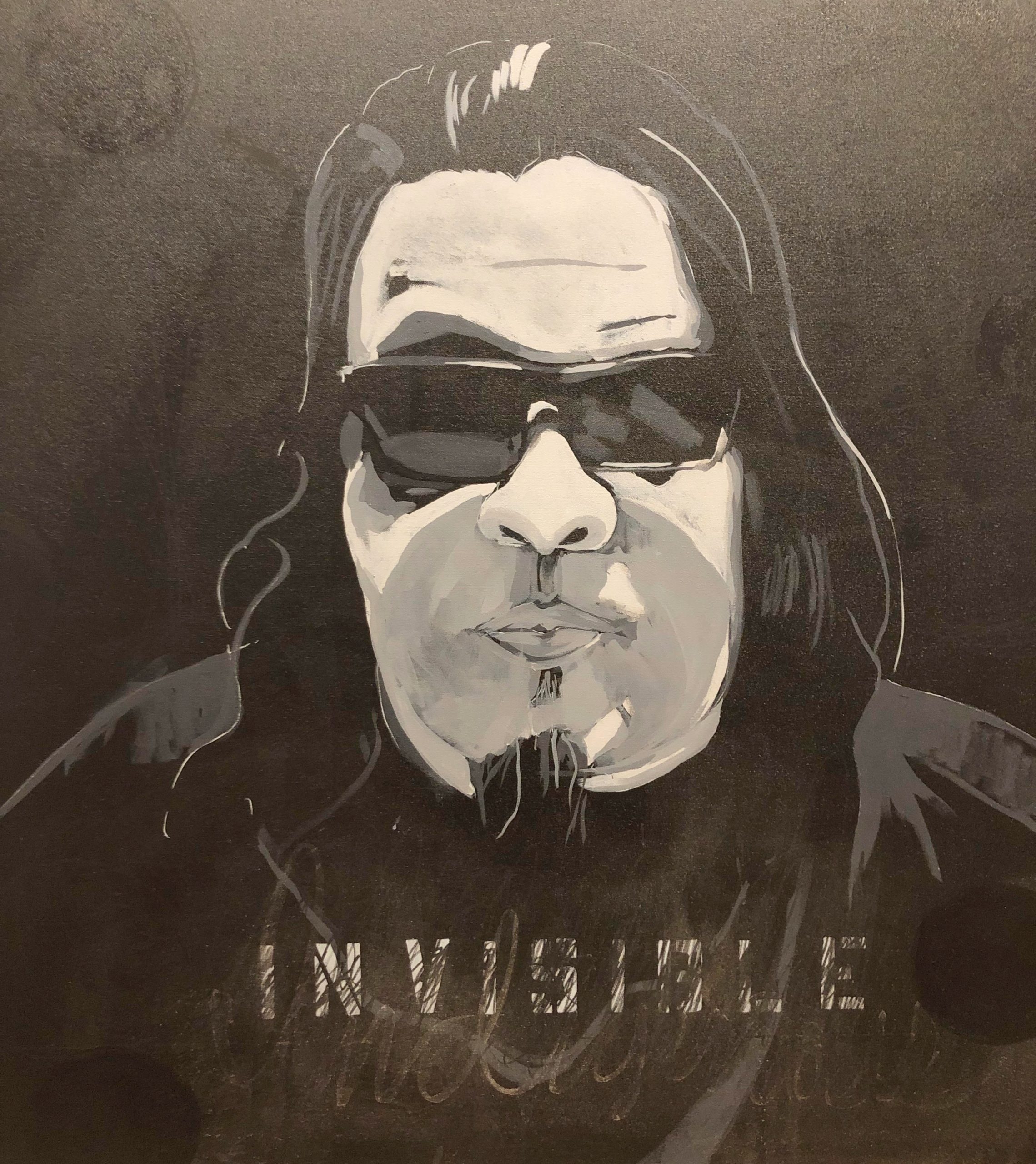
Hyde’s self portrait in the MTV series won the self-portrait challenge. It is intense, black on black, eyes hidden by black sunglasses, an expressionless countenance. The word INVISIBLE appears like a light puff of smoke, as though the letters will disappear in the blink of an eye. “That’s how I feel as a Native artist; invisibility is still an issue and we’re always marginalized. My self portrait is a direct reflection of the marginalization.”
On talking about the struggle between making and having to sell art, Hyde said life is full of paradigms. “We have to deal with: what lines do we have to cross to make money and make art? Everyone struggles with that one,” Hyde mused. “It’s like young love. Young love is fire, but it burns out. True love is sacrifice and compromise. Art is like true love; it’s what you have to do to keep the lights on.”
Hyde is keeping the lights burning strong through his art, whether with the help of a flash of a cell phone camera, the spark of history, or the ignition of new technology.
Hyde’s homecoming show “Native Americana” is at the Everson Museum in Syracuse, New York, through Sept. 10.

Our stories are worth telling. Our stories are worth sharing. Our stories are worth your support. Contribute $5 or $10 today to help ICT carry out its critical mission. Sign up for ICT’s free newsletter.

