The Associated Press and Mary Annette Pember/ICT
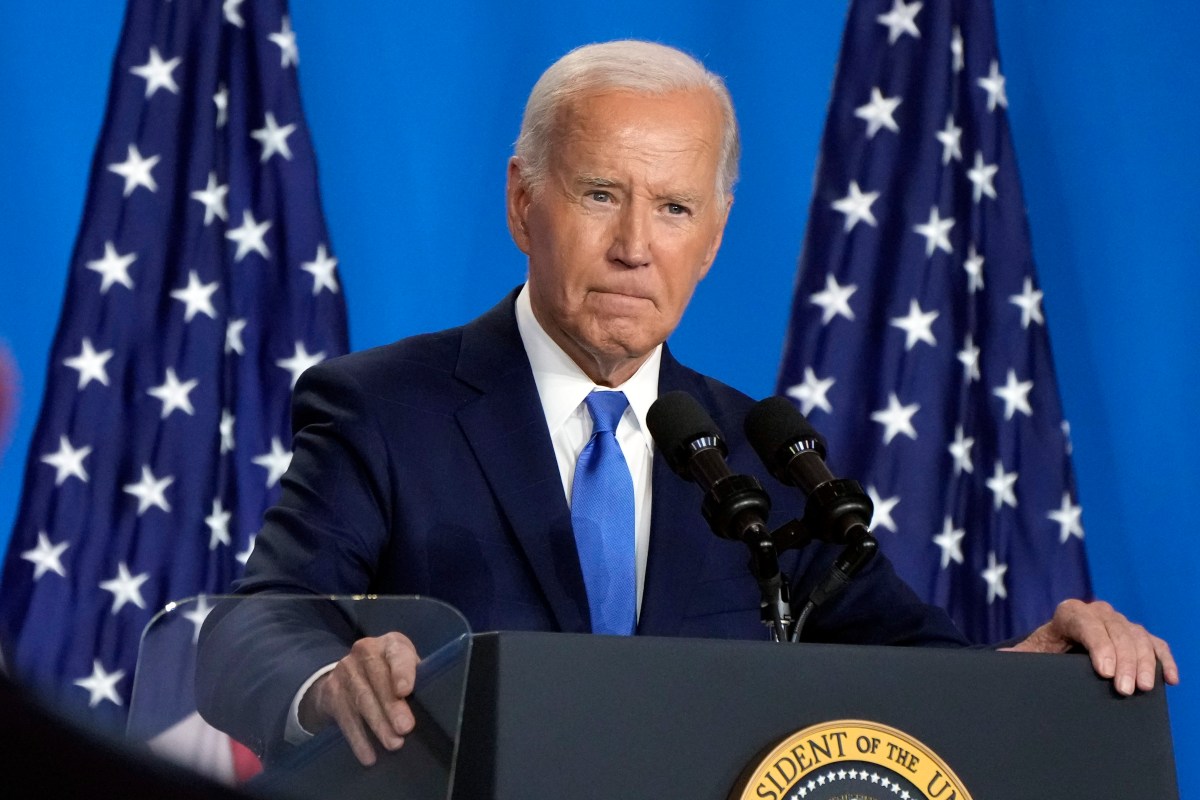
WASHINGTON, D.C. — President Joe Biden dropped out of the 2024 race for the White House on Sunday, ending his bid for reelection following a disastrous debate with Donald Trump that raised doubts about his fitness for office just four months before the election.
A note posted to his X account offered his “full support and endorsement” for Vice President Kamala Harris to be the Democratic nominee for president.
“Democrats – it’s time to come together and beat Trump,” Biden wrote. “Let’s do this.”
Related story:
—Trahant Reports: It’s hard to walk away from power
The decision came after escalating pressure from Biden’s Democratic allies to step aside following the June 27 debate, in which the 81-year-old president trailed off, often gave nonsensical answers and failed to call out the former president’s many falsehoods.
Biden plans to serve out the remainder of his term in office, which ends at noon on Jan. 20, 2025.
“It has been the greatest honor of my life to serve as your President,” Biden wrote in a letter posted to his X account that was followed up by the note endorsing Harris. “And while it has been my intention to seek reelection, I believe it is in the best interest of my party and the country for me to stand down and to focus solely on fulfilling my duties as President for the remainder of my term.”
Biden, who remains at his Delaware beach house after being diagnosed with COVID-19 last week, said he would address the nation later this week to provide “detail” about his decision.
The White House confirmed the authenticity of the letter.
The Sunday afternoon announcement sent a wave of surprise through Indian Country, where early reactions ranged from shock to caution.
“I’m still processing,” one prominent tribal leader told ICT.
“Best move ever,” Winona LaDuke,White Earth Ojibwe, an environmental activist who ran as the vice presidential nominee for the Green Party with Ralph Nader in 1996 and 2000. “Time to organize … and get out the vote for Indian people.”
A number of Republican leaders, however, called for him to leave office immediately, citing the 25th Amendment.
“If Joe Biden is unfit to run for re-election, he is unfit to carry out his term. 25th Amendment,” U.S. Sen. Markwayne Mullin, Cherokee, a Republican from Oklahoma, posted on social media.
The latest jolt
Harris has been the party’s instant favorite for the nomination but the move throws the nomination process into question at the upcoming Democratic convention in Chicago in August.
The announcement is the latest jolt to a campaign for the White House that both political parties see as the most consequential election in generations, coming just days after the attempted assassination of Trump at a Pennsylvania rally.
A party’s presumptive presidential nominee has never stepped out of the race so close to the election. The closest parallel would be President Lyndon Johnson who, besieged by the Vietnam War, announced in March 1968 that he would not seek another term.
Now, Democrats have to urgently try to bring coherence to the nominating process in a matter of weeks and persuade voters in a stunningly short amount of time that their nominee can handle the job and beat Trump. And for his part, Trump must shift his focus to a new opponent after years of training his attention on Biden.
The decision marks a swift and stunning end to Biden’s 52 years in electoral politics, as donors, lawmakers and even aides expressed to him their doubts that he could convince voters that he could plausibly handle the job for another four years.
Biden won the vast majority of delegates and every nominating contest but one, which would have made his nomination a formality. Now that he has dropped out, those delegates will be free to support another candidate.
Harris, 59, had appeared to be the natural successor, in large part because she is the only candidate who can directly tap into the Biden campaign’s war chest, according to federal campaign finance rules.
The Democratic National Convention is scheduled to be held Aug. 19-22 in Chicago, but the party had announced that it would hold a virtual roll call to formally nominate Biden before in-person proceedings begin.
The date for the roll call hasn’t been set, and it’s unlikely that will happen since the field is suddenly wide open. Harris would likely have competition from others looking to replace Biden. But that could create a scenario in which she and others end up lobbying individual state delegations at the convention for their support.
In 2020, Biden pitched himself as a transitional figure who wanted to be a bridge to a new generation of leaders. But once he secured the job he spent decades struggling to attain, he was reluctant to part with it.
Biden was once asked whether any other Democrats could beat Trump.
“Probably 50 of them,” Biden replied. “No, I’m not the only one who can defeat him, but I will defeat him.”
High stakes
Biden is already the country’s oldest president and had insisted repeatedly that he was up for the challenge of another campaign and another term, telling voters all they had to was “watch me.”
And watch him they did. His poor debate performance prompted a cascade of anxiety from Democrats and donors who said publicly what some had said privately for months, that they did not think he was up to the job for four more years.
Concerns over Biden’s age have dogged him since he announced he was running for reelection, though Trump is just three years younger at 78. Most Americans view the president as too old for a second term, according to an August 2023 poll from The Associated Press-NORC Center for Public Affairs Research. A majority also doubt his mental capability to be president, though that is also a weakness for Trump.
Biden often remarked that he was not as young as he used to be, doesn’t walk as easily or speak as smoothly, but that he had wisdom and decades of experience, which were worth a whole lot.
“I give you my word as a Biden. I would not be running again if I didn’t believe with all my heart and soul I can do this job,” he told supporters at a rally in North Carolina a day after the debate. “Because, quite frankly, the stakes are too high.”
But voters had other problems with him, too — he has been deeply unpopular as a leader even as his administration steered the nation through recovery from a global pandemic, presided over a booming economy and passed major pieces of bipartisan legislation that will impact the nation for years to come. A majority of Americans disapprove of the way he’s handling his job, and he’s faced persistently low approval ratings on key issues including the economy and immigration.
Biden’s age surfaced as a major factor during an investigation of his handling of classified documents. Special counsel Robert Hur said in February that the president came across in interviews with investigators as “a sympathetic, well-meaning, elderly man with a poor memory.”
The president’s allies seized on the statement as gratuitous and criticized Hur for including it in his report, and Biden himself angrily pushed back on descriptions of how he spoke about his late son.
Biden’s motivation for running was deeply intertwined with Trump. He had retired from public service following eight years serving as vice president under Barack Obama and the death of his son Beau, but decided to run after Trump’s comments following a “Unite the Right” rally in Charlottesville, Virginia, in 2017, when White supremacists descended on the city to protest the removal of its Confederate memorials.
Trump said: “You had some very bad people in the group, but you also had people that were very fine people on both sides. On both sides.”
That a sitting president didn’t unequivocally condemn racism and White supremacy deeply offended Biden. Then, Biden won the 2020 election and Trump refused to concede and stood by for hours while his supporters stormed the U.S. Capitol on Jan. 6, 2021, beating and bloodying law enforcement in a failed attempt to overturn the certification of Biden’s win.
“If Trump wasn’t running, I’m not sure I’d be running,” Biden once said during a campaign event.
But calls had been coming from a growing list of Democratic leaders for Biden to step aside even as they praised his term as president.
Reactions from Indian Country
As the news began to spread, reactions to Biden’s decision among Indigenous leaders began to surface on social media, largely divided among party or regional lines. Democrats – even those who supported Biden’s decision to leave the race – praised his work as president, vice president and in Congress.
Stephen Roe Lewis, governor of the Gila River Indian Community in Arizona, praised Biden’s work as “historic.”
“The @gilariver deeply appreciates President Biden’s unwavering commitment to Indian Country,” he wrote on Facebook. “His historic investments and support are a lasting legacy that will transform our Community and so many others across Indian Country. May the Creator be with you and your family! “
LaDuke also cited Biden’s appointments of Native people during his term in office, including Deb Haaland, Laguna Pueblo, the first Native person named to serve as Secretary of the Interior, and Charles “Chuck” Sams, Cayuse and Walla Walla, a conservationist who is the first Native director of the National Park Service.
“I have been thinking of Biden as the ‘hole in the donut’ for a while,” LaDuke wrote. “That’s to say, he was becoming weaker, but he appointed so many good people in his administration, especially Native people … The administration is full of good people.”
She continued, “Trump was happy to brutalize Biden, but Kamala is a much stronger opponent and many more of us will feel the ability to support her in the months ahead.”
Heather Dawn Thompson, Cheyenne River Sioux, served as director of tribal relations in the U.S. Department of Agriculture and recently left to become vice president for the World Wildlife Fund.
“It has been my absolute honor to serve in the Biden-Harris Administration,” Thompson said. “We achieved more for Indian Country than perhaps any Administration in history. Aging gracefully is a challenge for us all, and I greatly respect the President’s leadership, heart, and hard and honorable choice today. I look forward to supporting Vice President Harris in her continuation of President Biden’s unprecedented support for Indian Country.”
Jim LaBelle Sr., Inupiaq, an Indian boarding school survivor and former board president of the Native American Boarding School Healing Coalition, wrote to ICT via FB messenger.
“It had to be a difficult decision for President Biden to make,” he said. “Especially for himself, his family, his party and Nation. He will go down as one of the greatest presidents in the modern era, his accomplishments are numerous. In spite of polarized times Biden has fostered and passed bipartisan legislation that benefited the entire nation. For Indian Country, Biden has created a pathway for Deb Haaland to be the Secretary of the Interior and advancement of the Truth and Healing Commission Bill.”
Deb Parker, Tulalip, current executive director of the boarding school coalition, likewise praised Biden’s track record NABS and urged his successor to push for passage of the Truth and Healing Commission on Indian Boarding School Policies Act.
“We owe a debt of gratitude to the leadership of President Joe Biden,” Parker said. “We understand the importance of selecting a solid presidential candidate to help bring this nation together. We are in support of a candidate who understands and honors tribal sovereignty, especially as it pertains to the federal Indian boarding school era.”
She continued, “Our sincere hope is that we pass the Truth and Healing bill prior to the next Administration. We will always remain committed to truth, justice and healing.”
Update: This story has been updated to include comments from Indigenous leaders.