
Sandra Hale Schulman
Special to ICT
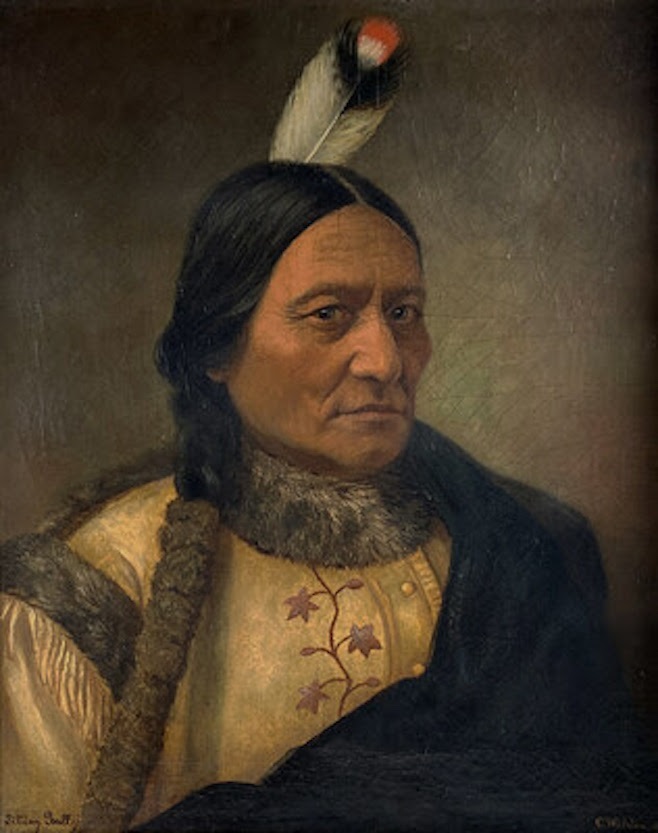
A rare painting of Lakota Chief Sitting Bull by a woman he apparently befriended in the late-1800s is set to be auctioned off by descendants of the original owner who bought the portrait in 1890.
The work is one of four paintings of Sitting Bull by New York artist Caroline Weldon and is believed to be the only one still in private ownership. It will go up for sale on March 18 at Blackwell Auctions in Clearwater, Florida, along with a variety of other unrelated historical items.
SUPPORT INDIGENOUS JOURNALISM. CONTRIBUTE TODAY.
“The cultural significance of this piece can hardly be overstated,” Edwin Bailey of Blackwell Auctions said in a statement. “It’s a wonderful portrait. One of the best portraits of a Native American, especially by a woman who has no art career on record.”
Historian and researcher Daniel Guggisberg told ICT that the portrait was made from a photo and not from a sitting — contrary to the story that was portrayed in the 2017 film, “Woman Walks Ahead,” that featured actress Jessica Chastain as Weldon and Michael Greyeyes as Sitting Bull.
“It is based on a portrait made by photographers Palmquist & Jurgens of Minneapolis in March 1884,” Guggisberg said. “She did not paint from life — would not have the means to do so and Sitting Bull certainly would not have agreed to sit for a painted portrait for hours or days on end. Caroline Weldon certainly had artistic talent, but not beyond an amateur’s level.”
Guggisberg said the painting was believed to have been made by Weldon when she returned to Brooklyn in late 1889. It is dated 1890.
She appears to have sold the painting to William Lafayette Darling, a railroad engineer who is known to have worked on construction of a rail line that ran through the Dakotas and into Montana and Idaho, Guggisberg said.
The painting was handed down to his daughter in 1938 and then eventually ended up with his great-granddaughter. The painting has been consigned for sale with Blackwell.
Weldon, who was identified for years as Catherine Weldon based on a published misidentification in the 1930s, painted two other known portraits of Sitting Bull. They were based on photographs by William Notman & Son of Montreal, taken in August 1885, Guggisberg said.
One of those paintings, now held at the North Dakota Heritage Center and State Museum in Bismarck, was in Sitting Bull’s cabin when he was killed by Indian Agency police in 1890. Shortly afterward, a police officer whose brother had been killed in the exchange slashed the painting with his rifle, tearing the canvas. A Cavalry officer took the painting and later purchased it from Sitting Bull’s widows for $2, according to the museum website.
Another painting of Sitting Bull by Weldon is in the permanent collection of the Historic Arkansas Museum in Little Rock. The fourth painting is unaccounted for. According to the book, “Woman Walking Ahead,” by Eileen Pollack, the painting was in the apartment where Weldon lived when the fire broke out in 1921, and it was either burned or thrown away by the landlord.
SUPPORT INDIGENOUS JOURNALISM. CONTRIBUTE TODAY.
The March auction, “The American Sale,” will also feature a large collection of historical American items, including documents ranging from 1650 to the mid-20th century, as well as tintypes, daguerreotypes and weapons
No known opposition to the sale has surfaced, though Oglala Sioux Tribe leaders voiced opposition to an unrelated auction Jan. 19-21 in Las Vegas that included weapons, drums and ceremonial items.
Tribal leaders did not respond to a request for comment from ICT.
Tangled history
HIstorical details are murky about Weldon’s trip to see Sitting Bull and her decision to stay.
Guggisberg said Weldon went to see Sitting Bull in the late 1880s to help him politically in his fight with the U.S. government, not to paint him. She ended up staying in the area and moved with her teenage son into the camp at Standing Rock.
Records suggest she had become intrigued with the Native fight against the U.S. government and had traveled to Standing Rock to see for herself. Weldon had been a member of the National Indian Defense Association and had reportedly offered to be Sitting Bull’s voice and advocate.
Sitting Bull was a powerful military, spiritual and political leader who rallied the Sioux in 1876 to defeat then-Lt. Col. George Armstrong Custer, whose announcement of gold in the Black Hills triggered the gold rush to the area.
The U.S. government responded to the defeat at Little Bighorn by sending in additional troops, and Sitting Bull and his band moved into what is now Canada’s Northwest Territory in the late 1870s for a period before returning to the Standing Rock area in 1881.
After a stint with Buffalo Bill’s Wild West Show, he returned again and set up camp along the Grand River, where Weldon and her son, Christie, joined him and others.
He drew attention once again from the U.S. government when he allowed the Ghost Dance movement to set up camp with him. Soldiers moved in to arrest him on Dec. 15, 1890, and he was shot and killed in an exchange that left more than 15 other people on both sides dead.
Guggisberg, whose research has been consulted on various projects, said much of the story told about Weldon’s affiliation with Sitting Bull was fictional.

As a single, divorced mother with a young son, Weldon was outspoken about the Wild West and Indigenous rights, he said. He discounts suggestions there was a romance between them.
“Caroline Weldon, contrary to the movie’s portrayal, was a middle-aged woman, past her physical prime,” he said. “An idealist and perhaps a dreamer, but also disturbingly patronizing and considering the dominant culture superior to Native culture.”
The film version was “pure fiction, mostly made up and with only very vague connections to the true historical events,” he said.
“I was particularly unhappy that the filmmakers created the impression of a romantic relationship between Sitting Bull, who by then was already in his fifties, and Caroline Weldon,” he said. “Unfortunately, the movie-going public tends to accept fiction for fact.”
The real-life story has unhappy endings. Weldon left the area weeks before Sitting Bull’s death. Weldon’s son died from an infection, and Weldon died in the 1921 fire at her home in Brooklyn.
How much?
The value of Weldon’s painting of Sitting Bull remains unknown.
Auction items will be available for viewing online beginning in late February and the auction will be held in person at the 8,000-square-foot auction gallery in Clearwater, and online.
Bidding for the Sitting Bull portrait will start at about $15,000 to $20,000, said Bailey, with Blackwell Auctions.
“The value is always going to be subjective,” he said. “It’s what two people end up fighting over at the tail end of the auction. There is no established comparative value for her work.”
Still, he expects interest will be high.
“The painting represents the poignant intersection of two marginalized groups — the Indigenous peoples of America and women artists,” he said. “There are a lot of museums which probably would absolutely love to have it, and we hope whoever buys it will display it for the public.”
The solemn portrait of the legendary Lakota leader has been in storage for decades, in its original frame, and was in need of cleaning and repair, officials said.
“The Weldon painting when I got it was 130 years old, in a fairly advanced state of disrepair,” he said. “It needed to be cleaned, and this painting had deteriorated to the point where the edges of the canvas where it met the edge of the stretcher had worn off.”
He added, “I wanted the back original canvas to show, because the original canvas tells you a lot about the authenticity of the age of it.”
Other items in the auction are also expected to attract attention.
“Serious collectors of American history will be delighted when the auction goes online in late February,” Bailey said. “The vast majority of the items in this sale haven’t changed hands in generations.”

Our stories are worth telling. Our stories are worth sharing. Our stories are worth your support. Contribute $5 or $10 today to help ICT carry out its critical mission. Sign up for ICT’s free newsletter.
