

Amelia Schafer
ICT + Rapid City Journal
RAPID CITY, S.D. – For nearly 30 years starting in 1883, Lakota performers traveled the globe and performed in over 3,000 different locations as part of Buffalo Bill’s Wild West Show. Many different historical documents and research initiatives highlight William “Buffalo Bill” Cody’s life and show, but few projects exist highlighting the Indigenous performers he employed.
A new collaborative project between Oglala Lakota College and Clemson University with funding from the National Archives aims to gather information about Lakota ancestors who participated in Buffalo Bill’s Wild West Show.
The project, Wičhóoyake kiη aglí—They Bring the Stories Back: Connecting Lakota Wild West Performers to Pine Ridge Community Histories, is a community collaborative effort to get Lakota people talking about their ancestors’ involvement.
“We have so much history and experiences that have impacted us as a nation, but I think so few of us know all of the history of our people,” said Cecelia Firethunder, Oglala Lakota and a community collaborator for Wičhóoyake kiη aglí. “It’s just so amazing, it’s a beautiful history. Nowadays I can get on an airplane and get to many places in two hours. Back then they were getting on boats and traveling across the ocean for shows.”
Nearing the end of the Indian Wars and westward expansion, performers such as Cody used growing nostalgia for the American Frontier to bring in viewers from across the globe. Originally, the show used Pawnee performers but later switched to mostly Lakota performers from the Pine Ridge Reservation.
“The Buffalo Bill Wild West Show was a very integral part of our culture here. So many of our people went on that,” Firethunder said. “Our ancestors in those days went on trains across America into unknown territory. They traveled across the Atlantic Ocean to Europe. I mean they had no idea where they were going. I’m sure there was a certain amount of anxiety and fear there.”
Despite a large presence of Lakota people, not much is known about exactly how many Lakota performed in the show nor what all of their names were. Those who performed often brought souvenirs or photos back to their families on the reservation. Some of those souvenirs remain today.
For the Wičhóoyake kiη aglí project, organizers and researchers are hoping to gather stories, photos and other information from community members.
Over the past several months project community collaborators such as Amanda Takes War Bonnett, Cecelia Firethunder and Stella Iron Cloud have hosted radio shows, contacted relatives, and raised awareness for the project.
“Communicating to the community is one of the biggest challenges,” Firethunder said. “I think most people want to tell their stories, they want their family’s story recorded and documented, but they also want to make sure it’s in a place where they’re heard and respected.”
While the Wild West Show provided performers with income and an opportunity to travel the globe, it also perpetuated stereotypes about Native Americans, specifically the Lakota. In the show, the Indigenous performers would burn wagons, and reenact the Battle of Little Bighorn and other battles.
“It underscored that image (of Native Americans) to violence or that they’re wild and you should fear them,” said Douglas Seefeldt, associate professor of history and director of the Digital History PhD program at Clemson University. “I do think most got the exciting violent, wild west image, but the show also did a lot to keep them in the public mind.”
The show was massive. At one point, over 800 performers, 180 horses, 18 buffalo, 10 elk and two deer were brought as part of the Wild West experience. During their time overseas, many Lakota did not return home – either dying from illness or work-related injuries or deciding to stay in Europe.
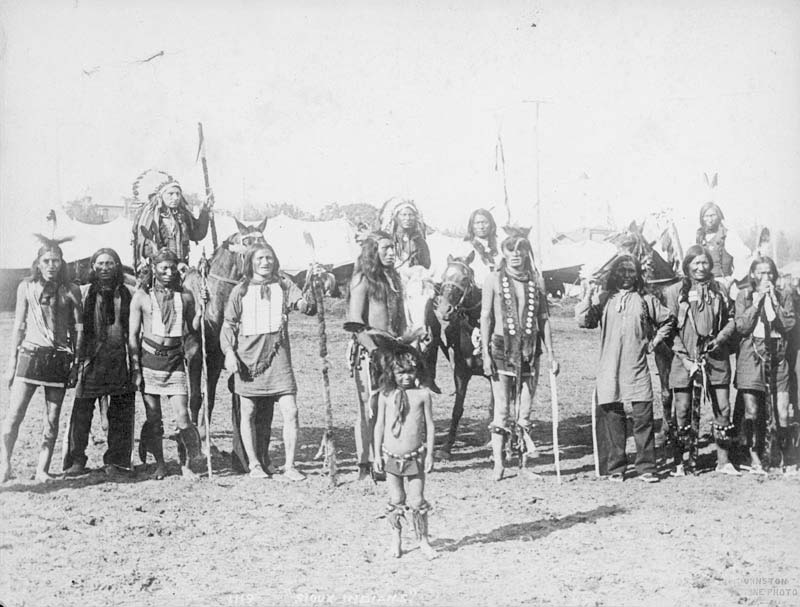
Many photos of performers lack names or have improper tribal affiliations. To make the show more interesting and diverse, some performers would be listed as being Cheyenne, Arapaho, or from other tribes despite being Oglala or Sicangu Lakota.
“Instead of these photos just saying ‘Indians,’ we will get everybody’s name,” Seefeldt said.
Eventually, a list will be made of performers, what season or year they performed and where they were from. A list of performers who died while working for the show will also be created.
Today, many Lakota people may not know about their ancestor’s involvement in the show. Firethunder and Takes War Bonnett said they’re willing to help anyone who is curious in researching their family.
“If you have an ancestor’s name or photo, we’d be happy to see if we can find any pictures or documents of them in the show,” Firethunder said.
On April 19 from 10 a.m. to 4 p.m. MST, project researchers are hosting a scanning party at Oglala Lakota College in Kyle, South Dakota. Community members can bring photos, trinkets and other documents from ancestors who participated in the show.
“We just hope there are people who have a little shoebox under their bed or in the attic or something with a story that they can bring and share,” Seefeldt said. “We’ll scan the stuff, give it back to them and give them some archival folders to help make those documents last just a little longer.”
Door prizes and snacks will be available at the event.
Eventually, research from the final project will be made available online using Mukurtu, an Indigenous-made, open-source platform used for digital heritage projects. This way, the project will be viewable for all. Documents will also be showcased in the Oglala Lakota College’s museum and a short film will be played at the National Museum of American History.

This story is co-published by the Rapid City Journal and ICT, a news partnership that covers Indigenous communities in the South Dakota area.
Our stories are worth telling. Our stories are worth sharing. Our stories are worth your support. Contribute $5 or $10 today to help ICT carry out its critical mission. Sign up for ICT’s free newsletter.

