
Sandra Hale Schulman
Special to ICT
A long-time visual artist and curator who works closely with tribal preservationists has been awarded the 2023 Johnson Fellowship for Artists Transforming Communities for his decades of work in art, film and writing.
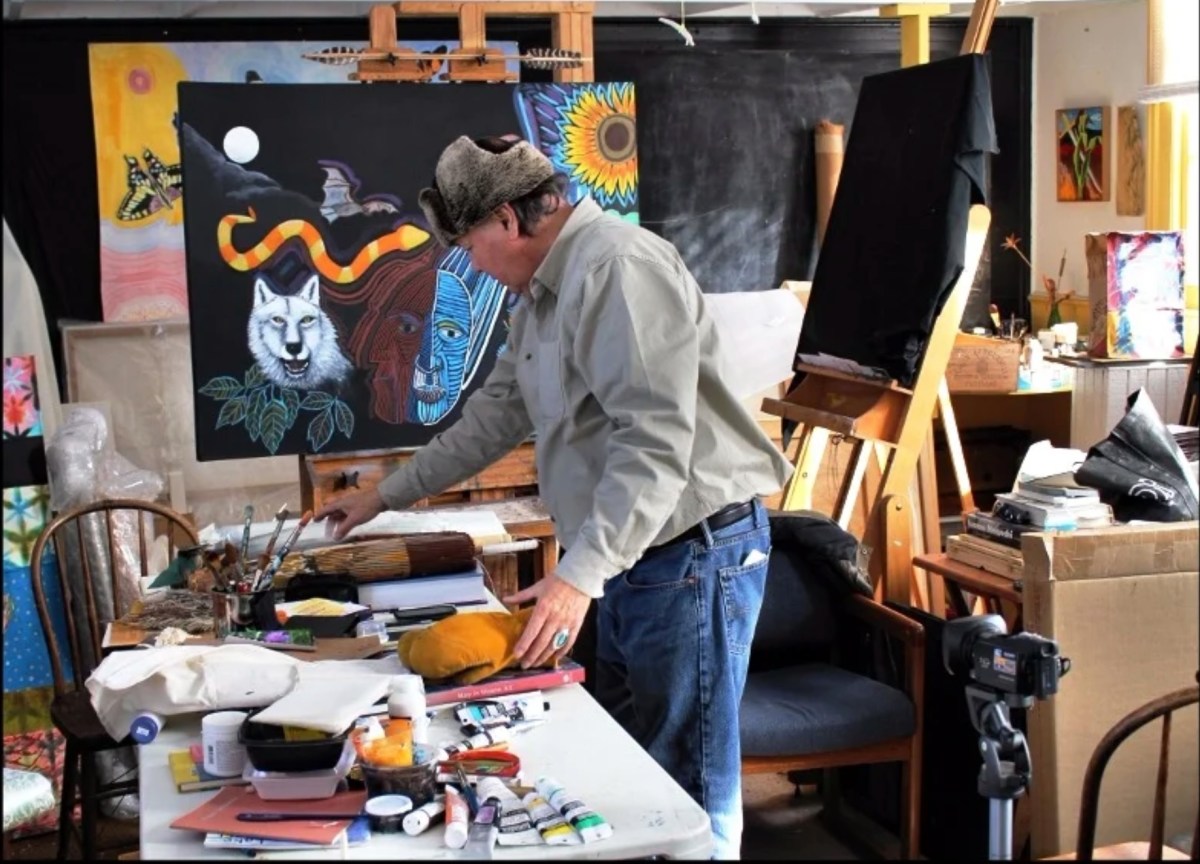
Artist G. Peter Jemison, Heron Clan, Seneca Nation, was named the recipient of the fellowship by Americans for the Arts, which recognizes artists or culture bearers who work in and with rural communities to advance cultural equity.
SUPPORT INDIGENOUS JOURNALISM. CONTRIBUTE TODAY.
“At Americans for the Arts, we believe that artists are the catalysts for the transformation of society and America’s communities — and Peter is doing exactly that,” Nolen Bivens, president and chief executive of Americans for the Arts, said in a statement.
“As a culture bearer and thought-provoking contemporary visual artist, Peter’s impacts on his own Seneca people and community in rural western New York are matched by leadership and action around issues of cultural preservation, cultural rights, and policies, benefitting Native nations across a wide geography,” Bivens said. “I look forward to hearing Peter share his knowledge, perspective, and experience over the course of this year.”
Jemison’s work is grounded in the Haudenosaunee belief in Orenda — that there is spirit and energy in all creation.
“Getting the Johnson Fellowship is an affirmation that the work I have been doing as a curator, artist, and Hodinoshoni cultural preservationist has been recognized as valid and important to ‘our way of life,’” Jemison told ICT in an email, using an alternate spelling for his people.
Evolving over time
Jemison grew up on the Cattaragus Reservation in western New York near Buffalo, and now lives in Victor, New York.
His mixed-media art is political in nature, portraying contemporary social commentary, historical collages, and work that reflects the natural world. Jemison also produces short videos, including the award-winning “Iroquois Creation Story,” with choreographer Garth Fagan, that combines live-action and animation.
His art has evolved over time as he continually learns about his culture, he said.
“My films were made to tell a story,” he wrote, “using visual beauty and a narrative that conveyed the perspective I had been taught by Seneca and other Hodinoshoni teachers. The cultural knowledge has great meaning to me. It has taken a lifetime to understand, and I am still learning. In return, I want to share a glimpse or an insight to act as a bridge for understanding.”
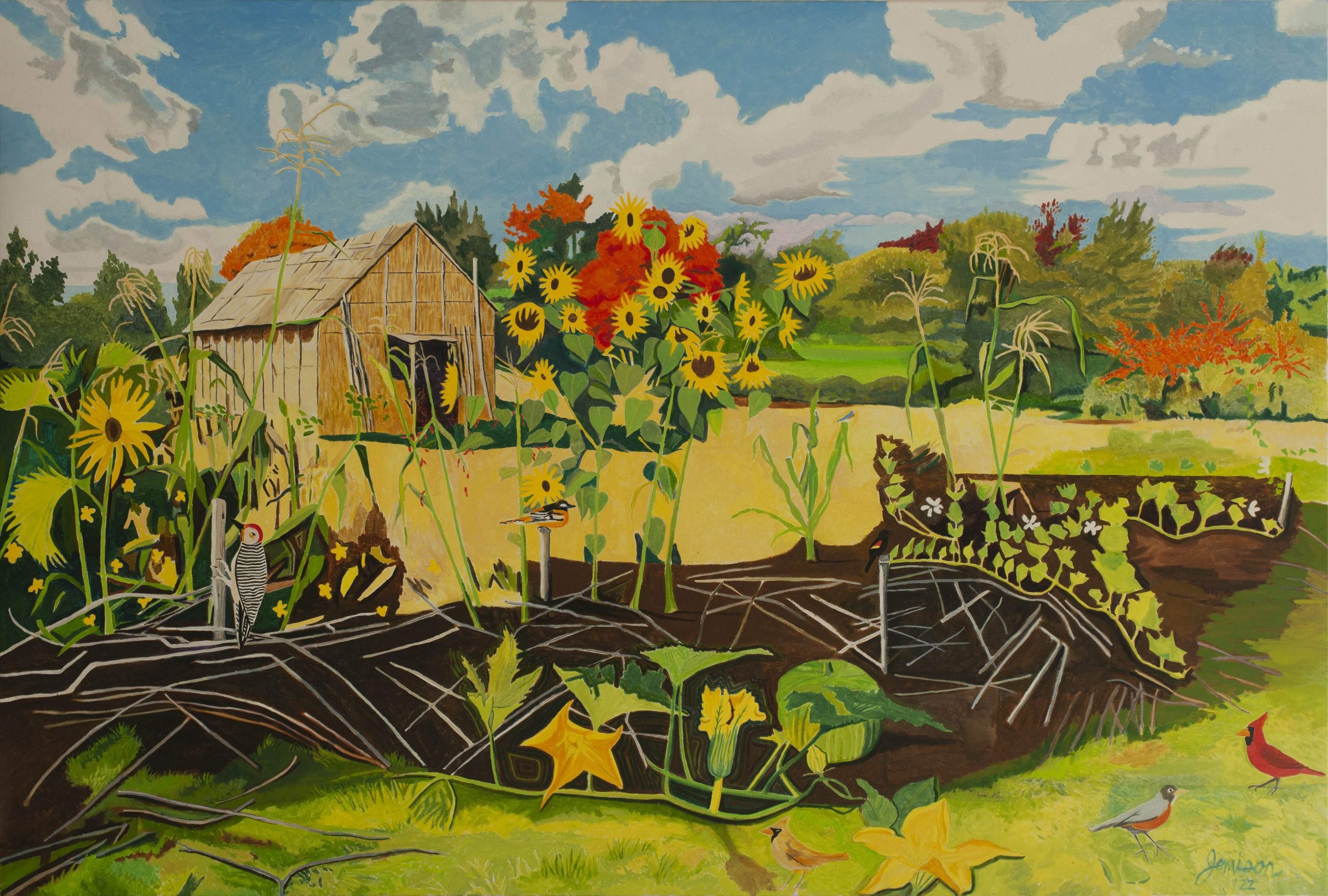
His films have screened at the Native American Film and Video Festival and at the National Museum of the American Indian in Manhattan.
Jemison has been advocating for Native rights issues of repatriation of sacred objects, cultural patrimony, and human remains of the Haudenosaunee for decades. He long-served as the site manager of the historic 17th century Ganondagan State Historic Site in New York.
A leading authority on Haudenosaunee history, Jemison co-edited a book, “Treaty of Canandaigua 1794: 200 Years of Treaty Relations between the Iroquois Confederacy and the United States,” published in 2000 by Clear Light Books.
Jemison is also part of Forge Project, a Native-led initiative that collects Indigenous art, promotes decolonial education, and supports leaders in culture, food security, and land justice. Forge Project is on the unceded homelands of the Muh-he-con-ne-ok in Upstate New York, and works to upend political and social systems formed through settler colonialism, according to Americans for the Arts.
As a curator, Jemison produced the Iroquois Biennial at the Fenimore Art Museum in Cooperstown, New York, for 20 years before retiring recently. His own artwork is in the collections of the Museum of Modern Art; the Whitney Museum of American Art; the Heard Museum; the National Museum of the American Indian in Washington, D.C. and New York City; and others.
In 2004, He was elected board member-at-large of the American Alliance of Museums in 2004 and was the founding director of the American Indian Community House Gallery in New York City.
‘Transformative impact’
Jemison said a common thread runs through his works, though he creates in a variety of mediums — making art, producing films and curating shows.
“Today, I am more focused than ever on my art,” he said. “I have gallery representation and there is interest from museums and collectors. This is extremely gratifying. When I have curated exhibitions of contemporary Native American artists, the intention was to highlight work that seemed to be unknown or unrecognized.”
Jemison has had a “transformative impact” on the region’s Indigenous communities through his realization of a center grounded in culture with programming related to health, education, economic achievement, agriculture, food sovereignty, arts, culture, and sports, Americans for the Arts officials said.
“As a culture bearer, speaker, educator, curator, writer, and arts leader, Jemison’s visionary efforts over decades have helped lay the groundwork to bring Indigenous perspectives into curation and cultural equity concerns,” according to a statement.
Americans for the Arts is a nonprofit organization based in Washington, D.C., that has advanced arts and arts education in the United States for more than 60 years.

Our stories are worth telling. Our stories are worth sharing. Our stories are worth your support. Contribute $5 or $10 today to help ICT carry out its critical mission. Sign up for ICT’s free newsletter.

