
Mark Trahant
ICT
Congress and the White House are at odds over how to manage the country’s massive debt – and an artificial spending limit that could leave the government without the authority to pay its bills.
There isn’t a lot of time. And if the country’s leaders do not figure out a plan soon, the ramifications would be unbelievable.
So, let’s go into a World of the Unbelievable. Here you’ll find mind numbing numbers. And policy decisions – and consequences – that could soon inflict a lot of pain, such as job losses, increased poverty, and fewer health care options.
It’s no secret that programs serving Indigenous people have been historically underfunded. For instance, we like to think of healthcare as a prepaid plan, a work product from the treaties that promised to send a doctor and a nurse to tribal communities. But the story has always been more complicated.
If you look at the budgets of the 1800s there was far more concern about treating infectious diseases from Indians rather than improving Indian health. One account in 1880 found that the Army spent $21.91 per soldier – and the Navy’s cost was more than double that, $48.10 per sailor. That same year the total per person expenditure for Indian health was $1.25.
It’s also true that a lot of progress has been made in the past couple of years. The current proposed Indian health budget (which is unlikely to get approval from Congress) would hit $9.4 billion or about $3,672 per person. If you add Medicaid – which is critically important – the number would more than double that amount. And for older Americans, Medicare spends an average of $12,530 per patient.
All this is context for the scary debate ahead.
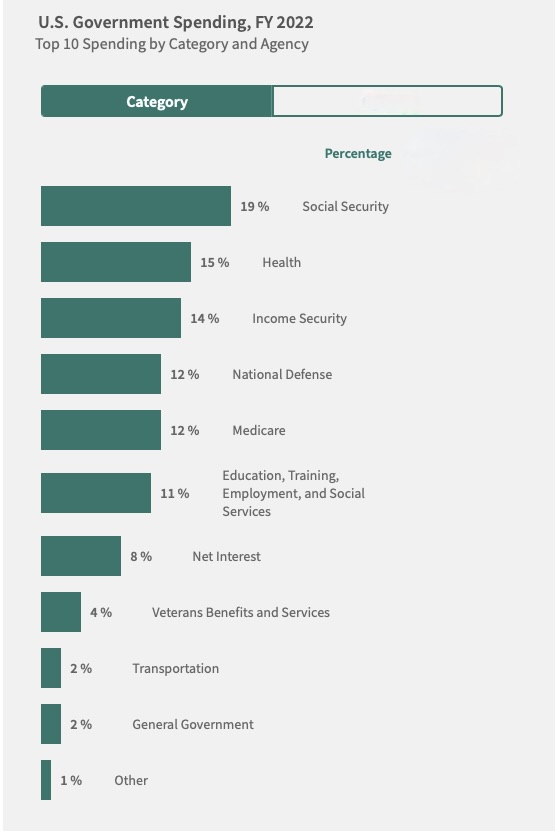
One of the fastest growing “programs” is interest that the United States pays on its debt. It’s already a big number, just under $400 billion annually. But here’s the thing: That interest payment is at a really low rate, best in the world, about 2.1 percent. Investors around the world are keen on U.S. bonds because, well, they are a safe bet. And even though the total amounts continue to grow, the cost of borrowing is limited.
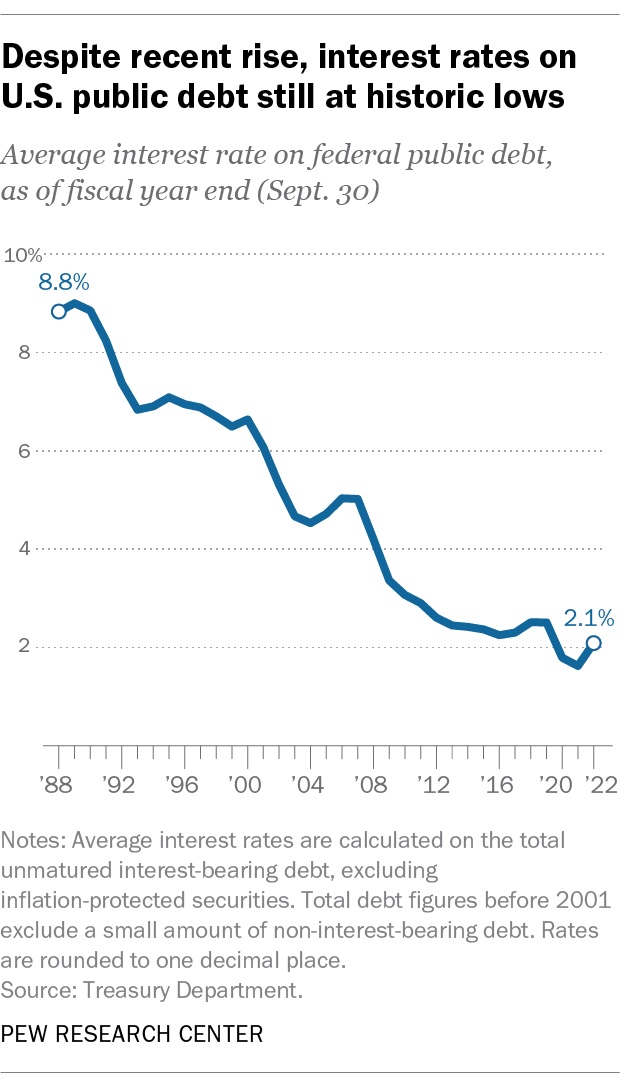
But if the bond markets no longer trusts that safety, then interest rates will go up. An increase of 500 basis points – or one-half of one percent – will cost the federal treasury $105 billion a year. A one percent hike would cost a total of $7.3 trillion between now and 2031. And two percent adds $418 billion to the budget and a total of $9.2 trillion for the next decade.
That is just one risk from the debt ceiling crisis.
The White House Council of Economic Advisors released a paper Wednesday that spelled out what else could happen.
“History is clear that even getting close to a breach of the U.S. debt ceiling could cause significant disruptions to financial markets that would damage the economic conditions faced by households and businesses,” the White House said.
If there is a default “the economy would quickly shift into reverse, with the depth of the losses a function of how long the breach lasted. A protracted default would likely lead to severe damage to the economy, with job growth swinging from its current pace of robust gains to losses numbering in the millions.”
And that historic low interest rate that the U.S. now pays would become a memory. The White House’s economic advisors say a default “would cause interest rates to skyrocket” for the government and for businesses and families.
President Joe Biden has asked congressional leaders to meet at the White House on May 9 to come up with a plan to raise the debt ceiling. Unless there is a resolution soon, probably the first week of June, the U.S. Treasury will not have enough money to pay all of its bills. This would be a default and interest rates would increase, both for the government and for companies and individuals on their own loans.
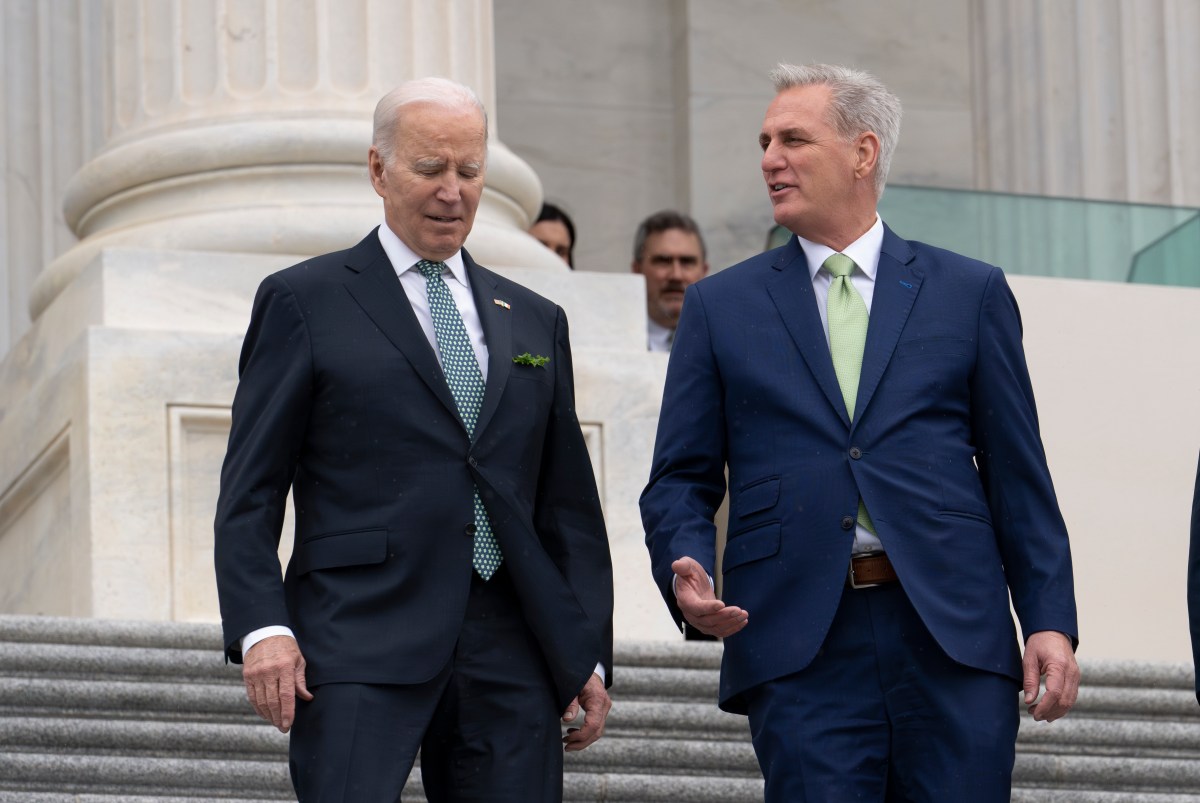
House Speaker Kevin McCarthy says the only way Republicans will agree to an increase in the debt ceiling is to include sharp spending cuts. The president – and Democrats – say the debt limit should be raised on its own, preventing default, and discuss spending on a separate track (since Congress already has to approve spending bills every year).
“House Republicans did their job and passed a responsible bill that raises the debt ceiling, avoids default, and tackles reckless spending,” McCarthy said in a statement. “The Senate and the President need to get to work — and soon.”
And 43 Senate Republicans have sent a letter to Senate Majority Leader Chuck Schumer that said they oppose any bill that raises the debt limit without significant “spending and budget reforms.” It takes 60 votes in the Senate to move legislation, meaning that group of 43 members could block any legislation proposed by Democrats.
The Republican plan would require deep cuts in non-defense discretionary programs – including Indian health, the Bureau of Indian Affairs, and housing. The White House figures that budget would mean a 22 percent reduction for non-defense programs. The president cited a Moody’s Analytics report that there would be 780,000 fewer jobs next year if the bill became law.
The House bill does not offer specific spending cuts – Republicans want the White House to take the total amount and then figure out where that economic pain should happen.
But the real problem for the White House – and the Republicans – is what kind of deal could be made that would be acceptable to both sides? Speaker McCarthy can only afford to lose five votes – so he would have to keep conservatives aligned while at the same time reaching an accord with the White House and Democrats. If the speaker gets too much support from Democrats, then he could face a revolt from Republicans and lose the speakership.
Another possible deal could come from the 64 members of the bipartisan Problems Solvers Caucus. A framework published by the groups describes the next steps as “a reasonable, responsible bipartisan approach — putting country and stability first.”
The caucus proposes a six-month suspension of the debt ceiling allowing the normal budget process to work its course. In addition there would be a bipartisan commission created to come up with a plan for the long-term issues related to deficit spending.
But for that plan to happen Congress would need to pass a discharge petition where at least 218 members challenge leadership in order to bring legislation to the floor.
One other complication is the clock, and a June 1st deadline. The Washington Post says that there are only about six working days that the House and Senate will both be in town. “May 16 is the last day all the key players are scheduled to be in Washington,” The Post reported. “After that, Biden will be out of the country for more than a week, traveling to Japan for a Group of Seven summit and then to Australia for talks with other leaders of the ‘Quad’: Australia, Japan, the United States and India. The House and the Senate are both slated to be out around the Memorial Day holiday.”
What happens if there is no deal? Other than interest rates going up – a lot is unknown. A report by Moody’s predicts that even a short debt limit breach could cost nearly 2 million lost jobs.
Plus that could launch a vicious cycle where more debt leads to higher interest rates, and therefore, more debt to service. The bottom line: Fewer dollars for the programs popular with voters.
There was another debt ceiling crisis in 2011.
Senate Minority Leader Mitch McConnell, a Republican from Kentucky, then proposed that Congress give the president the authority to raise the debt limit and that Congress could enact a resolution of disapproval if it did not agree.
But Congress would not go there. And in August of that year the credit rating agency, S&P, downgraded the nation’s status from from AAA to AA+. The credit agency said political brinkmanship was the reason for the downgrade.
Indeed, the debate did look impossible and the Treasury Department came up with a plan to basically shuffle bills, paying what it could, when it could.
That is still possible. A research paper from the Brookings Institution said: “In other words, it will delay payments to agencies, contractors, Social Security beneficiaries, and Medicare providers rather than attempting to pick and choose which payments to make that are due on a given day.”
But a 2021 study by the Bipartisan Policy Center said that figuring out which bills to pay is not possible “given the sheer number of daily payments, prioritization of any obligations beyond interest and principal on the debt would require a massive — and potentially impossible — overhaul and reprogramming of the Treasury Department’s computerized payment systems. This would be unlike any prior operation. To believe that the federal government could pull such an effort off seamlessly with limited time for preparation requires a lot of faith in the bureaucracy. Even if prioritization is feasible, errors would be certain …”
One immediate impact of a default could be on federal employees. The federal government is the largest employer in the country. The Indian Health Service, for example, has 15,000 workers.
“Federal employees would likely continue working during a debt-limit impasse in contrast to the government shutdowns that occur when Congress hasn’t enacted appropriations bills,” Brookings says. “That’s because federal agencies would still have legal authority, provided by Congress, to obligate funds. Thus, national parks and other government agencies would likely remain open, but federal workers’ paychecks would be delayed.”
Another idea would be to cut payments on everything by about 25 percent, so that interest payments can still occur on time. Even that plan is based on revenue, and the amount of money collected by the government varies month by month.
Some have proposed “magic bullet” solutions, such as minting and then depositing trillion dollar coins. Or just refusing to accept the limit as constitutional, citing the 14th amendment, which states: “The validity of the public debt of the United States, authorized by law, including debts incurred for payment of pensions and bounties for services in suppressing insurrection or rebellion, shall not be questioned.” Either solution would end up in courts and not be a resolution that would make markets happy. And the Treasury Secretary Janet Yellen said that plan would not work, it would only create a constitutional crisis.
Brookings’ conclusion: “The only effective solution is for Congress to increase the debt ceiling without delay or, better yet, abolish it.”
That’s unlikely. The hope is for a last minute deal that pushes back the unbelievable off into the future. That at least would be better than an unfathomable default on the debt.
Sequester hit Indian Country hard
And to bring this challenge back home: One “solution” that was used by Congress for a previous fight over the debt ceiling was the Budget Control Act of 2011. That act required a sequester of funds already appropriated, some $85 billion for federal agencies serving Indigenous people for housing, health, education, and food programs.
A letter from Jefferson Keel, who was president of the National Congress of American Indians in 2012, made the case against across the board action. “Cuts at the sequester level of 8.2 percent, or deeper, to investments in education, housing, roads, law enforcement, tribal courts, natural resources, energy development, job training, and health care would deal a devastating blow to the economic conditions in Indian Country. The blunt mechanistic savings from sequestration is not good public policy and should be averted. Please work together to find a balanced approach to deficit reduction that does not include further cuts to tribal programs as part of the non-defense discretionary budget.”
Two years later, at a 2014 Senate hearing, Assistant Secretary for Indian Affairs Kevin Washburn was blunt. “Indian people are often among the poorest communities in the United States, reductions to the budget caused by sequestration has undermined the health and safety of some of the most vulnerable segments of society with particular effects on children, the elderly, and families.”
And as the committee’s chair Sen. Maria Cantwell pointed out. All of this pain in Indian Country was for a small part of the federal budget, violating the spirit of treaties.
“The percentage of the entire United States’ budget that is going to Indian Country today is only 0.07%. That is a third less than the percentage was in 1995. So it’s clear that our country’s financial troubles are not stemming from our obligations to Indian Country, and frankly, we’re not doing a good job in fulfilling those obligations.”
The parameters for this federal budget debate have not changed.

Mark Trahant, Shoshone-Bannock, is editor-at-large for Indian Country Today. Trahant is based in Phoenix. The Indigenous Economics Project is funded with a major grant from the Bay and Paul Foundations.

