
ICT is working to shape the future of journalism and stay connected with readers like you. A crucial part of that effort is understanding our audience. Share your perspective in a brief survey for a chance to win prizes.
Sandra Hale Schulman
Special to ICT
It’s a 6 ½-minute song of hope, unity and survival with thundering drums and powerful vocal chants.
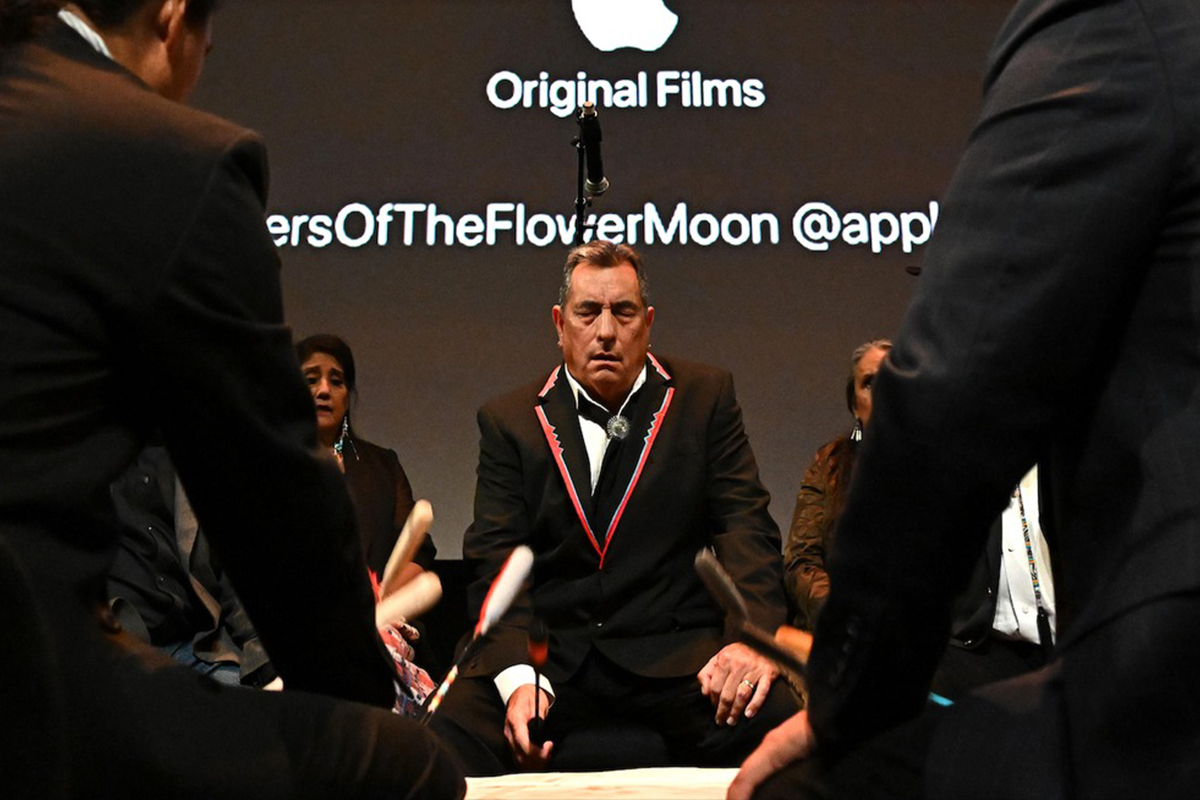
Performed in the closing credits by the Osage Tribal Singers, “Wahzhazhe (A Song For My People)” from the Martin Scorsese film “Killers of the Flower Moon” is the first Indigenous nominee in the best original song category for the Academy Awards, which will take place March 10 at the Dolby Theatre at Ovation Hollywood in Los Angeles and be televised live on ABC.
The song was written by Osage Nation citizen Scott George of Del City, Oklahoma, along with Vann Bighorse,who is the Cabinet Secretary of the Osage Nation Language/Cultural/Education Department, to evoke the Osage Inlonshka dances. In English, Inlonshka means “playground of the eldest son.” The dance celebrates traditional masculine values of passing along the drum keeper role while helping to break down factionalism and feuding within the tribe.
George’s best original song nod is among the 10 nominations “Killers of the Flower Moon” received for this year’s Academy Awards, including a nomination for best actress for “Killers” actress Lily Gladstone. The lyrics were written and performed in the Osage language. They encourage the tribal people to rise up, be strong and have faith through life’s ordeals.
How does it feel to be an Oscar nominee?
“Unbelievable and a little overwhelming at times,” George told ICT. “There are hints that we might be performing, but I’m not sure if that’s coming from (film producer) Apple or from the Academy yet.”
George said he was approached by director Scorsese to add a new song to the film.
“We had talked about trying that when they first found out that they wanted to do this last thing with them. We had talked about our music and reviewed it. We have several traditional songs that probably could have delivered the same impact, but they had people’s names in them that were two or three hundred years old, and there are still people today that refer back to those as their relatives, so they weren’t appropriate for that purpose.
“We finally came to the conclusion that we’re going to have to compose our own. Myself and my brother, lifelong friend, Vann Bighorse, we started about the process. In doing so, traditionally, if you’re going to compose a song, we used to go to a prayer in order to get it started and ask for help, then our belief is that even the music that we sing over and over is just a gift from God and it didn’t really come from us.”
George and Bighorse began to figure out what they wanted to say and the words to use.
“We found that once you put the words that you want in there and start singing a little bit, they find their own way into the song. That’s probably why they say it’s God’s way, is that our song, our words have a natural rhythm to it, and they just happen to fit into that rhythm or that type of music. “
Martin Scorsese said in an interview for Apple Films: “By the end of the film, we had to have some sense of the presence of the Osage. They survived, and the music of the Osage is the best display of this extraordinary survival. I felt that we should end the film with a special piece of music created by the Osage.
“When I was there, we attended a number of the dances, and I was really impressed by the music and the dances and how they all moved. So I thought, what if there’s something modern? What if the drumming and the song itself, the singing is a modern Osage? And it is something that is going to continue to exist because it survives now. Scott George was the head singer for Gray Horse. And he wrote this song specifically for the film, really to express his feelings about being an Osage and everyone that will never leave this place. This is something that means a great deal to the Osage nation.“
George explains more of the songwriting process. “Once we start playing with it a little bit, then we bounce it back and forth on each other and say, ‘Well, listen to this, what this sounds like.’ It might sound something like you heard years ago, and so you have to research that to make sure that you’re not using something from somebody else’s song or something that was way back there that you forgot that you knew after 40 years.
“When this process started, I’d be like, ‘Hey, where’d that come from?’ And I’d listen, I’d sing it to myself and it might take me a while to get it right. Then if I got it right, I thought oh, okay, that’s from when I was about 18, somebody sang that, and that was kind of popular back then. So it took a little while, before we finally came up with something, and then my brother, Vann Bighorse, we’re all consultants on this project, he composed a song also. We were both working at the same time trying to do this. I don’t know if it’s miraculous, but we both finished our song at about the same time.
“He said, ‘I think I’ve got one brother.’ I said, ‘Well, sing that to me. Yeah. I think you’ve got one. I haven’t heard that before.’”
Were the writers given directions as to the length of the song they needed for the film?
“Not really,” George said. “I think there’s probably not an understanding outside of us singers what the parts are to the song and actually how long they last, or what it takes to get to what they wanted to hear. They wanted that energy that they saw in our dances. Martin and I think Leonardo and Lily (Gladstone) all attended our ceremonial dances, so they saw that energy that we were involved in, but it’s not one that you could just sing one song and get there. You build up to it over a course of four or five songs, and then you throw one in there that you know that captures that energy.”
Ponca songs and Lakota songs have a certain feel and a rhythm. What makes Osage singing different?
George said it’s “probably not much different than Ponca songs except for just changes in our language. We share the same language. We’re all the same linguistic group. But there are certain words that we use that are a little different than what our Ponca relatives use. So that’s really the only difference there.
“We liken that to what’s sung at powwows because they’re trying to create something for the dancers to have their contests with. I’m probably telling my age, but there was a time down here we didn’t have Northern music and Northern contests. So in Oklahoma when I first got started our people started adopting those styles of dancing, and when they did, then we had to create music to fit that.
“I would say that that becomes more contemporary than what we’re trying to do. It’s to use something that’s already given to us and that we’re just going to create more to like for this song in particular, when this is all over with, we want to use this song as an honor song in case somebody’s called to be a headman or head lady. They can use the song if they don’t have a family song to use.”
As far as the lyrics, George said in the two parts of the song, there’s the lead part and then there’s what they refer to as honor beats in the middle, then there comes the tail of the song where the words are.
“We’re asking my people to stand up. When you translate it literally, it’s that simple. That’s all it says. And when you ask me what I meant by it, I meant that everything that our people have gone through, especially what’s depicted in the movie, but even today, we still go through issues and situations politically and some horrific situations that are still out there about the missing Indian women and things of that nature. So we’re still going through those things. I’m saying that I want my people to stand up, be proud because God got you this far.”
Longtime Scorsese collaborator Robbie Robertson, Mohawk, was in charge of the overall soundtrack and is Oscar-nominated as well. Robertson died after he completed work on the film on August 9, 2023, at age 80.
George said “my understanding is after we recorded both of those songs and sent them to Marty that him and Robbie both listened to them and they chose which one they wanted. We didn’t get to work with him at all. I believe he wasn’t feeling well at the time.
“Martin and Robbie picked the song then we said, Okay, we know how to do this thing. We know what we’re doing. Tell us what you want, what speed you want, we’ll see if we can make it happen. They had all the dancers out there with us to record. When you’re singing by yourself in a recording studio, it’s difficult to capture that, but once you get dancers around you, then the energy picks up and you can feel it a lot better. “
George is looking forward to the Oscar ceremony and said he will most likely bring his wife.
“We’re hoping we get to perform it live. That would be amazing if we were to be able to do that, and all the singers, whether it’s only five of us, we’re all excited that might get to happen for us. We’re so appreciative of having gotten this far, it’s not something we aspire to, we just want to contribute to the movie and show our people that we care, we love our people and that’s where we were coming from.”

Our stories are worth telling. Our stories are worth sharing. Our stories are worth your support. Contribute $5 or $10 today to help ICT carry out its critical mission. Sign up for ICT’s free newsletter.
