
Alleen Brown
Grist
In March 2025, a jury ordered the environmental giant Greenpeace to pay $666 million to the companies behind the Dakota Access pipeline.
The companies argued that Greenpeace was responsible for protests near the Standing Rock Sioux Reservation nearly a decade ago that drew thousands.
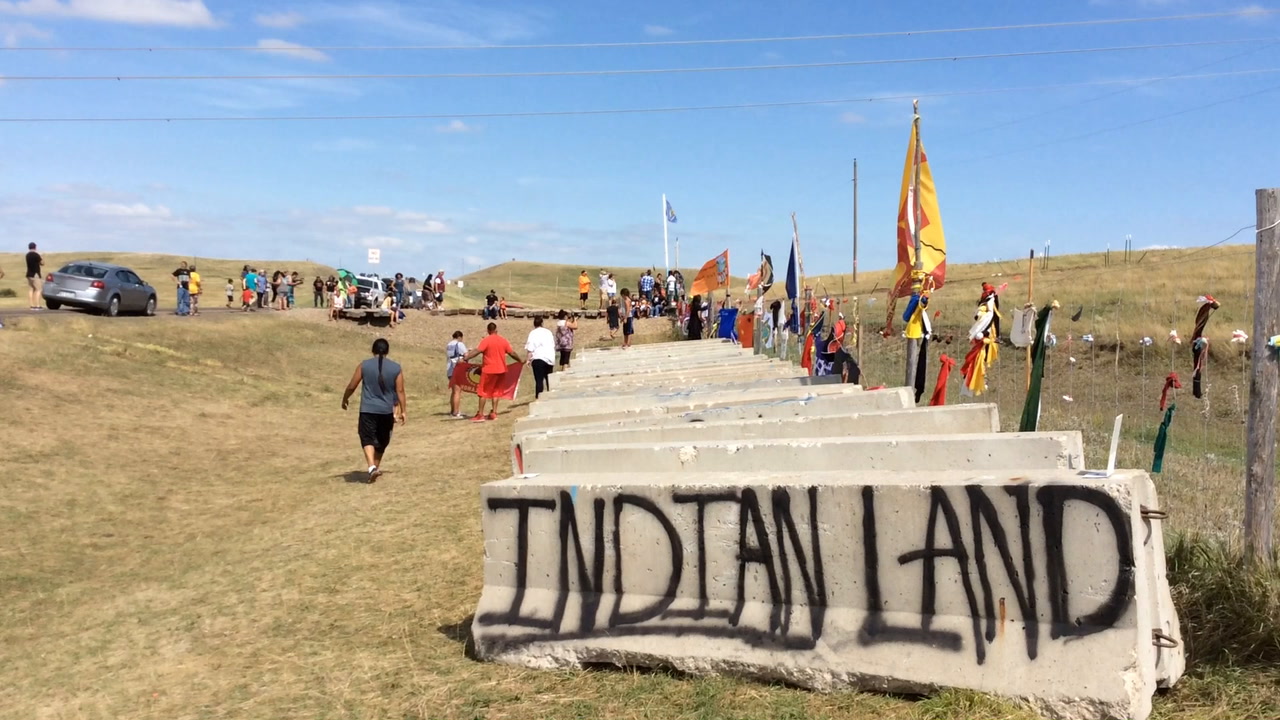
But Indigenous leaders, water protectors, activists, and court records agree: Greenpeace played a bit part in the Standing Rock movement, at best.
“They’re trying to point the finger at Greenpeace,” said Honorata Defender, a Standing Rock Sioux tribal member who helped start the movement.
“Because God forbid some Indians think for themselves and make a decision to stand up for themselves and their water and their land.”
CHAPTER 7
This story is a partnership between Grist and Drilled, a global multimedia reporting project focused on climate accountability.
“Do you have any personal knowledge about anything Greenpeace did at all in relation to the protests?” a lawyer asked.
“No,” said Kelcy Warren, Energy Transfer’s board chair and largest shareholder — who was CEO when the Dakota Access pipeline was constructed.
Warren took the stand on March 13, via a pre-recorded video deposition. It was the final day of testimony.
While the board chair had no recollections about Greenpeace, he did have memories about the Standing Rock Sioux Tribe. In 2016, Warren approached Chairman Dave Archambault to make a deal. “I went there with the intention of working out a financial transaction,” Warren said. Long before Greenpeace went to court, before the conspiracy lawsuits began, and before Trump’s executive order greenlighting the pipeline, Energy Transfer tried to pay off the tribe.
At the height of the protests, Warren and Archambault sat down to talk. “I said, ‘David, I’m here to make a deal with you. Let’s go. Do you want cash? What do you want?’” Warren first offered Archambault the ranch the company bought, the one that held the sacred sites identified by Mentz. “We could build you a whole new school on your reservation. Let’s make a deal,’” Warren urged.
“And he says, ‘I can’t do it,’” Warren recalled. “He made it very clear he could not accept any offer from me that involved them backing down.”
“It was clear to me that he had struck a deal with the devil,” Warren said.
“And the devil being Earthjustice?” the lawyer replied.
“Yes,” said Warren.
Earthjustice is a nonprofit public interest law organization that represented the Standing Rock Sioux Tribe in the early part of its court fight against the Army Corps of Engineers. It is not connected to Greenpeace: It is not an affiliate, a subsidiary, or even funded by the organization.
“They’re scumbags,” Warren said, of Earthjustice.
“I read between the lines, and I believe that they made a deal, and Archambault couldn’t make a deal with me,” he continued.
In a statement, Archambault explained the meeting. “I was there to discuss safety — not to negotiate an end to the protests.” When Warren asked what it would take to stop the movement, Archambault said, “I explained that it was no longer in my control. The fight against the pipeline had become much bigger than Standing Rock; it was about Indigenous rights and the long history of injustice faced by our people.”
In court, the lawyer asked, “Nothing was said about Greenpeace during that meeting, was it?”
“Not that I recall,” Warren replied.
In Warren’s understanding, the Standing Rock Sioux were the entity to negotiate with when it came to ending the protests and pushing the pipeline through — not Greenpeace. According to his testimony, the tribe’s refusal to take a deal revealed that Standing Rock had sold out to its law firm, Earthjustice — not Greenpeace Inc., Greenpeace Fund, or Greenpeace International.
On the next day of court, during closing statements, Cox revealed the true extent of what Energy Transfer was demanding from the Greenpeace organizations. The lawyers said that $266 million would compensate Energy Transfer for their expenses — but they wanted triple that, in order to set an example.
Two days later, the jury returned its verdict. Greenpeace Inc. was liable for all of the on-the-ground damage claims. Greenpeace Inc. and Greenpeace International were guilty of conspiracy, and all three Greenpeace organizations committed tortious interference, as well as defamation when they made their assertions on police violence, tribal territory, and desecration of sacred sites.
The total damages amounted to over $666 million.
Outside the courtroom, Cox, the Energy Transfer lawyer, posed with a huddle of attorneys from Gibson Dunn. He wore an American flag pin on the lapel of his suit, while his colleagues wore sunglasses. “Greenpeace paid protesters and trained individuals to unlawfully disrupt the construction of the Dakota Access pipeline,” he said. “These are the facts, not the fake news of the Greenpeace propaganda machine.”
He added, “Peaceful protest is an inherent American right; however, violent and destructive protest is unlawful and unacceptable. This verdict clearly conveys that.”
The Greenpeace employees and water protectors looked on, stunned.
Energy Transfer and Gibson Dunn did not provide responses to detailed questions related to the case. Instead, they provided a statement saying that the verdict was a win for North Dakotans who faced disruption and harassment during the protests.
“That the disrupters have been held responsible is a win for all of us,” the spokesperson wrote. “It is also a win for all law-abiding Americans who understand the difference between the right to free speech and breaking the law.”
Greenpeace is preparing to appeal once the court issues a final judgment.
“ What this really is an attempt to do is to destroy the idea of solidarity,” said Deepa Padmanabha, the senior legal advisor for Greenpeace in the U.S., in an interview with Grist and Drilled. “By working together, by uplifting voices, by showing support, by showing up, by communications, you somehow could face hundreds of millions of dollars of lawsuit. Because this idea of a movement, of people working together in solidarity, is actually more powerful than the dollar.”
Asked if the organization regretted not taking the settlement, Padmanabha said, “There was no choice.”
“Is our existence our ultimate mission? Just the existence of an entity?” she asked. “Or is there something in our mission that’s bigger than that?”
The Center for Media and Democracy supported document review for this article.
