
Pauly Denetclaw
ICT
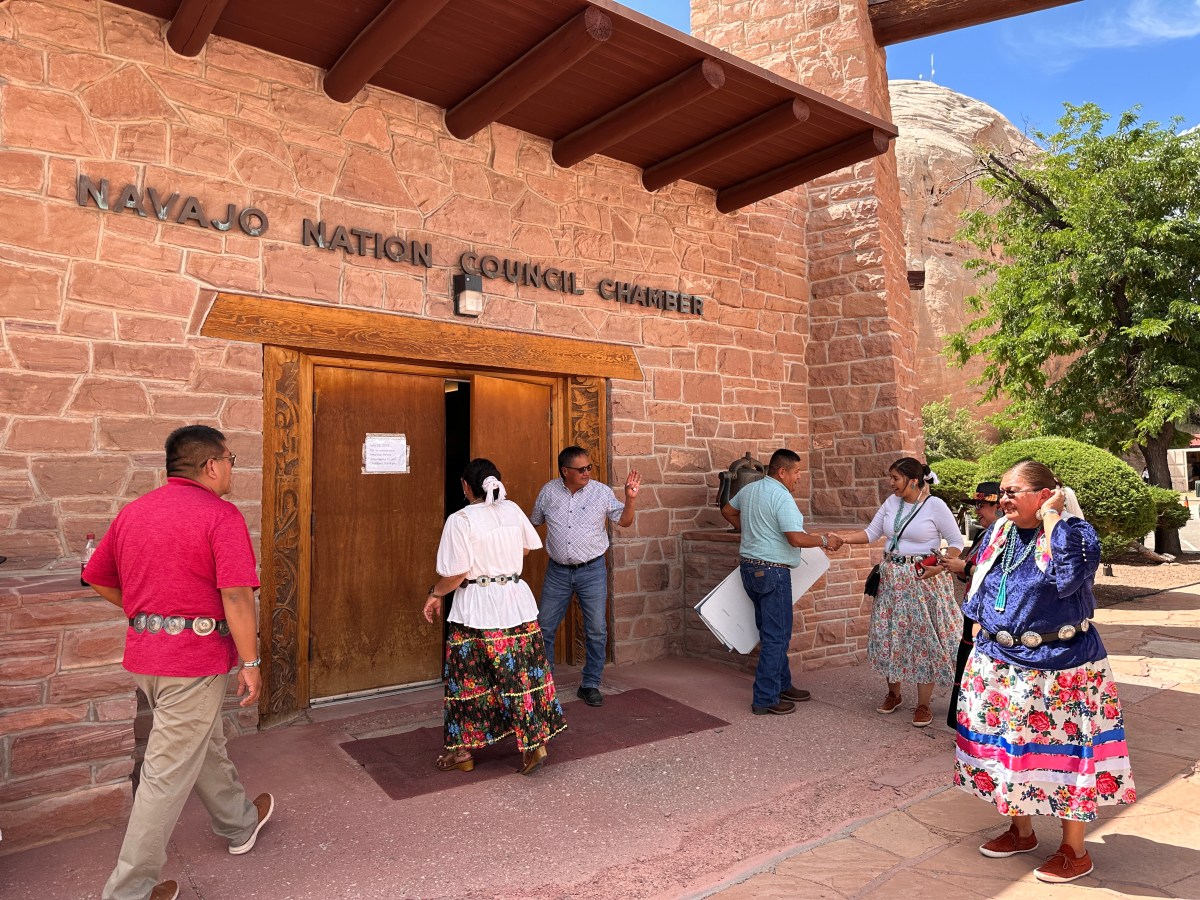
It’s the centennial of the Navajo Nation Council and the 24 delegates have convened for another summer to vote on 28 legislative bills, ranging from virtual meeting attendance for delegates to infrastructure update.
“There are things that are very traditional today, or very historical,” said Lloyd Lee, professor of Native American studies at the University of New Mexico. “They’re also very modern and Western. So in that sense you have to step back and say, ‘Okay, from an analytical standpoint, is that what we want? Is that sort of the future of how Navajo governing is supposed to be?’”
The Navajo Nation government has evolved steadily, but radically, over the last 100 years. The government, which is now a three branch system of checks and balances, looks nothing like it did when Chee Dodge and U.S. military officials first created a central Navajo government.
Despite its colonial roots, the government retains many Navajo traditions. Delegates conduct business in Diné Bizaad, the Navajo language, refer to each other by clan relationship and created the Naabik’íyáti’ Committee, or talking it out committee. The tribal council meets four times a year, another tradition marking the four seasons, to discuss the tribe’s resources and economic development.
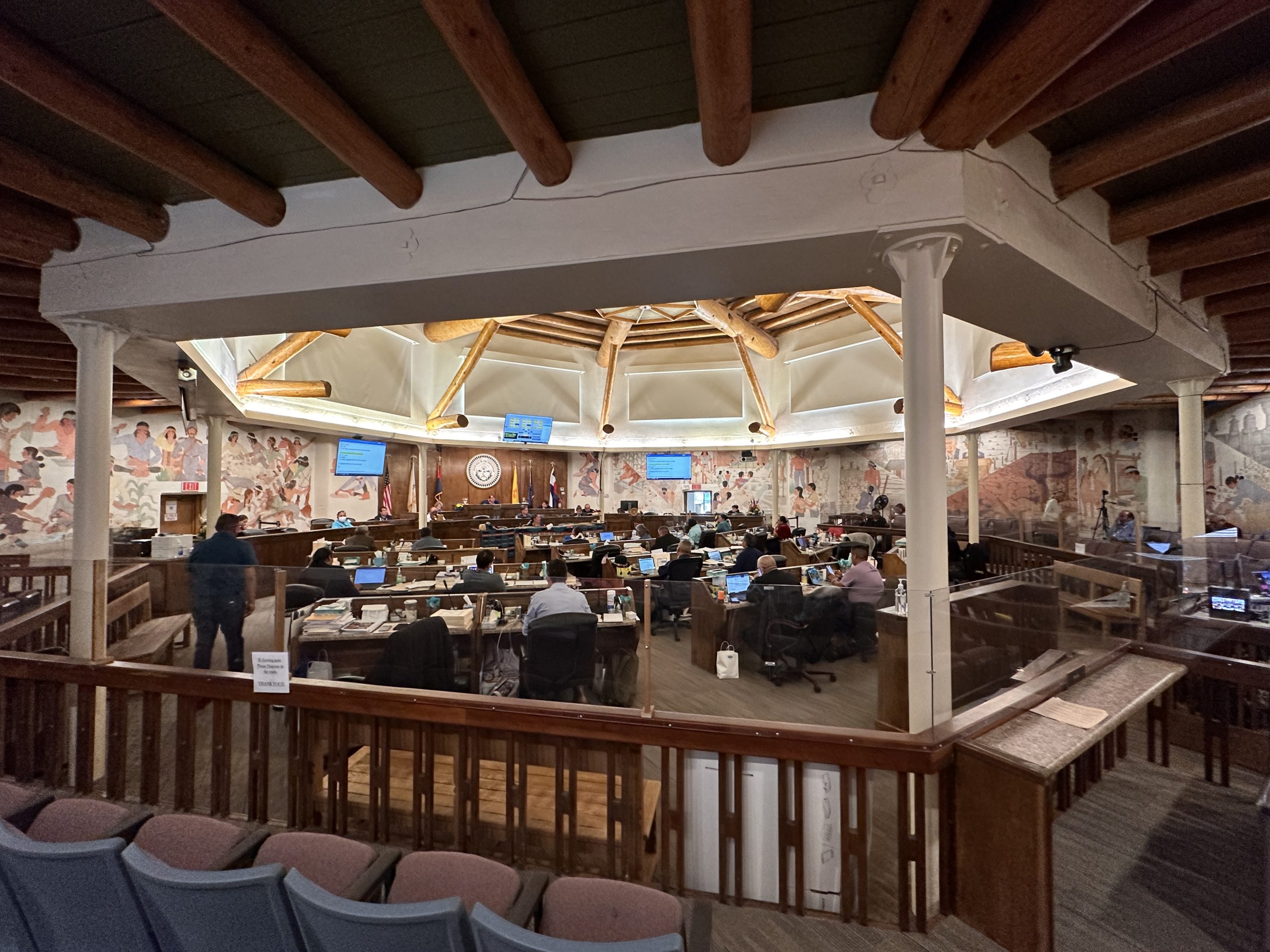
One of the legislations centered around the purchase of Goulding Monument Valley Lodge and Tours located in Monument Valley, Utah at a whopping price tag of nearly $60 million for 670 acres of land.
The discussion over the proposal would be contentious and veer into nearly all aspects of tribal politics.
Council delegate Brenda Jesus asked about issues written in the property documents.
“There has been a mention of 12 recognized environmental conditions,” Jesus said on the floor of the chambers. “What are the severity of those environmental conditions that were stipulated in this particular legislation?”
A day later, freshman delegate Cherilyn Yazzie questioned why the nation was even thinking about purchasing the Monument Valley land at all because it was stolen in the first place.
“The most absurd use of our resources is buying back our own land and ignoring the truth or history of what we all know to be true,” Cherilyn Yazzie said. “That land that Goulding sits on is Indigenous land.”
She later pointed out that one of the attractions on the land is a cabin once owned by Hollywood actor John Wayne, who was known to make deeply racist comments about Indigenous people.
After eight hours, spanning across two days, the legislation to buy the Monument Valley property ultimately failed by one vote, much to the disappointment of Navajo Nation President Buu Van Nygren who publicly supported the purchase.
These types of bills and agonizing discussions over property purchases are, these days, common on the floor of the Navajo Nation Council Chambers. It is often controversial. In particular now, with the voices of voters and community members amplified via social media. People ask why the nation is purchasing various properties.
Meanwhile, people are more concerned with local roads that are unpaved, utility infrastructure that needs to be expanded and scarce housing.
Navajo leaders say this is part of the balancing act of the government.
“If there’s going to be a responsible Navajo Nation government, there needs to be a responsible Navajo Nation government that can make sure that we sustain ourselves and help our Navajo people through the basic infrastructures on the nation, but also have that economic prosperity as well,” Seth Damon, former speaker of the Navajo Nation Council, told ICT.
On the other side, the nation needs to diversify its revenue streams, moving away from extractive industry that is the legacy of Navajo wealth and the roots of why a Navajo Nation Council even exists.
100 years of government
In July of 1923, government appointed Navajo chief, Chee Dodge, along with his colleagues, handpicked a group of Navajo men, despite the tribe’s history as a matrilineal society, to create the Navajo Business Council for the sole purpose of approving leases for extractive energy projects.
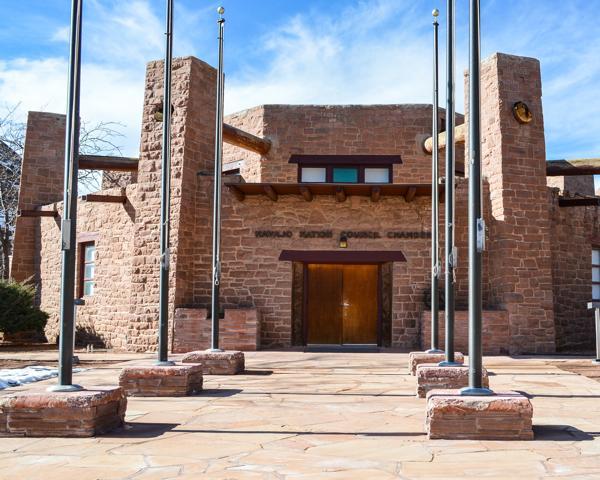
“Understanding that the very inception of Window Rock, the very inception of all of the arms that we now think of as the Navajo Nation government, they were always intended to be a corporate entity,” said Melanie Yazzie, assistant professor in American Indian studies at the University of Minnesota and an expert in Navajo history.
The business council morphed into the Navajo Tribal Council in 1934 after the passage of the Indian Reorganization Act and with it came a more formal western government structure. The roots of this continue 100 years later into the present with a question of if it will carry on into the future.
“Today, we still carry that burden in forms of leases and other aspects of trying to enhance and trying to benefit the Navajo people in general,” Otto Tso, a three-term council delegate, said.
The story of the Navajo Nation Council and government must be rooted in context.
Before the Long Walk, Hwéeldi and the Treaty of 1868, governing and leadership was highly localized to extended family and clanship. A leader of a family might look like a head matriarch, said Lee.
“In those small communities and those extended family networks, there were individuals within that dynamic that would be recognized as being important voices that you needed to have conversation with to make decisions,” Lee said. “In certain families, it was to the head matriarch. The issues or challenges that they were dealing with were related to making sure that the family was safe, that there was enough nourishment and food. Who would go on hunting excursions. What type of ceremonies need to be conducted.”
In those small communities or families, the roles that are known to exist were the head person, a peace leader and a war leader. A peace leader would be the person who acted as a neutral third party to address an issue and negotiate a compromise. A war leader not only strategized around war but would be the person to plan hunting parties.
“I don’t want to romanticize it and say everything was perfect 200, 300 years ago,” Lee said. “They were criticized as well. If it got to the point where someone in that dynamic was not being responsible, and not doing what they were supposed to be doing, they eventually had to come together and decide, you’re just not ready to hold that responsibility. They would decide from that point, we’ll choose someone else.”
A mainstay of Navajo governing has been accountability then removal, if issues with leaders persisted. There was always the structure of voting, but instead of ballots, folks would physically stand behind the person they wanted to hold a leadership position.
The hyper-local governing style of Navajo was disrupted and eventually replaced due to colonization by the United States.
The 1900s came just a few decades after the scorched-earth policy where the U.S. Army burned crops, hogans and massacred Navajo people. Then came the capture, torture and imprisonment of Navajo people at Hwéeldi, or Fort Sumner, New Mexico, by the United States government.
Navajo leaders brokered a deal with the U.S. and under duress signed the Treaty of 1868 to return to the Four Sacred Mountains. When the Navajo people returned life would never be the same. The Navajo reservation was just 5,200 square miles and movement was severely restricted.
“In 1923, things were bad. The conditions for our people in this diminished capacity after our return from Hwéeldi, poverty rates were really high, hunger rates were high. We weren’t thriving as a people because of the conditions,” Melanie Yazzie said. “The constant encroachment of settlers on our land base and our life had just been totally upended, it had been turned upside down, essentially, after we returned from Hwéeldi.”
Being fluent in both Diné Bizaad and English, Chee Dodge was selected by high ranking military officials as head chief of the Navajo people.
“Chee Dodge was a collaborator with the U.S. government and they relied on him very heavily during this period before the 1923 Business Council to introduce this idea to our people and then to select in collaboration with white U.S. government officials, the initial business council and it certainly wasn’t a democratic process,” Melanie Yazzie, Diné, said. “It wasn’t like Diné people were like, these are the people we want making these very important decisions on our behalf.”
While he was not necessarily a scout, he worked closely with the U.S. military. It’s also important to note that because of his proximity to military officials, he amassed a huge amount of personal wealth. Meanwhile the majority of people he represented were dealing with extreme poverty.
“He had huge cattle herds in the thousands and there’s descriptions of this,” Melanie Yazzie said. “He was known for always having brand new cars, he really loved having shiny things. He really liked them. For Diné people, your wealth is usually in your things right? It’s usually in your jewelry, your kids are thought of, your family is thought of as wealth. So I think he very much had that attitude. But he lived in a big house somewhere around the Chuska Mountains where his clan and his family were from.”
The first meeting was held in Window Rock, Arizona, an arbitrary location that was selected with no real reasoning according to Yazzie’s research.
Growing pains
The Indian Reorganization Act of 1934 was passed by Congress and the appointed Navajo leaders encouraged the Navajo people to vote in favor of new reforms and constitution that were encouraged by John Collier, a U.S. Commissioner for Indian Affairs. The Navajo people voted down the reform and rallied for the creation of a more democratic process. There was deep mistrust of the Navajo government. (Some would say this continues today.)
From 1934 to 1938, the Navajo government went back to voting for leaders but through voting ballots, the hyper localized leadership became centralized and a constitution was written, though later rejected by the Bureau of Indian Affairs.
“It’s become a system where it’s tried to be reformed or amended,” Lee said. “They do this every so often. They did that in the 40s. They did it in the 50s. They did it again in the 80s. And then, of course, Title II was passed in 1989 to where our governing system is now. You have three branches, executive, legislative, and judicial branches.”
The tribe did experience growing pains. For instance, the 1989 government overhaul was the direct result of former tribal chairman Peter MacDonald gaining tremendous political power resulting in his conviction in a number of financial scams. His refusal to step down as chairman, despite the tribal council voting to suspend him in 1989, led to a riot that resulted in the deaths of two people.
A little over a decade ago, in 2011, the council was reduced from 88 to 24 after rampant and systemic misuse of discretionary funds.
Today, the 24 delegates are stretched thin, some representing up to nine different chapter houses, which act as local municipalities. There are five committees that meet regularly and an unknown number of subcommittees. On top of that some delegates sit on task forces, boards and commissions.
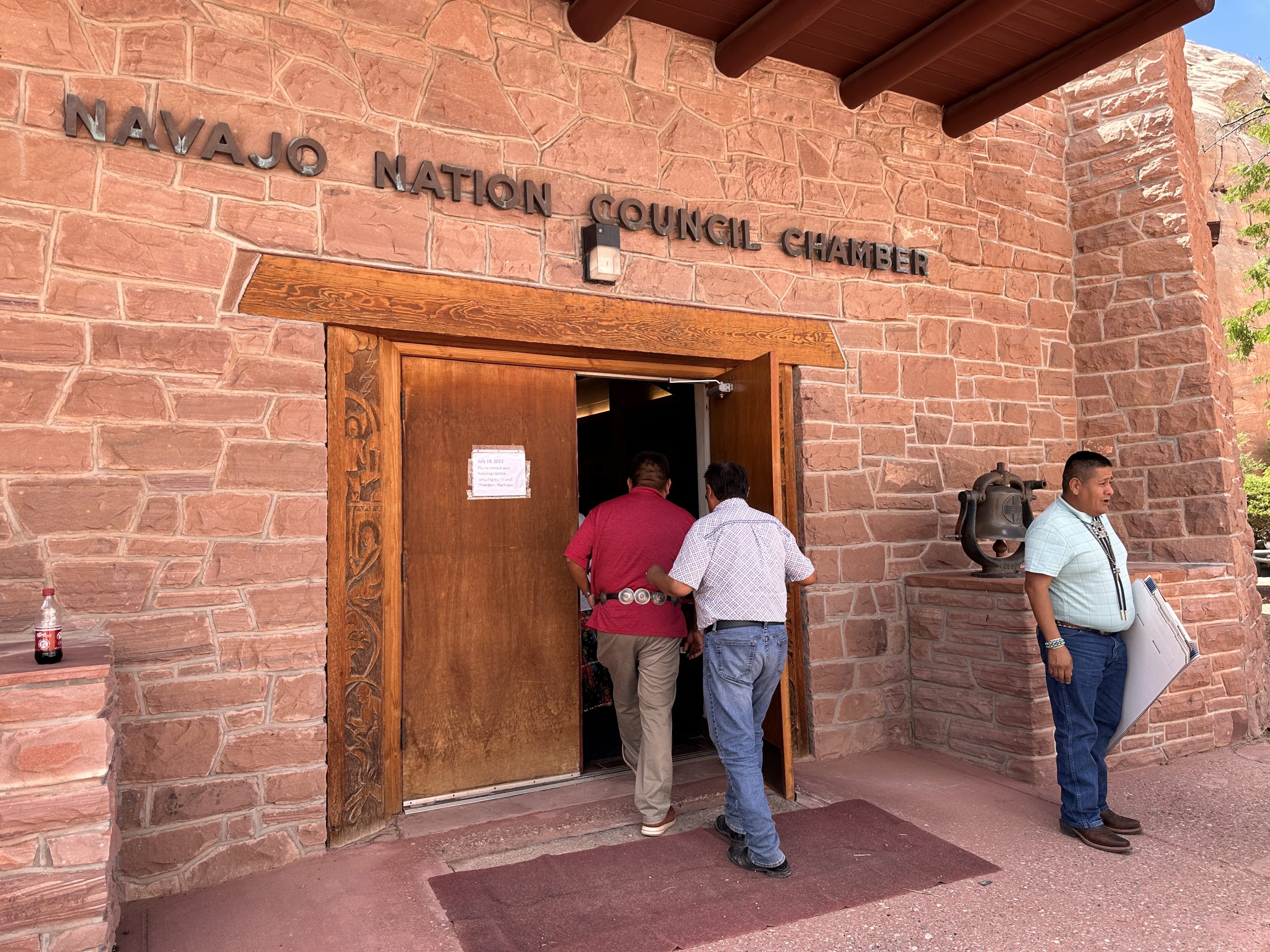
They’re called to Washington, D.C., or the capitals of Arizona, New Mexico, Utah and Colorado to testify before state and federal officials. This doesn’t account for the monthly chapter house meetings their communities convene. At times, crossing hundreds of miles for meetings. All this on a salary of just $25,000,according to both Delegate Otto Tso and Deputy Chief of Staff for Speaker Jared Touchin.
“It’s very honorable, it’s very humble to be the delegate at this time but I don’t wish it upon anybody with what the job carries, what are your duties and your responsibilities,” Tso, Tuba City council delegate, said. “At times, we had to make these hard decisions where you have support, and you have non-support, and you have all these different views coming in. But when you make these decisions, the bottom line is, what is in the best interest of the Navajo people.”
Every four years, the Navajo people elect a whole new government, from president to their council delegate. These elections impact all three branches of government. It is a very hectic time when new leaders come in, especially a new president.
There are criticisms from people online, by community organizers and researchers that the Navajo Nation government is inefficient and needs dramatic improvement.
“We have a very good solid foundation, internally, but maybe that story isn’t being told,” Damon said. “There’s improvements that are needed in every government, no matter what kind of government you are, whether it be the Navajo Nation government, state government, county government, federal government, there’s always changes to every single government. That’s a reason why leadership needs to take that responsibility and that’s why priorities are set to say, ‘Okay, we can’t fix everything. There’s no way we can fix everything.’ But what we can do is we can say, ‘Okay, these are our top issues.’”
The question remains, how can the Navajo Nation government continue to improve and grow over the next 100 years? What direction does it need to go in? How can it build trust and transparency?
“The Navajo people do not make major decisions about the destiny and the future of who we are as a nation,” Melanie Yazzie said.
When she was younger the solution was to get rid of the whole government and rebuild it from the ground up in a better way. Today that view has changed.
“It would be very destructive and destabilizing, which concerns me. I don’t want to destroy or destabilize our people any more than we already are,” Yazzie said.
A transition into a new style of governing could be to fully implement Navajo Fundamental Law into the legislative and executive branches, giving the Navajo people more referendums to choose the direction of their nation, and to foster more transparency in all areas of governing. Fundamental Law, a written code, that is steeped deep in Navajo tradition, is already commonly used by the tribe’s judicial branch, in particular the Navajo Supreme Court, which tends to defer to Fundamental Law in its decisions.
“I’m quite pessimistic and very critical of Navajo leaders just because I understand the history so well,” Yazzie said with a laugh. “But I would say, with the exception of maybe a few people, every Diné person I know whether or not they’ve been a president or a chairman, or grassroots leader, a council delegate, genuinely wants the best for our people. I think genuinely, there is this value that we all share, that, yes, we want a vibrant future for our people and how do we get there? And what do we implement in order to get there?”

ICT is a nonprofit news organization. Will you support our work? All of our content is free. There are no subscriptions or costs. And we have hired more Native journalists in the past year than any news organization ─ and with your help we will continue to grow and create career paths for our people. Support ICT for as little as $10. Sign up for ICT’s free newsletter.

