
Greetings, relatives.
A lot of news out there. Thanks for stopping by ICT’s digital platform.
Each day we do our best to gather the latest news for you. Remember to scroll to the bottom to see what’s popping out to us on social media and what we’re reading.
Also, if you like our daily digest, sign up for The Weekly, our newsletter emailed to you on Thursdays. If you like what we do and want us to keep going, support and donate here.
Okay, here’s what you need to know today:
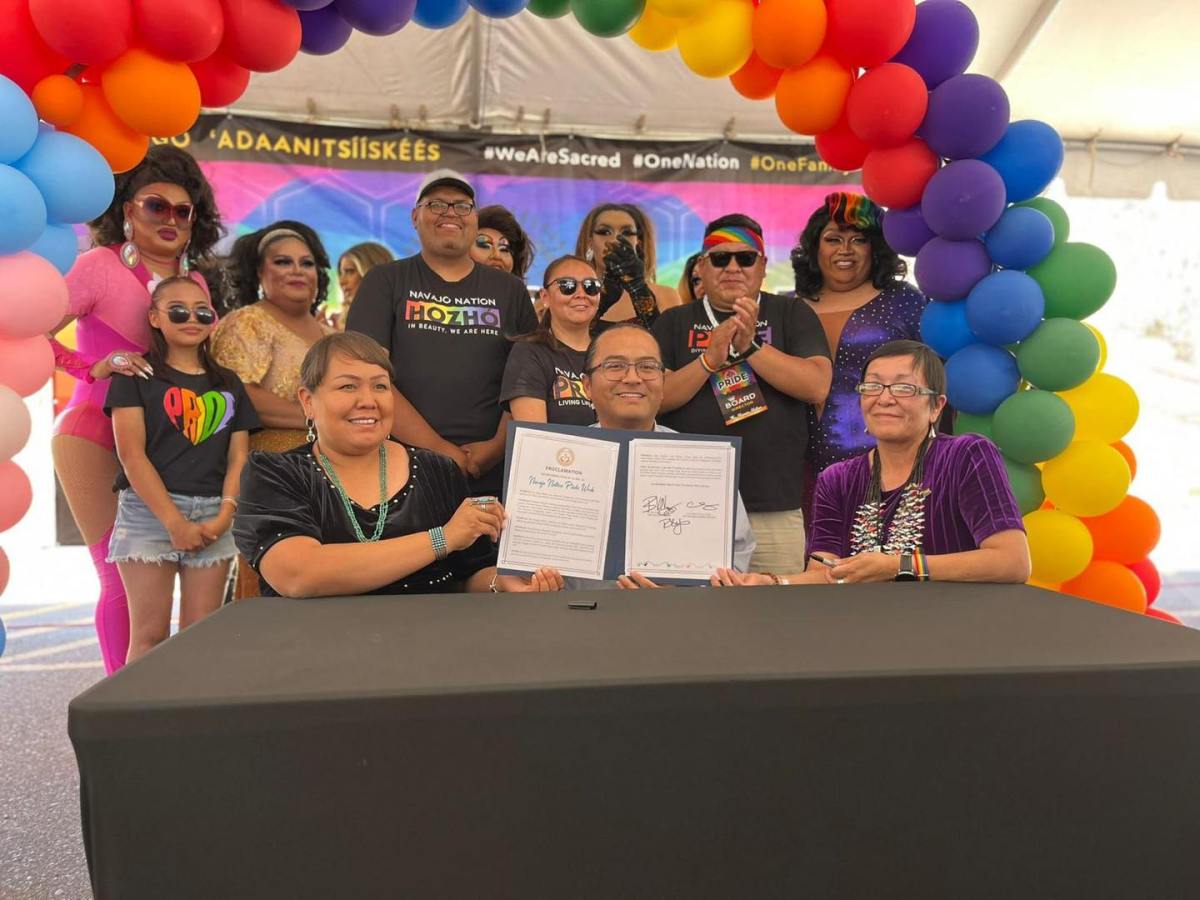
The fight to have same-sex marriage recognized by the Navajo Nation continues during Pride Month.
Navajo Nation Council Delegate Seth Damon signed and sponsored legislation that would recognize same-sex marriages within the Navajo Nation during the Navajo Nation Pride opening ceremony on June 23.
“The prohibition against same-sex marriages does not uniformly welcome or support the well-being of all Diné,” Damon said. “The purpose of the legislation I’m sponsoring is to ensure that all Diné are welcome within the four sacred mountains and to recognize all marriages within the Navajo Nation.”
The legislation also amends other provisions within the Navajo Nation Code to conform with this repeal, but the traditional Navajo wedding ceremony involving a man and woman shall remain unchanged. READ MORE — Kalle Benallie, ICT
SUPPORT INDIGENOUS JOURNALISM. CONTRIBUTE TODAY
The Haudenosaunee Nationals are among the final eight teams vying for the 2023 World Lacrosse Men’s Championship.
After going 2-2 in pool play, the third-seeded Nationals won their first round playoff matchup Tuesday against Hong Kong, 13-3.
The game was dedicated to missing and murdered Indigenous women across the United States and Canada. The team wore red shirts before the game.
“We are proud to wear REDress Project shooting shirts, highlighting the issue of Missing and Murdered Indigenous women and girls across North America, as a visual reminder of the staggering number of women who are no longer with us,” a tweet from the team’s twitter page said. READ MORE — Kolby KickingWoman, ICT
Around the world: Traditional Owners demand input in Australia, a genetic variant found in Māori and Pacific people could help cholesterol levels, a palm oil company in Ecuador faces allegations of illegal operations, a study finds that extractive industries hit Indigenous people disproportionately, and U.S. lawmakers propose priority refugee status for Uyghurs.
AUSTRALIA: Native owners demand input on air base
Traditional Owners of the lands for the proposed expansion of the Royal Australian Air Force in Western Australia say they have not been consulted about the project, National Indigenous Times reported on June 20.
Rosita Shaw, director and cultural advisor at the Walalakoo Aboriginal Corporation, said the Native title holders have been seeking to give input on the planned expansion of the RAAF Base Curtin.
The Walalakoo Aboriginal Corporation, led by the Nyikina Mangala Native title holders, serves as the Registered Native Title Body Corporate. READ MORE — Deusdedit Ruhangariyo, Special to ICT
Since time immemorial, the Snoqualmie Falls has been a sacred site for the Snoqualmie Indian Tribe. The base of the tribe’s creation story, each droplet of mist that flies into the air is said to carry prayers up to the ancestors in the heaven’s above.
“In a way, it’s our beginning, it’s our middle, and it’s our end. It is the center of the spirit of the Snoqualmie people,” said Steven Moses, director of archaeology and historic preservation for the tribe, in a video calling to save the falls.
A place of great importance to the tribe, the picturesque falls are also a popular destination for Washington state visitors, drawing over one and a half million visitors annually. The falls are a short drive east of Seattle.
To support projects and expenses associated with the ongoing work to protect ancestral lands, the Snoqualmie Tribe implemented a new two percent land protection tax on March 1, collected on sales made at the Salish Lodge & Spa. The tax is believed to be the first of its kind in North America, according to the tribe. READ MORE — Nika Bartoo-Smith, Underscore News + ICT
Sign up here to get ICT’s newsletter
The American Indian Alaska Native Tourism Association was established for tribes to address inequities in the tourism system. The association provides assistance, training, research, and publications to communities engaged in tourism and hospitality. CEO Sherry L. Rupert leads several initiatives, including the organization’s groundbreaking new Tribal Agri-tourism program and Native arts initiative.
Leslie Harper is determined to help tribal communities create their own futures. Raised by parents who instilled the values of sovereignty and self-determination, she believes that priorities and decisions must be determined from within a community, not from an outside entity. As a recipient of a Bush Fellowship, she will work to revitalize the Ojibwe language.
The U.S. Supreme Court said the United States is not required “to take affirmative steps to secure water for the Tribe.” That protection is not explicitly stated in the Navajo Treaty of 1868, according to its ruling in a 5-4 vote in Arizona v. Navajo Nation. ICT regular contributor Holly Cook Macarro weighs in. She’s the founding principal and president of The Angle, and a board member of IndiJ Public Media, the parent company that owns ICT and the ICT Newscast.
The Confederated Tribes of Siletz Indians and the Confederated Tribes of the Coos, Lower Umpqua and Siuslaw Indians can now issue permits for tribal citizens to hunt, fish, trap and gather under tribal licenses with this new co-management plan in Oregon. Two other tribes, the Cow Creek Band of Umpqua Tribe of Indians and the Coquille Indian Tribe previously entered into deals with the state.
WATCH HERE:
RENO, Nev. — Lawyers for environmentalists and tribes urged a U.S. appeals court on Tuesday to overturn a judge’s decision to allow construction to begin on a huge lithium mine in Nevada.
A lawyer for four conservation groups seeking to halt the project said a U.S. district judge in Reno illegally exceeded her authority when she refused to revoke the mine’s operation plan in March despite her conclusion that federal land managers had violated the law in approving parts of it.
“This is the first time in public land history that we have a major project violating a number of provisions but is allowed to go forward,” Roger Flynn, an environmental lawyer told a three-judge panel of the 9th Circuit Court of Appeals.
“In the meantime, thousands of acres of public land are essentially being clear-cut,” he said Tuesday about the high-desert sagebrush that serves as critical habitat for the imperiled bird species sage grouse. READ MORE — Associated Press
- Canada’s UNDRIP plan draws mixed reactions from Indigenous leaders: Proposal draws sharp criticism from some chiefs as ‘repealing the Indian Act’
- Maine House advances proposal to let federal laws apply to tribes: The bill stops short of full sovereignty sought by the tribes
- Alaska salmon task force to develop science plan: The team, 19 experts appointed by state and federal leaders, will develop a plan to better understand salmon following recent population crashes
- Gail Schubert is no longer CEO and President of BSNC
- America’s Biggest Museums Fail to Return Native American Human Remains
- Dozens in 16 states charged with health care fraud schemes, including $1.9B in bogus claims
We want your tips, but we also want your feedback. What should we be covering that we’re not? What are we getting wrong? Please let us know. dalton@ictnews.org.

Our stories are worth telling. Our stories are worth sharing. Our stories are worth your support. Contribute $5 or $10 today to help ICT carry out its critical mission. Sign up for ICT’s free newsletter.

