
ICT is working to shape the future of journalism and stay connected with readers like you. A crucial part of that effort is understanding our audience. Share your perspective in a brief survey for a chance to win prizes
Greetings, relatives.
A lot of news out there. Thanks for stopping by ICT’s digital platform.
Each day we do our best to gather the latest news for you. Remember to scroll to the bottom to see what’s popping out to us on social media and what we’re reading.
Also, if you like our daily digest, sign up for The Weekly, our newsletter emailed to you on Thursdays. If you like what we do and want us to keep going, support and donate here.
Okay, here’s what you need to know today:
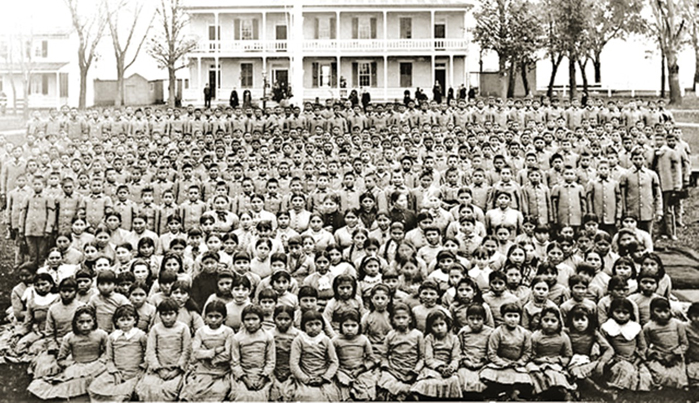
George Little Wound was gravely ill when he was sent home to Pine Ridge from the Carlisle Indian Industrial School in 1889, just three years after arriving at the notorious boarding school.
Little Wound, the son of Chief Little Wound, was among a group of three Pine Ridge students shipped home together with what the school physician described as “incipient consumption” and “scrofula,” a disfiguring infection of the skin and lymph nodes caused by the same bacteria as tuberculosis, according to Carlisle records.
All three appeared to survive their illness for some time after they returned to Pine Ridge, though Little Wound was never the same. Forever weakened by the disease, he struggled to support himself and expressed disgust with his school experience.
“I went to [Carlisle] school to get a good education … but I was greatly mistaken when I went to school,” he wrote in 1911, in a tersely worded survey he sent to Carlisle more than 20 years after returning home. READ MORE— Mary Annette Pember, ICT
SUPPORT INDIGENOUS JOURNALISM. CONTRIBUTE TODAY
Navarre Scott Momaday, Kiowa, a writer, poet, educator and master storyteller, has died. His Pulitzer Prize winning debut novel “House Made of Dawn” is credited with the start of a renaissance in contemporary Native American literature. He was 89. Momaday died Wednesday at his home in Santa Fe, New Mexico, publisher HarperCollins announced. He had been in failing health.
On Facebook, friends and organizations shared condolences and remembrances lamenting the loss of a “beloved member of our community and an inspiration to all,” and, “a giant of Native American literature.”
Vice chairman of the Kiowa Tribe of Oklahoma Joseph Tsotigh said, “The Cáuigú and the world have lost one of the most eloquent voices of our generation! It’s with deep sadness that I acknowledge the passing of a magnificent, talented and irrepressible author, poet, and raconteur Dr. N. Scott Momaday. The world will never know another like him. Hegau ém âuibòñ:[dàu”.
Iñupiaq author and poet Joan Kane, a visiting associate professor at Reed College, recalls encountering Momaday’s writing during her first year as a student at Harvard College. “How late and accidentally to come to the work of one of the most influential of American writers! Without Momaday’s many contributions to academia as well as literature, it’s hard to imagine the increasing representation of exemplary Indigenous scholarship and creative works we’ve seen especially in the last decade.” READ MORE — Joaqlin Estus, ICT
ST. FRANCIS, S.D. – When talk turns to preparing more children on the Rosebud Indian Reservation to pursue positive opportunities, Stacee Valandra just nods her head.
The 41-year-old Lakota educator grew up on the reservation in Todd County, one of the poorest sections of America, where more than 60 percent of residents under age 18 live below poverty level.
Valandra was a good athlete who attended public school in Mission and went to college in Nebraska to play volleyball. But she struggled in the new environment and moved back home.
“I didn’t make it – I’m one of those statistics,” said Valandra, now principal at Sapa Un Jesuit Academy in St. Francis. “Most of my teachers were white, and at times I felt stupid, to be honest. I had a lot of reflecting to do when I came back. I found my passion trying to show kids that there are possibilities out there, but you need to be prepared.” READ MORE — South Dakota News Watch
At least two Indigenous players are set to take the field in America’s biggest game at Allegiant Stadium in Las Vegas, Nevada, as the Kansas City NFL team will take on the San Francisco 49ers in Super Bowl LVIII Feb. 11.
Both play on the Kansas City offensive line and are back to defend last year’s Super Bowl championships in center Creed Humphrey, Citizen Potawatomi Nation, and long snapper James Winchester, Choctaw Nation of Oklahoma. Kansas City is a team on a dynastic run appearing in its fourth championship game in five seasons.
Kansas City took home the title in 2023 and is looking to be the first team since the 2003-04 New England Patriots to win back-to-back titles.
Speaking to ICT before last year’s game in Arizona, Winchester said it’s exciting to play in the game and it means a great deal to him to represent his nation. READ MORE — Kolby KickingWoman, ICT
Sign up here to get ICT’s newsletter
Yurok Tribal citizens are engaged in a major habitat restoration project. ICT‘s Stewart Huntington has more on efforts to restore vegetation in the Klamath River Valley—as the world’s largest dam removal project picks up steam.
Two filmmakers have worked tirelessly to shine a light on a decades-long struggle to revive Tar Creek in Miami, Oklahoma. ICT’s Daniel Herrera has this interview.
It’s not every day a foundation solicits a grant proposal, but that’s exactly what happened to the Center for Great Plains Studies. The Mellon Foundation made a three-year, $1.5 million grant to reconnect the Otoe-Missouria Tribe to its ancestral Nebraska home. ICT‘s Shirley Sneve has more.
Dreaming our Futures is an exhibit featuring Ojibwe and Dakota artists. It’s in Minneapolis until mid-March. Shirley Sneve visits with professor and curator Brenda Child, Red Lake Ojibwe.
WATCH
We are only a month into 2024 and Indigenous newsmakers remain busy. Let’s take a moment to catch up on the news that made headlines in January.
Boarding school policies covered up hidden deaths from tuberculosis and other diseases far beyond those students buried in school cemeteries. Mary Annette Pember has more.
After her historic Golden Globes win earlier this month, Lily Gladstone became the first Native American to be nominated for an Oscar for best actress. Read more from Felix Clary.
From organizing marches, to using social media to spread information, to paddling in traditional Nisqually canoes to block docked military ships, Indigenous organizers from across Turtle Island have been actively speaking up and speaking out against what they all agree is a genocide currently taking place in Gaza. Nika Bartoo-Smith has more details here. READ MORE — ICT
- New program seeks to boost Native student success in languages: Fort Peck Tribes collaborate with Montana Digital Academy to help reduce barriers for students, to offer free Dakota and Nakoda courses open to adults separately
- IndigiPolitics: ‘We have a front runner in the Republican party’: ICT’s political correspondent Pauly Denetclaw introduces our newest regular contributor Michael Stopp
- Oklahoma governor, Chickasaw Nation finalize new tobacco, car tag compacts: New state-tribal agreements will be in effect through 2034
- Prisoners are part of a hidden workforce linked popular food brands
- What is Tower 22, the military base where 3 US troops were killed?
- US job openings rose in December, pointing to a still-durable labor market
We want your tips, but we also want your feedback. What should we be covering that we’re not? What are we getting wrong? Please let us know. dalton@ictnews.org.

Our stories are worth telling. Our stories are worth sharing. Our stories are worth your support. Contribute $5 or $10 today to help ICT carry out its critical mission. Sign up for ICT’s free newsletter

