ICT is working to shape the future of journalism and stay connected with readers like you. A crucial part of that effort is understanding our audience. Share your perspective in a brief survey for a chance to win prizes
Greetings, relatives.
A lot of news out there. Thanks for stopping by ICT’s digital platform.
Each day we do our best to gather the latest news for you. Remember to scroll to the bottom to see what’s popping out to us on social media and what we’re reading.
Also, if you like our daily digest, sign up for The Weekly, our newsletter emailed to you on Thursdays. If you like what we do and want us to keep going, support and donate here.
Okay, here’s what you need to know today:
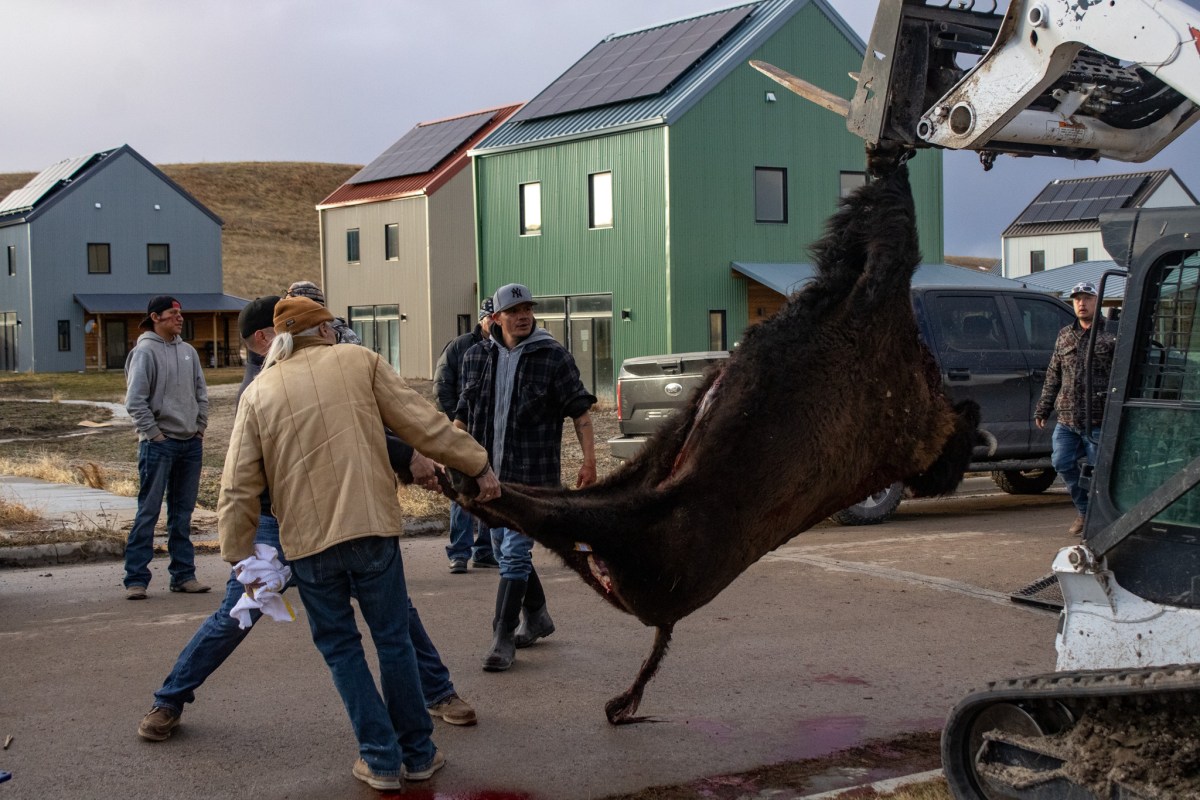
ALLEN, S.D. – The thundering echo of hooves rang through the Oglala Sioux Tribes’ northern pasture near Allen, South Dakota. From inside a caravan of pickup trucks, hunters watched over the pasture looking for the right buffalo. It needed to be a bull, not too old and not too young. This was part of the traditional Pte Oyate Wanasa Pi (Buffalo Hunt).
Traditionally, the entire camp would be prepared for a buffalo hunt through rigorous training methods. Young boys would be prepared for their first kill. Now, these traditions carry on with modern elements.
Instead of chasing buffalo on horses, hunters follow the herds in trucks. Instead of hunting enough buffalo to feed the camp all winter long, only one is killed.
“This was and is a ceremony to teach young men and women about honoring and respecting the spirit of the buffalo,” said Warren Yellow Hair, Oglala Lakota and the Thunder Valley CDC Men’s Lifeways Coordinator. “Since the beginning of time, we’ve had a very close relationship with the buffalo nation, the Pte Oyate. We don’t just kill them, we honor the spirit and utilize every part of the buffalo.”
Starting Jan. 11, a sweat lodge ceremony was held to prepare hunters for the coming day. Early Jan. 12, hunters and community members set out on the Pte Oyate Wanasa Pi. For six hours, community members roamed the pasture searching for the right buffalo.
“This is about going out and providing for the people,” said Marlon Kelly, Oglala Lakota/Diné and the Thunder Valley Lifeways and Wellness Equity Director. “This is to show and teach the youth.”
This hunt was an initiative by Thunder Valley CDC’s Lifeways and Wellness Equity Department. The department seeks to recreate and re-identify traditional Lakota methods of spirituality and healing. READ MORE. — Amelia Shafer, ICT
How the ancestral ground of Montana’s Indigenous peoples came to generate millions for in-state campuses
To the motorists locked in midafternoon traffic on Missoula’s Reserve Street corridor, the vacant lot at the southwest corner of South Seventh looks like any other undeveloped tract of urban property. Tangles of cottonwood, birch and quaking aspen loom above the roughly two-acre swath of brown grass, bisected by an irrigation ditch and flanked by residential homes. A red-and-white sign perches near the curb, carrying the logo of Montana’s Department of Natural Resources and Conservation, which is dwarfed by large type advertising “Property for Lease.”
Passing commuters could easily miss the logo’s clue to a deeper story suffusing that soil. The tract, like all of Missoula, lies within the aboriginal territory of the Salish, Kootenai and Pend d’Oreille peoples, who for generations lived in and around the Missoula Valley. Today, unlike most of Missoula, it’s managed by the DNRC with the express purpose of generating revenue for Montana State University.
How did a tiny slice of Indigenous land get pressed into service for the benefit of Missoula’s longtime collegiate rival? The answer lies at the start of Montana’s rise to statehood, and in a complex network of millions of acres commonly known as “state trust lands.”
“State trust lands” is a phrase familiar to many Montanans in the context of K-12 education. Roughly 90 percent of state trust lands are dedicated to supporting Montana’s public K-12 schools, generating millions of dollars each year from grazing leases, timber harvests, recreation fees and natural resource development. The undeveloped parcel in Missoula speaks to the other 10 percent, which, through a succession of treaty agreements and acts of Congress more than a century ago, came to benefit the state’s higher education system.
Similar tracts throughout the American West function in this same manner, a facet of the state trust lands tale that was recently the focus of a Pulitzer Center-supported reporting project by the nonprofit news outlet Grist. According to data obtained by Grist and shared with Montana Free Press, the Bozeman Daily Chronicle and ICT, acreage purchased or seized by the federal government from dozens of Indigenous tribes now generates billions of dollars annually for 14 universities including the University of Minnesota, Texas A&M and Washington State University.
“Universities continue to benefit from colonization,” Sharon Stein, an assistant professor of higher education at the University of British Columbia and a climate researcher, told Grist. “It’s not just a historical fact; the actual income of the institution is subsidized by this ongoing dispossession.” READ MORE. — Montana Free Press
SUPPORT INDIGENOUS JOURNALISM. CONTRIBUTE TODAY.
The leader of the Forest County Potawatomi tribe on Thursday called on Wisconsin lawmakers and other state leaders to search for bipartisan solutions to problems including human trafficking and affordable housing.
James Crawford, chair of the Potawatomi, delivered the annual State of the Tribes address in the Assembly chamber. In addition to Assembly members, other attendees included leaders from the state’s 11 other federally recognized tribes, state senators, Wisconsin Supreme Court justices, Attorney General Josh Kaul and Secretary of State Sarah Godlewski.
“Despite our differences, Wisconsin’s tribes and our states leaders can and must continue to collaborate and work together for the greater good,” Crawford said.
He thanked lawmakers for working to increase Medicaid reimbursements for tribes, ensure access to indigenous foods, and pass bills designed to increase affordable housing and make foster care more attractive and affordable.
He specifically called on the Legislature to do more to address the problem of human trafficking in tribal communities, while thanking Kaul for forming a task force on the issue. — Associated Press
Lakota artist named SURF Artist in Residence
Marty Two Bulls Jr. comes from a family of artists. Growing up his first art instructor was his father, cartoonist Marty Two Bulls Sr. Now, the Oglala Lakota artist has been named the 2024 Sanford Underground Research Facility (SURF) Artist in Residence (AiR).
Two Bulls will spend the summer researching and exploring the SURF facility in Lead, South Dakota and will draw inspiration from it to create a public art display in fall 2024.
The SURF AiR program began in 2019 to create work inspired by America’s Underground Science Laboratory. The residency is modeled after various programs offered by the government, science and industry including the National Park Service, CERN and Fermilab.
Two Bulls said he draws from multiple disciplines in his own work, including painting, ceramic, printmaking, and sculptural techniques that yield unique assemblages of mixed media art. His curiosity about the SURF drew him to apply to the program.
Two Bulls was also drawn to the project to acknowledge the impacts of mining in his Lakota homelands. Two Bulls is a full-time faculty member at Oglala Lakota College where he teaches and runs a graphic arts program he founded at the college.
Gina Gibson, AiR program coordinator at SURF and a professor of digital communication at Black Hills State University, is looking forward to seeing what Two Bulls will create during this residency.
“Conversation with Marty Two Bulls Jr. reveals genuine curiosity and thoughtfulness. I am very excited to see the artwork and relationships that will be built during this year’s AiR program,” Gibson said in a press release. — Amelia Schafer, ICT + Rapid City Journal
Sign up here to get ICT’s newsletter
Before the colonization of what is now the United States, the Clatsop lived on the south shore of the Columbia River. At the river’s mouth, where the Columbia rushes into the Pacific Ocean, were the Lower Chinook on the north shore and the Willapa Chinook on the bay north of the river. The Lower Chinook and Clatsop had close familial and kinship ties to the Wahkiakum and the Cathlamet, who lived just a canoe ride to the east.
Today, the Chinook Indian Nation encompasses all five nations that have lived along the Lower Columbia River since time immemorial. But they have never received compensation for the land taken during colonization of what is now Washington state. In a press conference on Thursday, Chinook announced that its land claim settlement, originally awarded by the Indian Claims Commission over half a century ago and known as Docket 234, will no longer be withheld. Now, a payment will be distributed to the nation in exchange for some of the richest and most productive land in the West.
Chinook leadership believes this decision further affirms their title to their aboriginal territory which supports their ongoing fight for federal recognition. It also strengthens their efforts to take ownership of the Naselle Youth Camp, a juvenile detention facility that closed in Sept. 2022. The facility is within the boundaries defined by the land claim settlement, according to Tony Johnson, chairman of the Chinook Indian Nation.
“This docket 234 decision is not the formal federal recognition that we’re seeking but it is unambiguous recognition of our communities existence and of our rightful title to the lands where we continue to live,” Johnson said. READ MORE. — Luna Reyna, ICT
- Indigenous highlights at Sundance Film Festival: Buffalo’s Fire participated in this year’s press line for Indigenous filmmakers, including the premiere of Sugarcane, a documentary about a residential boarding school and unmarked graves
- The 50th anniversary of the Boldt Decision is a celebration of Native leadership: A landmark lawsuit reaffirmed treaty fishing rights after decades of intertribal activism, inspired by the civil rights movement. Fifty years later, we look back at how far we’ve come and the remnants of the Fish Wars that remain
- Nonbinary student’s death after attack elicits outcry: Nex Benedict, a nonbinary student of Choctaw descent, died in Owasso, Okla., Feb. 8 after being attacked by alleged bullies in a school bathroom the day before. Some say the school didn’t do enough to help
- Tillamook dialysis closure has patients fearing the worst: Sudden closure of rural Oregon facility by Texas firm leaves patients lacking options for crucial life-saving care
- Through film, Kayah George explores the nuanced responsibility of being səlilwətaɬ: After being on the frontlines from a young age, the young matriarch has started creating art as a ‘creative and cultural outlet’
- Amid salmon crisis, federal agencies propose adding Alaska Native representation to subsistence board
We want your tips, but we also want your feedback. What should we be covering that we’re not? What are we getting wrong? Please let us know. dalton@ictnews.org.