Greetings, relatives.
A lot of news out there. Thanks for stopping by ICT’s digital platform.
Each day we do our best to gather the latest news for you. Remember to scroll to the bottom to see what’s popping out to us on social media and what we’re reading.
Also, if you like our daily digest, sign up for The Weekly, our newsletter emailed to you on Thursdays. If you like what we do and want us to keep going, support and donate here.
Okay, here’s what you need to know today:
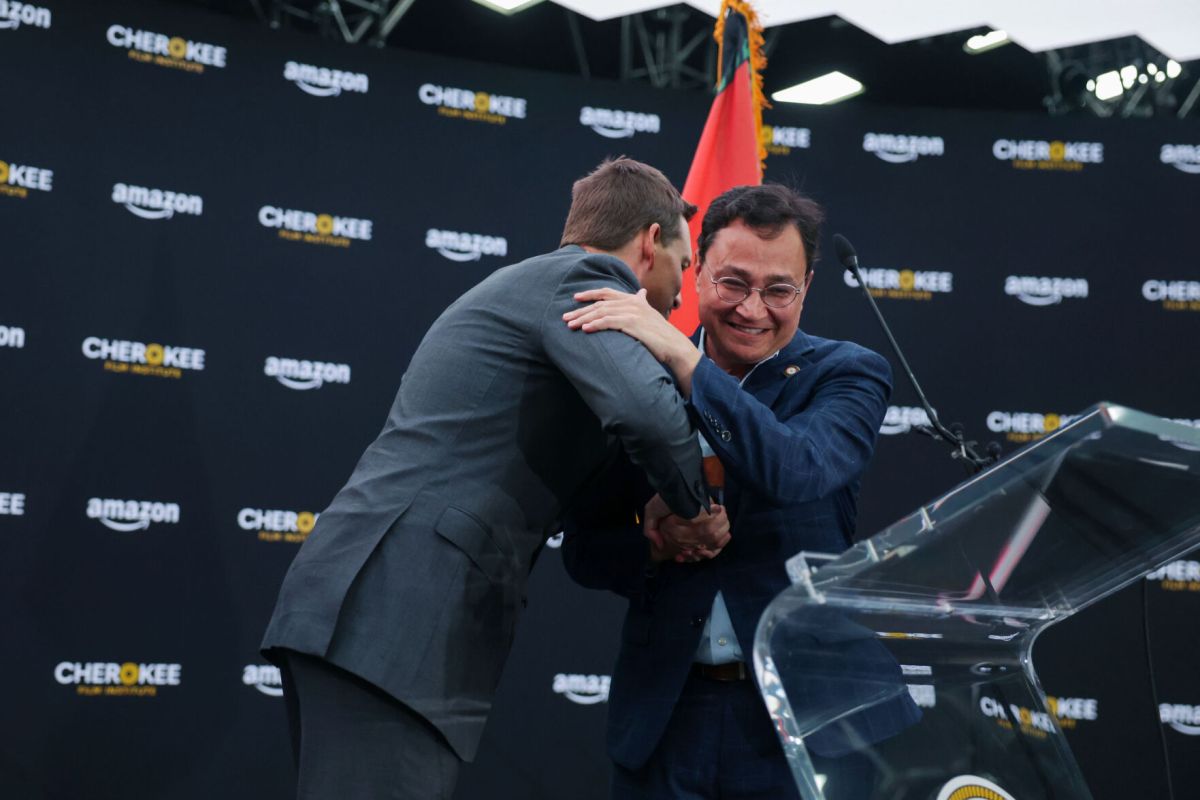
OWASSO, Okla. — In an effort to bolster Native representation in the film industry, Amazon is partnering with the Cherokee Nation to fund the tribe’s new film institute.
The Cherokee Film Institute is the first tribally operated education and workforce development center that aims to make it easier for Cherokee and Native people to enter the entertainment industry.
Amazon Vice President of Public Policy and Community Engagement Brian Huseman visited the Cherokee Film Studio in Owasso on Tuesday to celebrate the partnership.
I’m honored to announce a partnership with the Cherokee Film Institute that will allow the inaugural class of 25 Cherokee and Native American students to attend the institute — tuition free — starting in January 2025,” Huseman said.
Amazon’s partnership with the institute is meant to encourage more TV shows and movies to be filmed on the Cherokee reservation.
“Amazon has made a choice to help elevate the voices that for too long have been marginalized in this country. Voices that for too long have been often a caricature in the entertainment industry,” Cherokee Nation Chief Chuck Hoskin Jr. said. READ MORE —- Felix Clary, ICT and Tulsa World
SUPPORT INDIGENOUS JOURNALISM. CONTRIBUTE TODAY.
With only two weeks until the election, voting advocates, candidates, parties and community organizers are making last-ditch efforts to rally people to vote across Arizona.
Some will go canvassing in neighborhoods, set up phone chains, or organize rallies to inspire people to vote and educate them about what’s on the ballot.
But for those whose goal is turning out Indigenous voters living in Arizona’s urban centers, finding those voters is a challenge, in large part because there are no identifiable neighborhoods that only Indigenous people populate.
“Most other groups in cities have neighborhoods that they live in, and urban natives tend to literally be all over the city,” said Janeen Comenote, the executive director of the National Urban Indian Family Coalition, an organization that advocates for Indigenous families living in urban areas through partnerships with local Indigenous organizations.
Comenote said that it was because of the Indian Relation Act of 1956, when the federal government designed a program to relocate Indigenous people living on their tribal lands to major urban cities to acquire jobs and assimilate into the general population. READ MORE — AZ Mirror
Sign up here to get ICT’s newsletter
RAPID CITY, S.D. – The FBI gave citizens a rare glimpse into the work that’s gone into Operation Not Forgotten on Tuesday afternoon, detailing the two-year project’s successes in combating crime on reservations.
Twenty-two different tribal nations received a surge in FBI personnel for two four-month periods, one in 2023 and one in 2024. These surges allowed the FBI to work on numerous unsolved cases of Missing and Murdered Indigenous People as part of Operation Not Forgotten.
The operation sought to expand and build on relationships with tribal nations and law enforcement partners, move cases to the criminal justice system and provide care to victims.
From June to September of 2024, the FBI dispersed 51 personnel who opened 2,000 new investigations in 22 communities in Indian Country, officials said. These investigations include kidnappings, deaths, child sexual abuse, domestic violence and adult sexual abuse cases. READ MORE — Amelia Schafer, ICT and Rapid City Journal
More than 150 years after the first Native children were forced to attend Indian boarding schools that robbed them of their families, culture and language, President Joe Biden will issue a long-awaited apology for the dark history that has left generational damage among Indigenous peoples.
Biden is set to present the apology and a plan for helping tribal communities heal from the enduring traumas on Friday, Oct. 25, at the Gila River Indian Community in Arizona, marking his first visit to tribal lands as president.
It’s an apology that Native people have been seeking for decades.
“This apology is an acknowledgement that the President of the United States sees and hears them,” said U.S. Interior Secretary Deb Haaland, Laguna Pueblo, whose family members attended Indian boarding schools.
“This is an acknowledgement of a horrific history,” Haaland told ICT in an interview. “This happened in our country.” READ MORE — Mary Annette Pember, ICT
- Man arrested after fire killed former tribal corrections officer: An Oct. 19 fire on South Dakota’s Pine Ridge Reservation claimed the life of one woman, a former Oglala Sioux Tribe corrections officer
- Quapaw Nation restoring their reservation that scientist says feds destroyed: Since 2013, the tribe has removed around 8 million tons of chat, lead and zinc, from the ground
- Tim Walz heads to Navajo Nation: A planned visit by the Democratic vice presidential nominee continues the Harris-Walz campaign’s outreach to Native voters
- Wisconsin, Michigan Native voters could decide election: With key races decided by razor thin majorities, Native peoples in swing states like Wisconsin and Michigan are anything but on the margins. They instead hold the power to dictate outcomes of some of the most important campaigns in the country.
- Montgomery County reinstates Indigenous history book after public backlash
- Lumbee Tribe seeks action from presidential candidates on federal recognition
- ASU collections offer Indigenous perspective through traditional storytelling, innovative methodology

We want your tips, but we also want your feedback. What should we be covering that we’re not? What are we getting wrong? Please let us know. dalton@ictnews.org.