
Greetings, relatives.
A lot of news out there. Thanks for stopping by ICT’s digital platform.
Each day we do our best to gather the latest news for you. Remember to scroll to the bottom to see what’s popping out to us on social media and what we’re reading.
Also, if you like our daily digest, sign up for The Weekly, our newsletter emailed to you on Thursdays. If you like what we do and want us to keep going, support and donate here.
Okay, here’s what you need to know today:
ANCHORAGE, Alaska — Delegates to the Alaska Federation of Natives convention voted to oppose a measure Saturday that would do away with the state’s open primaries and ranked choice voting. AFN delegates represent nine Alaska Native regional and 154 village for-profit corporations, 174 federally recognized tribes, and nine regional non-profit entities.
Ranked choice voting allows voters to rank candidates in order of preference. If no candidate wins at least 50 percent plus one of the total votes, there’s a runoff based on those preferences.
The AFN resolution said the process provides more opportunities for Alaska Natives to run for public office and get elected, as well as more freedom and more choice. The current system also “allows for more influence and greater participation among Alaskans, decentralizing power and empowering voters.”
The delegates also adopted a resolution endorsing U.S. Rep. Mary Peltola, who is Yup’ik, as Alaska’s sole representative to Congress. She’s the first Alaska Native member of Congress. She’s in a tight race to hold on to her position in Alaska, which typically votes Republican. READ MORE — Joaqlin Estus, ICT
SUPPORT INDIGENOUS JOURNALISM. CONTRIBUTE TODAY
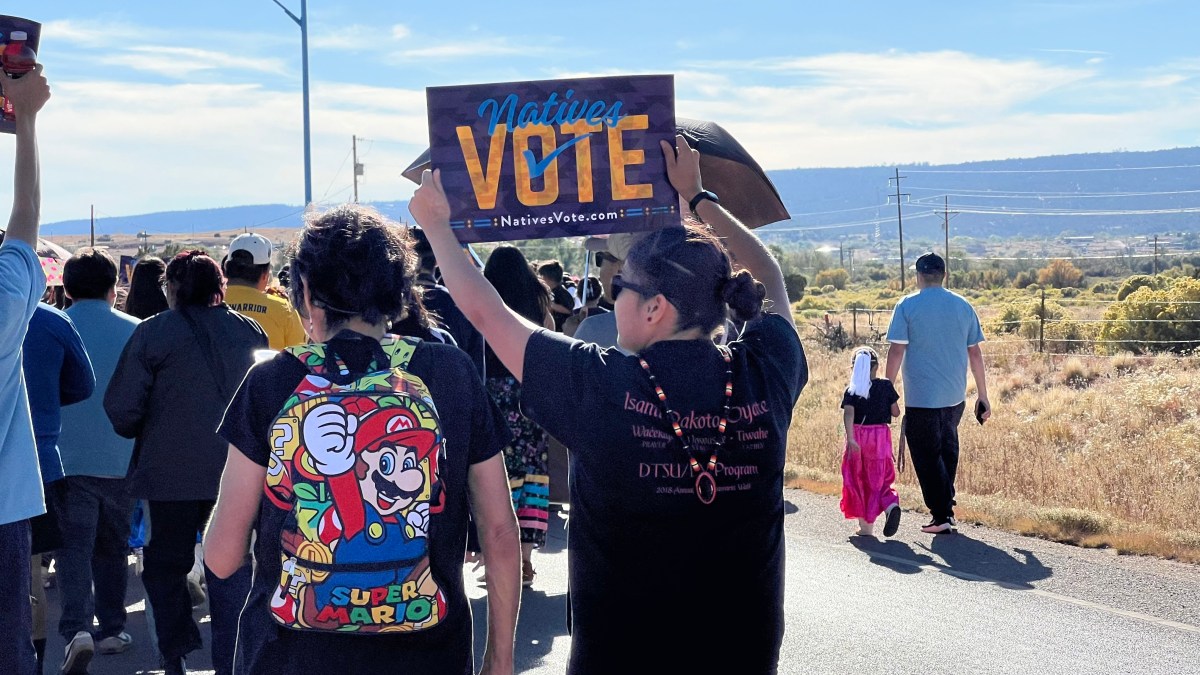
WASHINGTON — Voters nationwide have already started to cast their ballots for the 2024 general election. Two key swing states in the Nov. 5 election are Wisconsin and Michigan. Both have large Native populations that could decide the outcome of several key races.
In Michigan, there are nearly 242,000 Native peoples, according to the 2020 Census data for American Indians and Alaska Natives alone and in combination. The state has 12 federally recognized tribes. Wisconsin is home to 11 tribes, and about 147,000 Natives, according to 2020 Census data.
Early in-person voting in Wisconsin begins Tuesday, Oct. 22., and statewide in Michigan on Saturday, Oct. 26. Municipalities in both states offer even earlier voting, such as Detroit, where polling locations opened for early voting on Saturday, Oct. 19. Voters in both states are able to register to vote on election day.
Organizers say getting Native peoples to the polls now and on election day could decide the outcome of the presidential election. READ MORE — Kadin Mills, ICT
In Indian Country, major election years bring a deluge of messaging that “voting is sacred,” as then-Congresswoman and current Interior Secretary Deb Haaland said during the 2020 Democratic National Convention. The push to get out the Native vote is strong; it’s sometimes credited for swinging the 2020 election for Joe Biden.
Every election cycle, Native communities and individuals grapple with a web of dilemmas: Are polling stations accessible? Are any of the candidates not directly hostile to Indigenous interests? Is voting in American elections compatible with Native cultural value systems? And, ultimately, is it even worth doing?
This year marks the centennial of the Indian Citizenship Act, which theoretically gave Native people the right to vote in U.S. elections — though it was several decades before all 50 states actually honored it. But U.S. citizenship and the right to vote in U.S. elections are not universally celebrated by Native people.
The Haudenosaunee Confederacy rejected imposed U.S. citizenship as treasonous, and even now considers it a violation of international law. As citizens of the Six Nations, they do not necessarily seek dual citizenship. Indigenous history shows that citizenship and voting rights can actually be a defeat instead of a victory: they assimilate Natives, and face them with candidates who are unlikely to support Indigenous liberation. Given this reality, not all Natives embrace participation in American electoral political theater or see it as wholesome and constructive. READ MORE — High Country News
WINDOW ROCK, Ariz. — John Kinsel Sr., one of the last remaining Navajo Code Talkers who transmitted messages during World War II based on the tribe’s Native language, has died. He was 107.
Navajo Nation officials in Window Rock announced Kinsel’s death on Saturday.
Tribal President Buu Nygren has ordered all flags on the reservation to be flown at half-staff until Oct. 27 at sunset to honor Kinsel.
“Mr. Kinsel was a Marine who bravely and selflessly fought for all of us in the most terrifying circumstances with the greatest responsibility as a Navajo Code Talker,” Nygren said in a statement Sunday. READ MORE — Associated Press
Sign up here to get ICT’s newsletter
CANBERRA, Australia — An Indigenous senator told King Charles III that Australia is not his land as the British royal visited Australia’s parliament on Monday.
Sen. Lidia Thorpe was escorted out of a parliamentary reception for the royal couple after shouting that British colonizers have taken Indigenous land and bones.
“You committed genocide against our people,” she shouted. “Give us what you stole from us — our bones, our skulls, our babies, our people. You destroyed our land. Give us a treaty. We want a treaty.”
No treaty was ever struck between between British colonizers and Australia’s Indigenous peoples. READ MORE — Associated Press
Following criticism from advocates, the Indian Affairs Department says it will host a listening session in Albuquerque about the crisis of missing and murdered Indigenous people.
The announcement came Tuesday at the fourth meeting the department has held this year to inform the public of the work it and other agencies are doing to address the crisis.
Officials hoped the quarterly meetings would give community members the space to “keep in touch with each other,” Indian Affairs Secretary Josett Monette, then the deputy secretary, said at a legislative committee hearing last November.
Earlier in the year, Gov. Michelle Lujan Grisham’s administration had shuttered a task force focused on MMIP, even though, according to some members, its work was just beginning. A group of affected families protested the decision. READ MORE — New Mexico In Depth
- U.S. Treasury says tribally owned entities should be tax-exempt: Proposed new guidelines would clarify the decades-old question of whether tribal businesses or entities are exempt from federal taxes
- Bringing skateboarding to school: Pine Ridge High School establishes its first-ever skateboarding team
- Historic printing press returning to Cherokee Nation: An Oklahoma museum is returning a 149-year-old printing press that once served the Cherokee Advocate
- Medicaid will cover traditional healing practices for Native Americans in 4 states
- Joy Harjo, Robin Wall Kimmerer, Robert Martin and Rosita Worl Receive National Humanities Medals
- Stillaguamish Tribe partners with Heritage Distilling for tasting room in tribal casino
We want your tips, but we also want your feedback. What should we be covering that we’re not? What are we getting wrong? Please let us know. dalton@ictnews.org.

Our stories are worth telling. Our stories are worth sharing. Our stories are worth your support. Contribute $5 or $10 today to help ICT carry out its critical mission. Sign up for ICT’s free newsletter.

