Greetings, relatives.
A lot of news out there. Thanks for stopping by ICT’s digital platform.
Each day we do our best to gather the latest news for you. Remember to scroll to the bottom to see what’s popping out to us on social media and what we’re reading.
Also, if you like our daily digest, sign up for The Weekly, our newsletter emailed to you on Thursdays. If you like what we do and want us to keep going, support and donate here.
Okay, here’s what you need to know today:
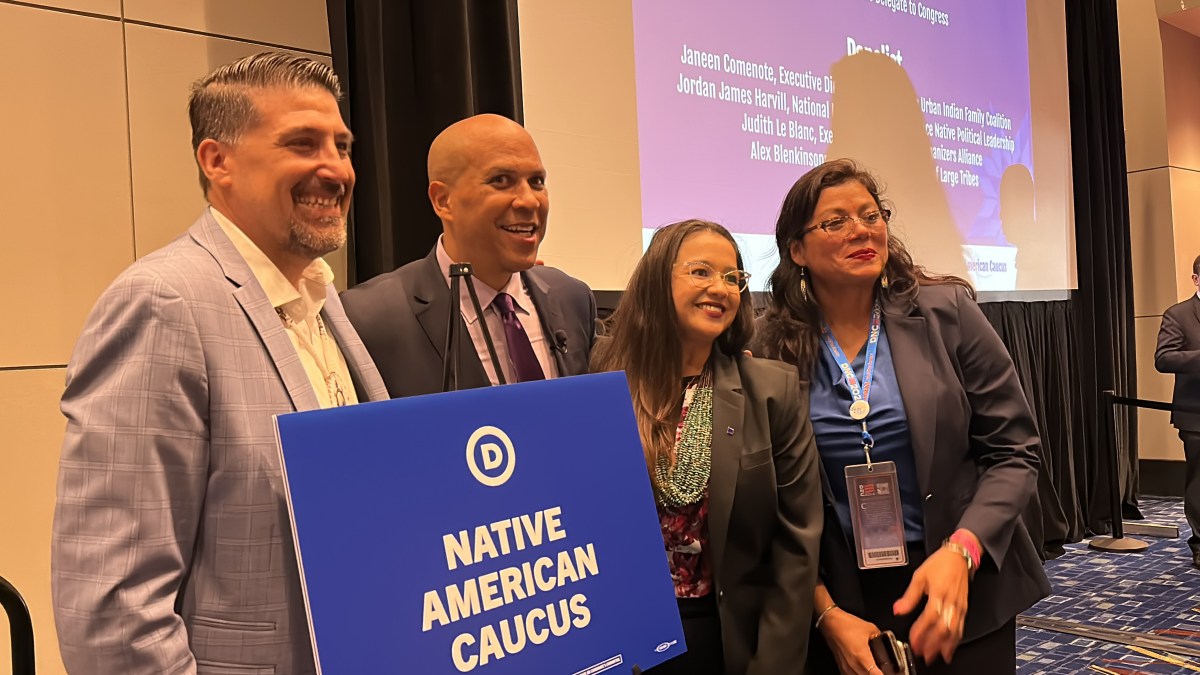
CHICAGO — The crowd of around 150 stood, and the roar of applause filled the Native American Caucus meeting room at McCormick Place in Chicago.
Caucus members were visibly shocked, many had smiles, and there were even some gasps when Minnesota Gov. Tim Walz, who is the Democratic running mate for Vice President Kamala Harris, strolled onto the stage with his signature smile and hearty wave.
“Coach! Coach! Coach!” the crowd chanted, as if they were at a football game.
“There’s something in Minnesota we take very seriously,” Walz said. “It’s tribal sovereignty. It’s not lip service. It’s actions and it’s not when it’s convenient to have tribal sovereignty. It’s every single day about every single decision that needs to be made.” READ MORE — Pauly Denetclaw, ICT
SUPPORT INDIGENOUS JOURNALISM. CONTRIBUTE TODAY
The U.S. Justice Department and Bennett County, South Dakota, officials are working to resolve barriers facing rural Native voters in the state following a Justice Department investigation.
The Justice Department’s investigation found that Native voters in Bennett County lacked equal access to the in-person registration and absentee voting available under state law.
Bennett County lies within the exterior boundaries of the Pine Ridge Reservation in southern South Dakota and is considered by the Department of the Interior to be reservation land. However, state agencies such as the South Dakota Department of Transportation list Bennett County as separate from the reservation.
Many Native people living on tribal lands cannot travel to Martin, the seat of Bennett County, for in-person voting services. Under a new agreement, the county will operate a satellite voting office in Allen to provide in-person registration and absentee voting services during regular business hours.
These services will be provided for the full state-mandated 46-day absentee voting period prior to federal, state and county elections.
“With this agreement, we will ensure that Native American voters will have the same access to registration and early voting as do other voters,” Assistant Attorney General Kristen Clarke of the Justice Department’s Civil Rights Division said in a press release. “The Justice Department will continue to challenge discriminatory election-related laws and policies and will vigorously enforce federal law to move us ever closer to a fully enfranchised Native electorate.” — ICT
On Monday in Milwaukee, the Forest County of Potawatomi signed a compact with the U.S. Department of Transportation. Compacts are funding agreements that give tribes more autonomy in managing services for their citizens’ needs.
The Potawatomi are the fourth tribe to sign a compact with the transportation department and the first Wisconsin tribe to do so. The four compacts were all done through the Biden-Harris administration. The other three tribes that have signed compacts are the Cherokee Nation, Ohkay Owingeh, and the Citizen Potawatomi Nation.
Tribal Chairman James Crawford said at the Forest County Potawatomi signing ceremony that the compact is more than a legal agreement. “It is a reaffirmation of our inherent right to govern ourselves. It is a recognition of our capacity to manage our own affairs, make decisions for our people, and chart our own course for the future. It is the embodiment of the principle that we as Indigenous peoples are best equipped to understand and meet the needs of our communities.”
Transportation Assistant Secretary Arlando Teller, Navajo, signed the agreement on behalf of the department. He said the compact gives the tribe greater decision making power and authority over its own affairs concerning a modern necessity: a reliable transportation system. READ MORE — Joaqlin Estus, ICT
WASHINGTON — The federal government is expected to announce water cuts soon that would affect some of the 40 million people reliant on the Colorado River, the powerhouse of the U.S. West. The Interior Department announces water availability for the coming year months in advance so Western cities, farmers and others can plan.
Behind the scenes, however, more elusive plans are being hashed out: how the basin will share water from the diminishing 1,450-mile river after 2026, when many current guidelines that govern it expire.
The Colorado River supplies water to seven Western states, more than two dozen tribes, and two states in Mexico. It also irrigates millions of acres of farmland in the American West and generates hydropower used across the region. Years of overuse combined with rising temperatures and drought have meant less water flows in the Colorado today than in decades past.
That’s made the fraught politics of water in the West particularly deadlocked at times. Here’s what you need to know about the negotiations surrounding the river. READ MORE — Associated Press
Sign up here to get ICT’s newsletter
For years, the Hualapai Tribe tried to work with the U.S. Bureau of Land Management by actively voicing their concerns about a lithium exploration project near Wikieup, in northern Arizona.
The project allows a mining company to drill and test over 100 sites across BLM land that surrounds one of the Hualapai Tribe’s cultural properties, among them Ha’Kamwe’, a medicinal spring sacred to the tribe.
Ha’Kamwe’ is featured in tribal songs and stories about the history of the Hualapai people and their connection to the land. The historic flow and spring temperature are important attributes for its traditional uses, according to the tribe.
Out of concern for Ha’Kamwe’, the tribe submitted multiple public comments, sent several letters of concern and participated in tribal consultations with BLM throughout the planning phase for the Big Sandy Valley Lithium Exploration Project. Big Sandy, Inc., a subsidiary of Australian mining company Arizona Lithium, leads the project. READ MORE — AZ Mirror
Environmental workers come in all varieties but, fairly or not, they’re often tagged with a set of stereotypes: determined, resourceful, prickly, crunchy.
No matter their widespread validity, these qualities certainly apply to the latest group of enviro warriors—crayfish.
For the past four years, a team of researchers from the University of Idaho has been capturing crayfish from water bodies across the Columbia River Basin to examine levels of mercury found in the crustaceans’ tails.
The Crayfish Mercury Project is a pilot for using crayfish as a “biosensor” to track pollutants in watersheds across the Columbia River Basin. READ MORE— Columbia Insight
- Anishinaabemowin heard in a galaxy far, far away: The premiere of ‘Star Wars: Episode IV – A New Hope,’ dubbed in Anishinaabemowin, hits Canada. ‘Our language is growing dramatically and I see it everywhere’
- Blink and it’s 50 years: Mark Trahant’s 50 years of reporting: ‘So lucky to be at the right places at the right times’
- Raye Zaragoza reflects on her first Broadway role: She plays Tiger Lily in Larissa FastHorse’s ‘Peter Pan’ and shares her experience fulfilling the once-controversial character, calls for more inclusivity of Indigenous artists
- People on the Move in Indian Country
- Utah lawsuit seeks state control over vast areas of federal land
- North Carolina elections board OKs university ID on phones for voter access this fall
We want your tips, but we also want your feedback. What should we be covering that we’re not? What are we getting wrong? Please let us know. dalton@ictnews.org.

Our stories are worth telling. Our stories are worth sharing. Our stories are worth your support. Contribute $5 or $10 today to help ICT carry out its critical mission. Sign up for ICT’s free newsletter.