
ICT is working to shape the future of journalism and stay connected with readers like you. A crucial part of that effort is understanding our audience. Share your perspective in a brief survey for a chance to win prizes
Greetings, relatives. (can be in traditional language, make intro your own)
A lot of news out there. Thanks for stopping by ICT’s digital platform.
Each day we do our best to gather the latest news for you. Remember to scroll to the bottom to see what’s popping out to us on social media and what we’re reading.
Also, if you like our daily digest, sign up for The Weekly, our newsletter emailed to you on Thursdays. If you like what we do and want us to keep going, support and donate here.
Okay, here’s what you need to know today:
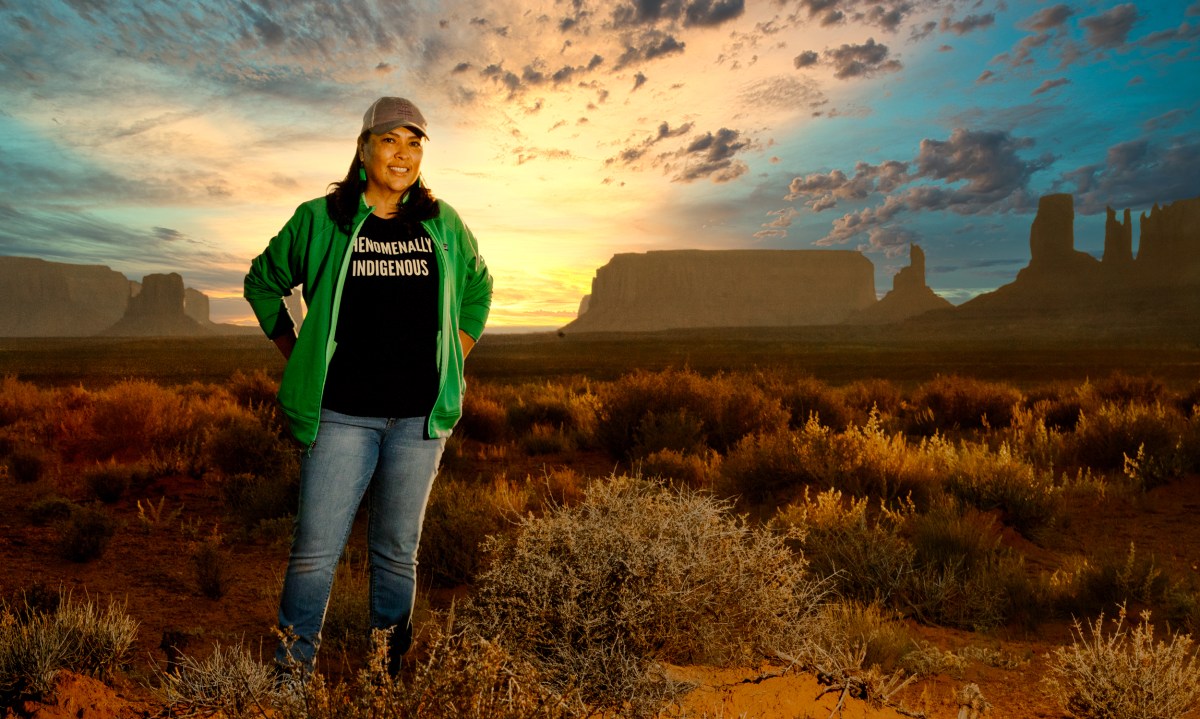
Davina Smith, Navajo, said got all her jitters out the first time she ran for Utah representative in 2022. She’s even more determined for her second round of campaigning for the District 69 seat.
Her former opponent Phil Lyman announced in October 2023 that he won’t be seeking reelection and is instead running for governor. So far, two Republican candidates Lynn Jackson and Logan James Monson will be facing Smith if she advances in the U.S. House of Representatives Democratic primary election on June 25.
Smith grew up in Monument Valley, Utah, with her grandparents where she had cattle and herded sheep. She said she knows what it feels like to struggle from hauling water and having no electricity. They additionally felt the effects of uranium mining, which her grandfather worked in and that she said infiltrated their livestock’s water and was present in the dirt.
“There’s this perception that I don’t know what it feels like to live off the land. I do genuinely. But also I come with another perspective of I lived in the city so I understand how it feels walking two worlds,” she said.
Smith is concerned how many Utah issues are not addressing rural issues, specifically in the southeastern part of the state. Some bills that have been introduced by Republicans in Utah’s recent legislative session are mandating mail-in ballots to arrive at the clerk’s office by Election Day. As of now, they just have to be postmarked by Election Day. Another bill that was introduced is to require voters who want to vote by mail to request it. Contrary to county clerks who send the mail-in ballots automatically.
Smith said there are residents in Navajo Mountain in San Juan County that could be impacted, like having to travel hours out of their way to vote.
“We’re talking about them having to maybe leave work, get out of work. It’s November so who knows we might have some severe weather conditions,” she said.
Some of the issues that she hopes to work on if elected is improving the education system in rural communities, teacher’s salaries, housing, investing the taxes from tourism to be invested back into the communities, healthcare and support for veterans. She said she’s not a career politician and being an Indigenous woman brings a different perspective to the table.
“There’s a lot we need to address, and that is why I ran. That’s why I wanted to make a better impact for our rural communities. The goal is to win and when that happens I look forward to doing some work that needed to be done a long time ago,” she said. READ MORE — Kalle Benallie ICT
Ahead of America’s biggest game, the Super Bowl Breakfast on Feb. 10 is honoring the great Jim Thorpe.
The acclaimed Kickapoo, Sac and Fox, and Potawatomi athlete will be honored by Athletes in Action and Pro Media Group during an event for the 36th Bart Starr Award.
“Being able to recognize such a special man whose impact reaches far beyond the game is an honor,” said Corwin Anthony, Super Bowl Breakfast Executive Director in a press release. “Mr. Thorpe is exactly the kind of person that Bart Starr would have loved to compete alongside and support in any way. We are thrilled to be able to posthumously unite and recognize these two men for their contributions to society that greatly surpasses their impact on the field of play.”
One of the greatest athletes of all-time, Thorpe won gold medals in both the pentathlon and decathlon at the 1912 Stockholm Olympics. His performance led to a proclamation from King Gustav V at the time.
“You, sir, are the greatest athlete in the world,” Gustav V said after placing two gold medals around Thorpe’s neck. “I would consider it an honor to shake your hand.”
In the press release, Thorpe’s grand-daughters said the recognition is an honor.
“Keeping our grandfather’s legacy alive is a deeply sacred honor for us,” said Thorpe’s granddaughters, Anita and Mary Thorpe. “We are excited to celebrate his accomplishments and contributions to the world of sports, especially his position as the first elected President of the NFL. Through sharing Jim Thorpe’s story, we hope to inspire the minds of millions and encourage future generations to embrace an unwavering belief in themselves to overcome adversity. Thank you for sharing Jim Thorpe’s legacy at this special NFL sanctioned Super Bowl Breakfast.”
Read the entire press release of the event here. The breakfast will be live-streamed on YouTube.
SUPPORT INDIGENOUS JOURNALISM. CONTRIBUTE TODAY.
It’s National Tribal Colleges and Universities Week February 4-10 and the 30th anniversary of land-grant college designations. President Joe Biden has taken notice and action.
For the first time ever, a presidential proclamation aims to make it easier for millions of Indigenous students to pay for college.
Ahniwake Rose, Cherokee, vice president of Congressional Federal Relations of the American Indian Higher Education Consortium, told ICT that the proclamation is a historical moment in myriad ways for tribal students.
“It’s such a big deal because it’s the first time we’re having national recognition like this for our tribal colleges and universities. We’re the backbone of tribal education,” Rose said.
One goal is to increase by $900 the maximum Pell Grant – which students do not have to pay back, making it easier for millions to pay for school, according to the White House announcement.
Another is to ensure that the Public Service Loan Forgiveness plan remains intact, ensuring that students who take public servant jobs after graduation benefit from some debt relief.
Yet another is to cut “in half” payments for undergraduate student loans via the Saving on a Valuable Education Plan, which also includes granting early forgiveness to borrowers with low-balance loans. The latter could save the typical student borrower about $1,000 per year.
“We are pursuing new actions to relieve the burden of student debt for as many borrowers as we can, as fast as we can,” said Biden.
Sandra Boham, Confederated Salish and Kootenai Tribes of the Flathead Indian Reservation, is Salish Kootenai College president and a life-long educator, said Biden’s directives – aimed at the Department of Education, Department of Interior and the Department of Labor – will definitely benefit her students. READ MORE — Renata Birkenbuel ICT
Sign up here to get ICT’s newsletter
Indigenous actor and former boxer Kali Reis is co-starring in the HBO crime drama “True Detective,” alongside Oscar-winner Jodie Foster. ICT’s Miles Morrisseau caught up with Reis to ask about Native representation and what it means to work on a show that explores the MMIP crisis.
Languages are among our most valued resources. Ensuring they are preserved, and taught, is important in Indigenous communities. ICT’s new segment is Language Breaks. Today, a taste of Passamaquoddy from the Wabanaki nation in the state of Maine.
A popular series on PBS has been unraveling the past for over a decade. This season, an award-winning Cherokee actor discovered some surprising facts about his ancestry on “Finding your Roots.” ICT’s Shirley Sneve has this interview with Wes Studi.
Two filmmakers have worked tirelessly to shine a light on a decades-long struggle to revive Tar Creek in Miami, Oklahoma. “Meet me at the Creek” is directed by Cherokee filmmaker Loren Waters, and features Cherokee elder Rebecca Jim. ICT’s Daniel Herrera has more.
WATCH:
Two years ago, when Joseph Bull first applied for the position as dean of Maseeh College of Engineering and Computer Science at Portland State University, he shared his vision of creating a destination university for Indigenous doctoral students in mathematics, statistics, physical sciences, engineering and computer science. Today, Dean Bull’s dream is coming to fruition, as PSU was one of 10 institutions, and the only one in the Pacific Northwest, selected to participate in the Sloan Centers for Systemic Change initiative.
“Oregon needs more diversity in its STEM workforce to meet industry needs and find the best solutions to our most pressing problems,” Bull, a citizen of the Delaware Tribe of Indians, said. “PSU has a responsibility to excel in this area and we have the expertise to be a destination for Indigenous STEM.”
The goal is to remove barriers such as funding and academic support, which will then lead to overall improved student outcomes, and ultimately create educational environments that are more effective and equitable for all.
“We know that we can make graduate education in STEM better for everyone,” Adam Falk, president of the Alfred P. Sloan Foundation, said in a statement last month. “But systemic change is hard. What stands out about these institutions is their level of commitment and readiness. These are campuses that have a vision for how to do better and are eager to take the next step.”
Over the course of the next two years, PSU will use the $250,000 seed grant to recruit, retain and invest in individual “Sloan Scholar” scholarships for eligible Black, Indigenous and Latiné doctoral students. In addition to diversifying programs, PSU hopes the grant will help bring systemic change by working toward equitable representation, supporting student success, and working to meet the needs of all students. Leadership believes this could become a model for other minority-serving institutions to follow. READ MORE
- ‘Genocide Bowl’: Activists to protest Super Bowl teams: Native advocates opposed to the Kansas City and San Francisco NFL teams’ names plan to demonstrate outside Allegiant Stadium on Sunday
- Kali Reis goes toe-to-toe with Jodie Foster in ‘True Detective’: The Wampanoag/Cape Verdean boxing champion brings light to Night Country and perhaps delivers one of the most quotable lines in Indigenous pop culture history
- PSU plans to become destination school for Indigenous doctorate students: PSU to dramatically increase the diversity of its Ph.D. programs with the help of a two-year, $250,000 grant from Alfred P. Sloan Foundation
- Canadian journalist’s arrest sparks international outrage: Brandi Morin faces charges for covering Edmonton police dismantling a homeless encampment
- Misplaced Trust: Stolen Indigenous land is the foundation of the land-grant university system. Climate change is its legacy.
- ROLLING HOPE: Cherokee Nation’s Mobile Clinic Pioneers Indigenized Harm-Reduction and Addiction Care
We want your tips, but we also want your feedback. What should we be covering that we’re not? What are we getting wrong? Please let us know. dalton@ictnews.org.
