
Help ICT make strides in 2024. Our goal is to raise $150,000 by the end of the year with generous contributions from funding partners and collaborators like you. We’re thankful for your support, and we’re thriving because of it. DONATE TODAY!
Greetings, relatives.
A lot of news out there. Thanks for stopping by ICT’s digital platform.
Each day we do our best to gather the latest news for you.
Okay, here’s what you need to know today:
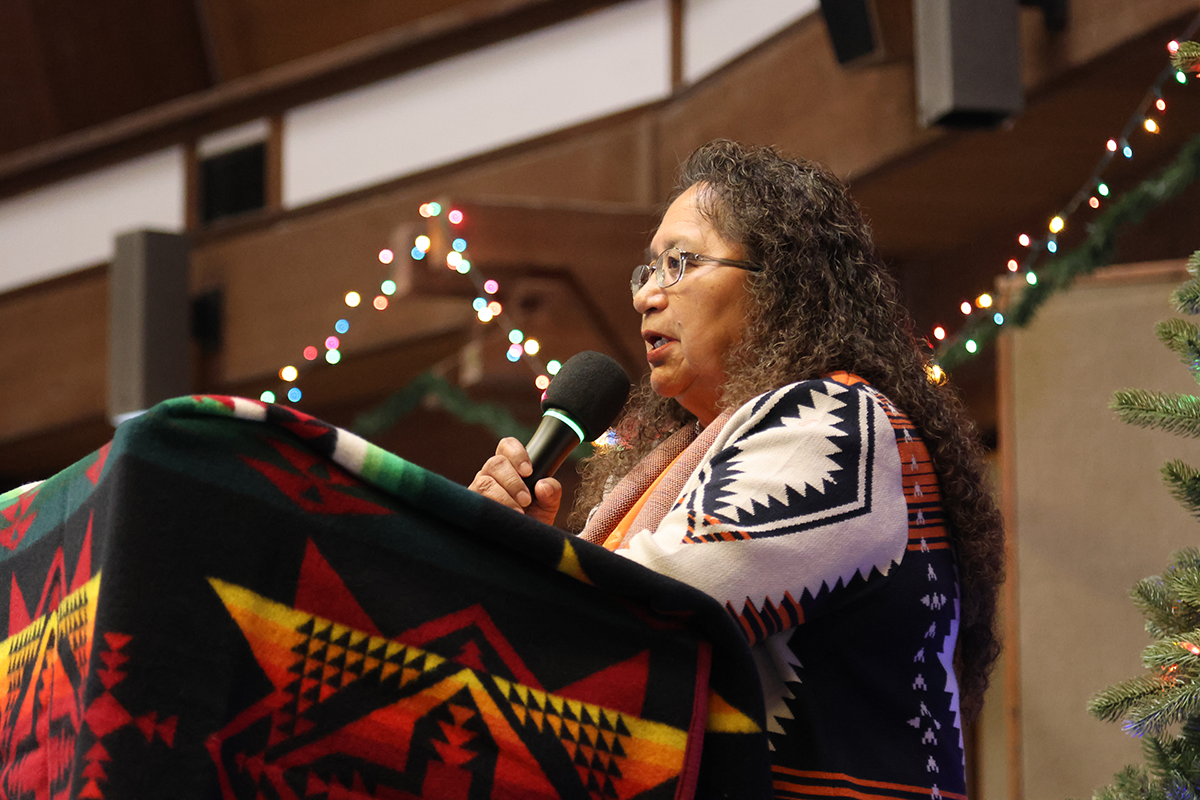
On a brisk, cloudy morning in mid-December, dozens gathered for the opening of the Yakama Nation Justice Center.
After a song and prayer led by tribal council, the crowd raised their hands toward the sky as the Yakama Warriors Association displayed the flags during a color guard ceremony, walking to the tune of “A Star Spangled Banner” played by Loren Corpus, Yakama, on trumpet.
“It is through the cooperative efforts that all of this has come together,” Gerald Lewis, chairman of Yakama Nation, told dozens gathered in Toppenish, Washington. “This has been a long, long time coming. It has been a big dream.”
Since the early 1950s when the Confederated Bands and Tribes of the Yakama Nation adopted its first written laws, the courthouse has been in the same building: a double wide trailer surrounded by a cluster of additional trailers made up the police station, clerks offices and tribal court. READ MORE. — Nika Bartoo-Smith, Underscore News + ICT
SUPPORT INDIGENOUS JOURNALISM. CONTRIBUTE TODAY.
A state commission selected a basic design concept Friday for a new state flag for Minnesota to replace a current banner that is considered offensive to Native Americans, but will need more time to add the finishing touches.
The final choice came down to two templates. The panel went with one bearing a stylized dark blue shape of Minnesota on the left with an eight-pointed white North Star on it, then either horizontal stripes or a solid field on the right.
The commission then decided to consider variants on that theme when it reconvenes Tuesday, including an asymmetrical Minnesota that looks more like the state’s actual shape, and either a solid light blue field on the right, or adding a green stripe along the bottom to symbolize the state’s agricultural heritage.
Minnesota’s current flag includes the state seal against a blue background. The seal depicts a Native American riding off into the sunset while a White settler plows his field with his rifle leaning on a nearby stump. The imagery suggests to many that the Indigenous people were defeated and going away, while whites won and were staying. — Associated Press
A clash between reality and the absurd in the Indigenous comedy, “Acting Good,” piles up to the point where you don’t know whether the joke is funny because it is outrageous or funny because it’s true.
Or both.
Based on the semi-autobiographical story of Anishinaabe comedian Paul Rabliauskas, the television series is the top-rated show on top-rated CTV Comedy, drawing rave reviews and laughs among Indigenous viewers and others with its look at the fictional northern Manitoba community of Grouse Lake.
The show isn’t just dropping F-bombs left and right. It is also dropping some Indigenous curse words like weenuck and geed. (I’m not explaining, but it’s pretty basic potty humor). READ MORE.— Miles Morrisseau, ICT
Expectations rise each year for the largest gathering of Indigenous leaders from across the United States. A leader from the Pacific Northwest understands this after more than four decades in his post.
“The first summit was with President (Bill) Clinton back in 1994 when he called the tribes together and said, ‘We need to have a nation-and nation-meeting,’” recalled W. Ron Allen, chairman of Jamestown S’Klallam Tribe in Washington state. “And (Clinton) was in the middle of his second term.” Clinton served as president from 1993 to 2001.
It could be debated that former President James Monroe was the first sitting president to invite Indigenous leaders to the White House, according to White House Historical Association. Monroe, Secretary of War John C. Calhoun and Benjamin O’Fallen, who was an Indian agent for the Upper Missouri, welcomed 17 representatives from Indigenous nations. READ MORE. — Jourdan Bennett-Begaye, ICT
Sign up here to get ICT’s newsletter
On the Monday edition of the ICT Newscast, a Washington rally called for the release of Leonard Peltier. We have lessons from the playing days of a hall of fame football player. It takes months to grow and seconds to eat. We speak to a New Mexico certified chile farmer who is sustaining her people’s practices.
Watch:
Visitors who enter the Sunrise Park Resort are greeted with the Apache word, Dagot’ee, meaning welcome. The resort is believed to be one of the only two tribally owned and managed ski areas in the country.
The White Mountain Apache Tribe has owned and operated Sunrise Park Resort in Arizona since 1970, originating from former and longtime chairman Ronnie Lupe and several other tribal citizens. It’s the only ski resort on tribal land, located north of the tribe’s sacred Mount Baldy.
The Mescalero Apache tribe owns and operates Ski Apache in south New Mexico. They are set to open Dec. 9 on weekends until Dec. 21. It will then be open daily after Dec. 21 until Jan.1, 2024. READ MORE. — Kalle Benallie, ICT
- Mauna Kea, sacred to spiritual practitioners and treasured by astronomers: Views vary on what’s best for Mauna Kea’s future.
- How the deep friendship between an Amazon chief and Belgian filmmaker devolved into accusations: ‘My name is used to raise money.’
- Food sovereignty movement sprouts as bison return to Indigenous communities: ‘With food sovereignty we are looking at the ability to put that healthy food and ancestral foods which we used to survive for thousands of years, putting those foods back on the table.’
- Inside the Marshall Islands’ life-or-death plan to survive climate change: The Pacific island nation is seeking $35 billion to protect against sea-level rise and prevent a mass exodus.
- Brazil’s Congress overrides veto to reinstate legislation threatening Indigenous: Supporters of the bill argued it was needed to provide legal security to landowners and accused Indigenous leaders of pushing for an unlimited expansion of their territories.
- Native voters in North Dakota secure big wins for fair representation.
- UNM law professor earns national award for advancing Native American rights.
- Seattle shelter for Native people set to close as U.S. hits highest reported level of homelessness.
We want your tips, but we also want your feedback. What should we be covering that we’re not? What are we getting wrong? Please let us know. dalton@ictnews.org.


