
You can help elevate meaningful stories from Indigenous nations when you support ICT during Arizona Gives Day! ICT is headquartered in Arizona, and covers the Indigenous world across North America. Help us reach our goal to raise $10,000 for reliable, compelling, Indigenous-led journalism in Arizona and across the U.S.
Greetings, relatives.
A lot of news out there. Thanks for stopping by ICT’s digital platform.
Each day we do our best to gather the latest news for you.
Okay, here’s what you need to know today:
They came to protect the water.
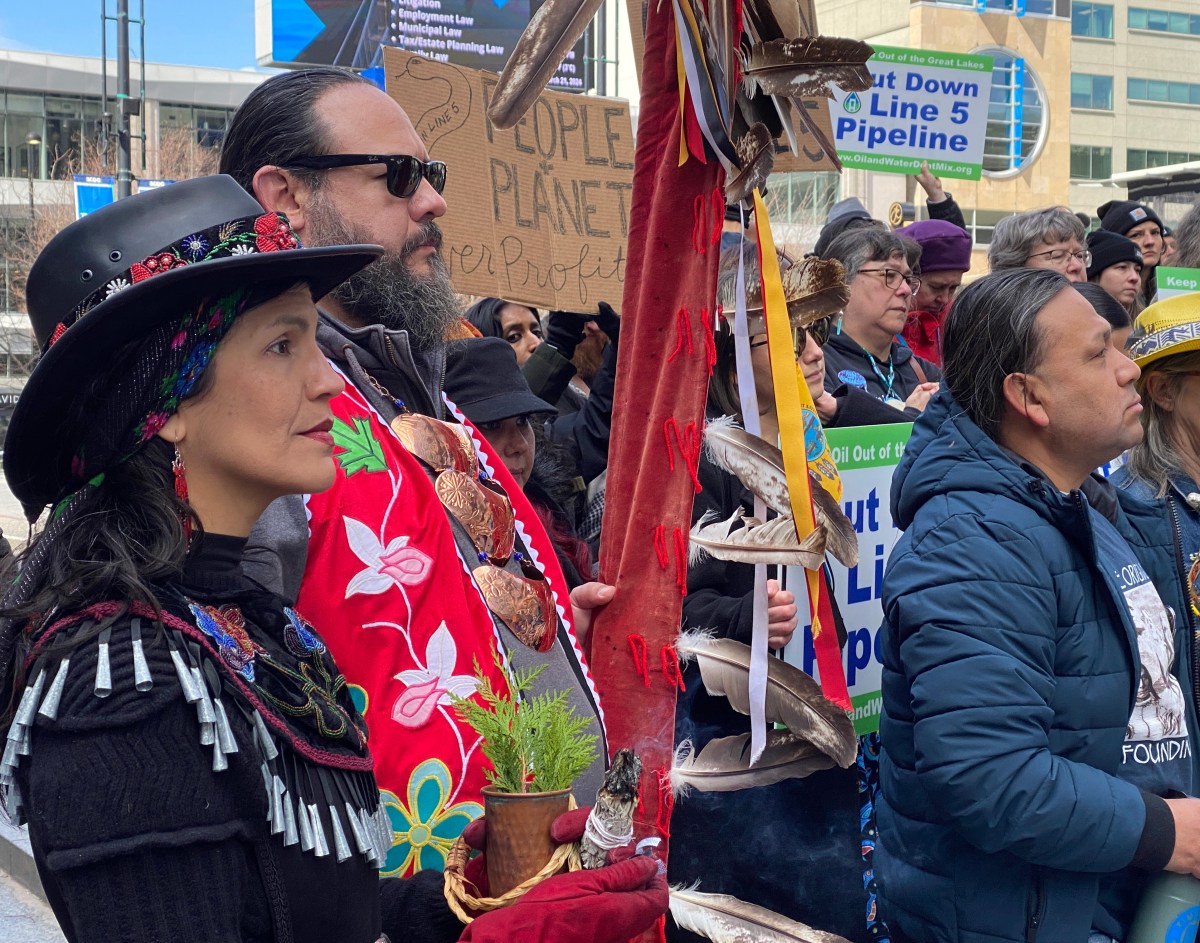
Nearly 200 people traveled from Michigan to Cincinnati on Thursday, March 21, to support the state of Michigan’s efforts to stay out of federal court with its legal case calling for a partial shutdown of Enbridge Line 5.
Several citizens and leaders of Michigan tribes were among those who joined the rally at Fountain Square, a major public space in downtown Cincinnati near the U.S. Court of Appeals for the Sixth Circuit.
The crowd waved banners and signs calling for the shutdown of the Line 5 pipeline, with some calling for “people and planet over profits.”
Inside the courthouse, Michigan officials asked the federal appeals court to allow the lawsuit filed by the state attorney general’s office to remain in state court – a move supported by a coalition led by the Bay Mills Indian Community of more than 60 tribes from the Great Lakes region and beyond. READ MORE— Mary Annette Pember, ICT
SUPPORT INDIGENOUS JOURNALISM. CONTRIBUTE TODAY.
Last year’s National Book Award winner, Ned Blackhawk, is rewriting Native American History for high school and college history courses.
“Most public schools do not adequately teach Native history, and I wrote this book as an alternative,” Blackhawk told ICT and Tulsa World.
Blackhawk recognized the misinformation and harmful stereotyping of Native history in public school textbooks. In his book, “The Rediscovery of America: Native People and the Unmaking of U.S. History,” he takes a professional approach to studying history akin to the way historians look broadly at other subjects, with “existing scholarship assessments” and “through researching archival materials.”
His book tells the history of America from the perspective of Indigenous people, whereas most history courses in America are told from a European focus, starting with colonization. READ MORE— Felix Clary, ICT + Tulsa World
For nearly 30 years starting in 1883, Lakota performers traveled the globe and performed in over 3,000 different locations as part of Buffalo Bill’s Wild West Show. Many different historical documents and research initiatives highlight William “Buffalo Bill” Cody’s life and show, but few projects exist highlighting the Indigenous performers he employed.
A new collaborative project between Oglala Lakota College and Clemson University with funding from the National Archives aims to gather information about Lakota ancestors who participated in Buffalo Bill’s Wild West Show.
The project, Wičhóoyake kiη aglí—They Bring the Stories Back: Connecting Lakota Wild West Performers to Pine Ridge Community Histories, is a community collaborative effort to get Lakota people talking about their ancestors’ involvement. READ MORE— Amelia Schafer, ICT + Rapid City Journal
Born and raised mostly in Portland, Oregon, Shyla Spicer, an enrolled citizen of the Yakama Nation and a descendant of the Seneca Cayuga Tribe who also has Filipino heritage, grew up deeply involved in the urban Native community. In December, she started her new role as president and CEO of the Native Arts and Culture Foundation.
Spicer’s traditional Yakama name is Wachea’wit, which means water rapids. She aspires to create a hub for the Indigenous community as a whole, and continue the foundation’s work supporting Indigenous artists across Portland, the country and beyond.
Formed in 2007, the Native Arts and Culture Foundation has spent the last 17 years supporting Indigenous artists through grants, opportunities to showcase their work, artist fellowships and more. READ MORE — Nika Bartoo-Smith, Underscore News + ICT
Sign up here to get ICT’s newsletter
On Monday’s ICT Newscast, we speak with a tribal leader who’s not stepping down, but stepping up for the environment. The world of opera with a Native Hawaiian woman redefining storytelling.
Watch:
More than 10,000 Native Americans live in Sioux Falls, yet no Native person has ever served on the Sioux Falls City Council, according to the Sioux Falls City Council and Minnehaha County Historical Society.
One Hunkpapa Lakota woman, Allison Renville, is hoping to change that.
Renville, who was raised in Sisseton, S.D., on the Lake Traverse Reservation, moved to Sioux Falls over two years ago after surviving domestic abuse. After moving to Sioux Falls she became invested in community protests, domestic violence and sex-trafficking outreach. Since moving to Sioux Falls, Renville said, she’s put over 1,000 miles on her car traveling around the Sioux Falls metro area helping with community projects.
Rapid City, the second largest city in the state, has had several Indigenous city council members and school board members over the years. Sioux Falls, the largest city, has never had a Native American council member. READ MORE— Amelia Schafer, ICT + Rapid City Journal
- Dene filmmaker releases first feature-length thriller: Kelvin Redvers’ ‘Cold Road’ was produced, written and directed by an Indigenous director and stars an Indigenous lead character.
- Prayer Horse Ride traversing communities impacted by mining: The Third Annual Prayer Horse Ride, a tribute to late Native activist Myron Dewey, will pass through mining-affected Native communities in western Nevada.
- Tahlequah book stores strive to create more readers: One way that Too Fond of Books is helping propel more readers is by highlighting authors with a number of them being Cherokee.
- ‘Tired of broken promises’: Ute leaders in Colorado call on state to follow through on Tribal commitments.
- Time is running out to increase internet speeds for Alaska’s rural schools: Only days remain until the deadline for federal grants that would make equitable speeds affordable.
- US Ski and Snowboard Hall of Fame inducts its first Native American member.
- Adrienne Benjamin Wins Shoe Design Contest.
- Native Americans are hardest hit by syphilis surge.
- ‘Cancel culture’: Supreme Court rejects case on dust-up between Catholic student and Native American.
We want your tips, but we also want your feedback. What should we be covering that we’re not? What are we getting wrong? Please let us know. dalton@ictnews.org.


