
Lindsey Bark
Cherokee Phoenix
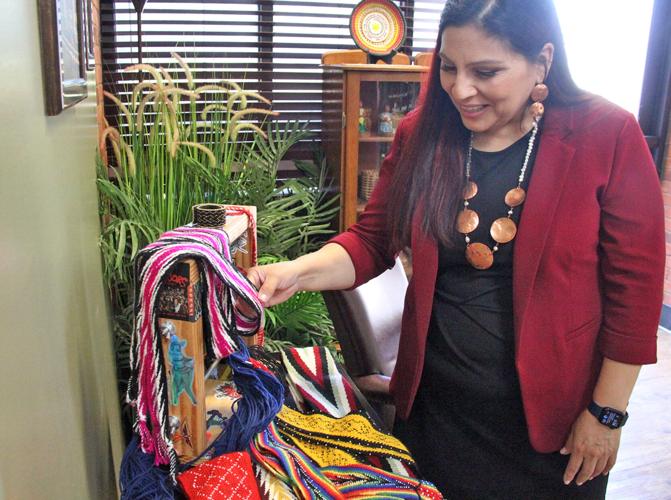
The ingenuity of Cherokee people continues through the creation of textiles such as finger weaving.
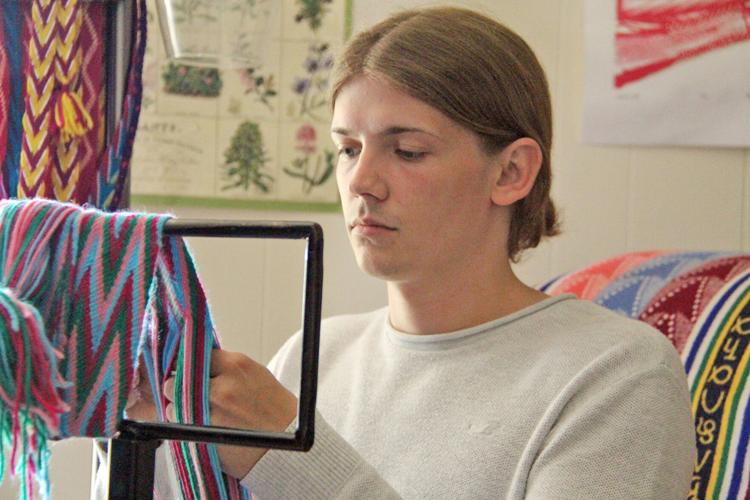
His story: Cherokee Nation citizen Luke Wassom, 24, started weaving at 15 years old. Having grown up in and around the Osage Nation, he began weaving regalia for Osage “in-lon-schka,” or stomp dance.
“I didn’t have anybody to make mine. So I just decided to learn to make my own,” Wassom said.
He was taught by his aunt, Debbie, and was also influenced by Cherokee National Treasure Candessa Tehee.
“The bulk of my weaving that I produced, because I grew up with Osages, is I produce Osage finger weaving,” he said. “It’s the same style of producing the textile, but it’s expressed in different colors and in different patterns.”
How it’s made: Contemporary belts are made using yarn or wool, depending on the weaver.
“You see individuals using all kinds of materials for finger weaving,” Tehee said. “You see everything from the Red Heart acrylic yarn … that you can buy like at Walmart and Hobby Lobby, to some really nice specialty wools that are like Peruvian in origin.”
Tehee said most belts are created with an open-face weave or an oblique weave using a handful of designs including diagonal, chevron and lightning.
“The one that seems to be most challenging for weavers as they’re starting out is the arrowhead design,” she said. “But once you’ve kind of gotten the arrowhead design down, then you can do, I think, just about anything.”
With no tools used, finger weaving is literal in its name.
“One of the most common misconceptions that I run into as a finger weaver is that people … assume that I am using like a tabletop loom to create a piece when in actuality it really is just my hands,” Tehee said. “I’m using my hands to create that space within the fibers and to move the fibers where they need to be, and that’s the only thing I’m using.”

Finger weaving history: Historically, Cherokee women did the weaving to create garters, belts, bag straps and other items for either utilitarian or ceremonial purposes for men.
Items were first made with plant fibers such as mulberry tree bark, and in the 17th century trade eras, Cherokees began using wool.
“It’s been theorized that with the trade blankets and the trade cloth that was being used in 17th century and being traded among people, that if those blankets became worn, had a hole in them or something like that, that Cherokee women would unravel those blankets thread by thread and then use that thread to weave belts with,” Tehee said. “So the process through which you accomplish that would be incredibly labor intensive.”
According to “The Cherokee People: The Story of the Cherokee from Earliest Origins to Contemporary Times” by Thomas E. Mails, Cherokee men’s daily attire consisted of a “colorful broad-woven belt with tasseled yarn ties, made by female finger weavers.” The belt was worn over a breechclout, or loincloth, with a knife and sheath and a buckskin pouch used to carry items such as tobacco, flint, bullets and mending supplies.
Modern day use: Finger weaving has moved beyond its historic use as belts and garters made primarily for men by women.
“In modern day, men and women both wear finger-woven belts,” Tehee said. “You also see finger weaving moving into things like jewelry, bracelets and earrings. So you see finger weaving moving into all of these different spaces. That’s going to mean that the art form itself really evolves, adapts and grows, which is really exciting.”
While historically women were weavers, Wassom said he does not let that slow him down.
“Women were the weavers and the artisans and men had a much more like industrious outside role,” he said. “I come from a long line of strong Cherokee women and I just feel like I’m carrying on their legacy through my work and times have changed. So if we don’t allow ourselves to change with time, it will be erased. I think that it’s important that if you have the ability that you try to perpetuate whatever you can do.”
Carrying on the tradition: Tehee and Mattie Drum, inducted in 1990, are the only two recognized Cherokee National Treasures for finger weaving.
Tehee said that inspired her to promote and celebrate any up-and-coming finger weavers like Wassom.
“I try my best to celebrate them and the work that they’re doing,” she said. “If anyone wants to learn, I’m always happy to teach people because I think that I’d love to see the art form just grow and be practiced by more people. I’m always excited to see what others create, and any help I can give them in creating.”
