
The Bureau of Indian Affairs is often thought about as an extension of the federal government in tribal nations. The BIA builds roads and bridges, funds law enforcement and the agency supports tribes as governments, carrying out the trust responsibility.
These days one can add to that list: climate change.
ICT’s Editor-at-Large Mark Trahant visited recently with the Interior Department’s Assistant Secretary for Indian Affairs Bryan Newland about the climate – and some other topics – and the government’s initiatives working with tribes. The Biden Administration’s proposed budget for next year is packed with funding for climate resilience and climate adaptation projects.
The following interview has been lightly edited for clarity.
Mark Trahant
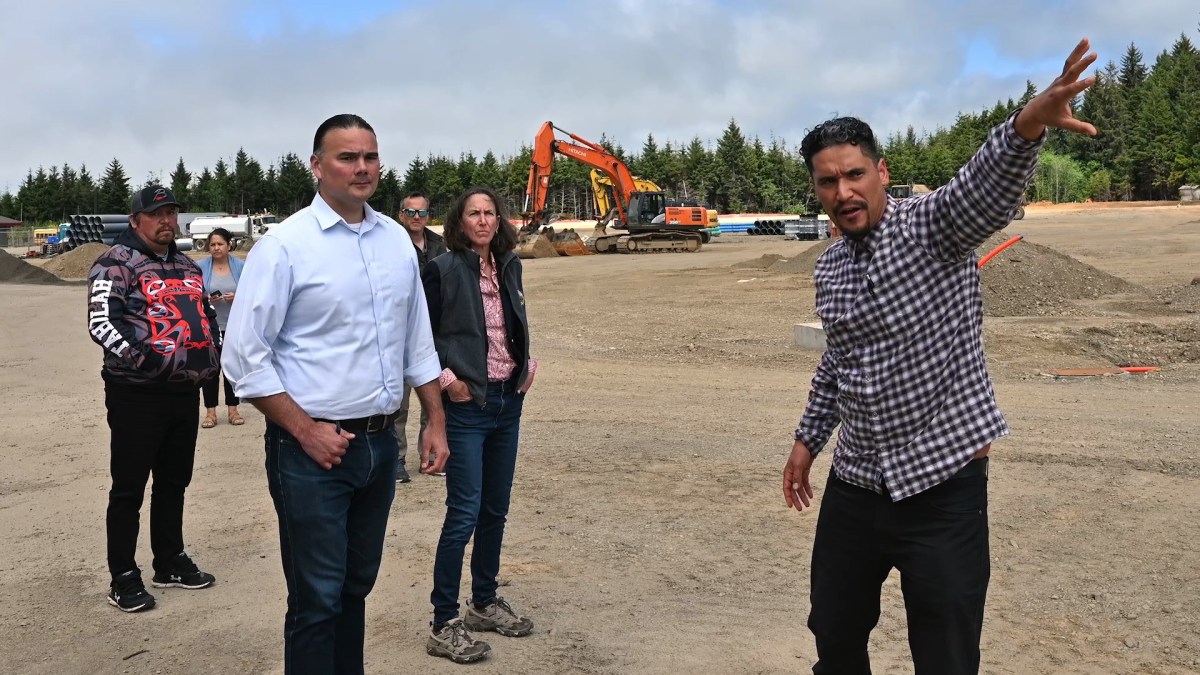
I just recently took a tour at the Quinault Indian Nation in Washington State. The Nation is in the process of moving an ancestral village to higher ground to escape rising sea levels. I know you visited there, so I wanted to get your perceptions of what’s happening there and some context for that.
Bryan Newland
I had the chance to visit Quinault a year ago, and they are doing just amazing work on climate relocation and climate resilience. We provided funding to Quinault almost two years ago now. It’s one of three communities that are going to serve as kind of pilot projects, if you will, on community driven relocation.
And they’re just doing amazing work. I was really impressed by their foresight in their planning and how they are really thinking through a lot of issues that aren’t intuitive and working to address them. And so I’ve been really impressed. And, you know, we shouldn’t be surprised that when tribes have resources, they’re able to do very impressive things. And so I look forward to seeing where they’re going to take that.
Trahant
One of the stories that kind of popped up was we drove the coast up and you see all these communities that are going to be facing the exact same situation. But it’s tribal communities taking the lead and saying we’ve got to start planning for this now.
Newland
Right. And, you know, when you think about it, Mark, not only are they taking the lead here in the United States, they’re really serving as leaders in this effort for the world. There aren’t a lot of places that are really engaged in this sort of activity right now. There are a lot of people who are thinking about it.
But what the tribe is doing at Quinault, and what they’re doing in the Native Village of Napakiak and Newtok Village in Alaska, is they’re really on the leading edge of things that we’re going to have to think harder about across the globe. And it’s really exciting for me and our team here at the department to be a part of that.
Trahant
One part of that thinking this through is the scale. And look at the $25 million that came to Quinault from the BIA. But they’re talking about a project that is ultimately going to be for $500 million. And you take that every tribal community and it’s a huge scale.
Newland
It is. And on top of that, Mark, there are tribes that are facing impacts from climate change that aren’t necessarily going to require them to move entire communities, but they’re going to have to spend a lot of money making their communities more resilient, whether it’s drought or wildfire or changing ecosystems that change the foods that they eat or just more severe weather.
It’s not just relocation, which is expensive enough, but it’s also that resilience piece of it. And we’re really ramping up our investments there as well. As you know, we just rolled out a $120 million investment and more than 100 locations across the country to help tribes with that resilience piece.
Trahant
When I saw that release I was struck because 20 years ago it was a question of mitigation versus adaptation. And now your budget is saying adaptation now.
Newland
Yes. Tribes have really been at the leading edge of people in this country feeling the impacts of climate change. And, of course, tribes have been warning about this for a long time. And so we have it as part of our trust responsibility to protect the ability of tribal people to live together in their homelands.
And so we’re putting our money where our mouth is. The president is leading this effort, and we’re really excited to be a part a partner with tribes in this innovative work. And we’re also really excited in making investments to mitigate climate change overall. So we’re doing a “yes, and” approach across the government.
Trahant
Another tough conversation is strategic minerals. If you look at what the country needs and what the world needs in terms of strategic minerals, 90 percent of them are on or near Indian Country. How do we have a conversation about these needs and how do we get mining companies to really be different this time?
Newland
For our part here in the federal government, it starts with meaningful consultation. And I want to emphasize and underscore, put it in bold, in italics, that the consultation has to be meaningful. And so that means that as federal agencies, when we’re considering permits or rights of way or things like that, that we have to be proactively engaging with tribes early on in the process.
And we’re working really hard to do that. The President has issued a government wide directive to agencies to engage in consultation and paired that with a memo outlining some of the baseline requirements for consultation. We always want to enter that process thinking about, how do we work to achieve consensus with tribes on any issues we’re working on?
And so for us, that’s where it starts. And again, that’s tied to our trust responsibility. And in a lot of places, tribes want to be a part of some of these initiatives, whether it’s critical minerals or renewable energy, because, you know, this stuff is necessary to deal with climate change. But we can’t just be reckless in the way that we go about it.
And that’s why the consultation piece is so critical.
Trahant
The BIA has budgeted $120 million to fund 146 climate related projects in tribal communities. Can you touch on what’s ahead for indigenous communities and the impact of climate change on food. We know game patterns are changing. Fishing areas are moving. What is the process for working together to adapt?
Newland
I mentioned earlier that we have to have a “yes, and’ approach. So we have to prepare for the impacts of climate change, but we’ve also got to continue to make investments in slowing and stopping climate change from advancing. And so we’ve seen that with the Inflation Reduction Act, the bipartisan infrastructure law. This is really a global effort that the president and his administration, Secretary of the Interior Deb Haaland, are helping to lead.
But when we look at things like ecosystems that support traditional foods up in Alaska, we have an initiative called the Gravel the Gravel initiative that we are working with Alaska Native Communities and other communities in Alaska to restore salmon and protect their habitat. We’re doing that in other places through things like dam removal investments and fish hatcheries and all sorts of things to protect traditional foods and not just fish.
Lots of other places around the country where we are supporting ecosystem restoration with an eye toward protecting those traditional food sources as we deal with climate change.
Trahant
And in all of these things, sometimes there’s a plus sign on the ledger because there may be new, for example, growing opportunities that exist now.
Newland
The thing about this, this whole effort is we want to make sure tribes are leading this. It’s not the BIA of old where we’re coming in and saying, we’ve got all the answers for you and we’ll show you how it’s done. It’s really about us making these investments in tribes and Indian people, providing support and then making sure that they’re leading these efforts on decisions about whether to rethink what’s a traditional food and how to grow it and how to use it.
We don’t want to be making those decisions for Indian people from here in the federal government.
Trahant
I want to close by asking about young people. It’s really easy to be dark about climate change. But on the other hand, if you’re a young person, your career is set if you have an interest in any of these areas.
Newland
Well, I love talking about the opportunities for young people, and really the opportunities for our country, when we engage with young people and get them involved. You know, the President hosted a tribal youth summit last fall, and I had the opportunity to attend that and sit at the table with some young leaders from across Indian country.
And I was really impressed. In fact, I told one of the groups I was talking with that if if I were put in a position of competing with them for jobs and opportunities out of college, I never would have measured up because a lot of young people from across Indian Country, you know, they are they are pushing doors open that Indian people haven’t had open for a long time.
And they’re so talented and they’re not accepting the status quo or the old way of doing things. And that’s the other thing that makes me really hopeful. We are trying really hard to make sure that we bring young folks into government through internships or hiring here to bring that new way of thinking into our work. And for me, as a leader now, I view it as part of my responsibility to help open those pathways for folks.
But I’m just really impressed by the talent that’s out there across Indian Country in terms of young people and excited to see what it’s going to do for all of us.

Mark Trahant, Shoshone-Bannock, is editor-at-large for Indian Country Today. Trahant is based in Phoenix.
Stewart Huntington is a producer for the ICT Newscast based in Colorado.
This story was produced as part of a partnership between ICT and the PBS NewsHour to cover how climate change is affecting Indigenous communities, funded with a major grant from the National Science Foundation.

