
Emma Davis
Maine Morning Star
Maulian Bryant can remember when few people knew about the issue of tribal sovereignty. Now, serving as the executive director of the Wabanaki Alliance, the 41 year old said she is blown away by the breadth of people engaged with the issue.
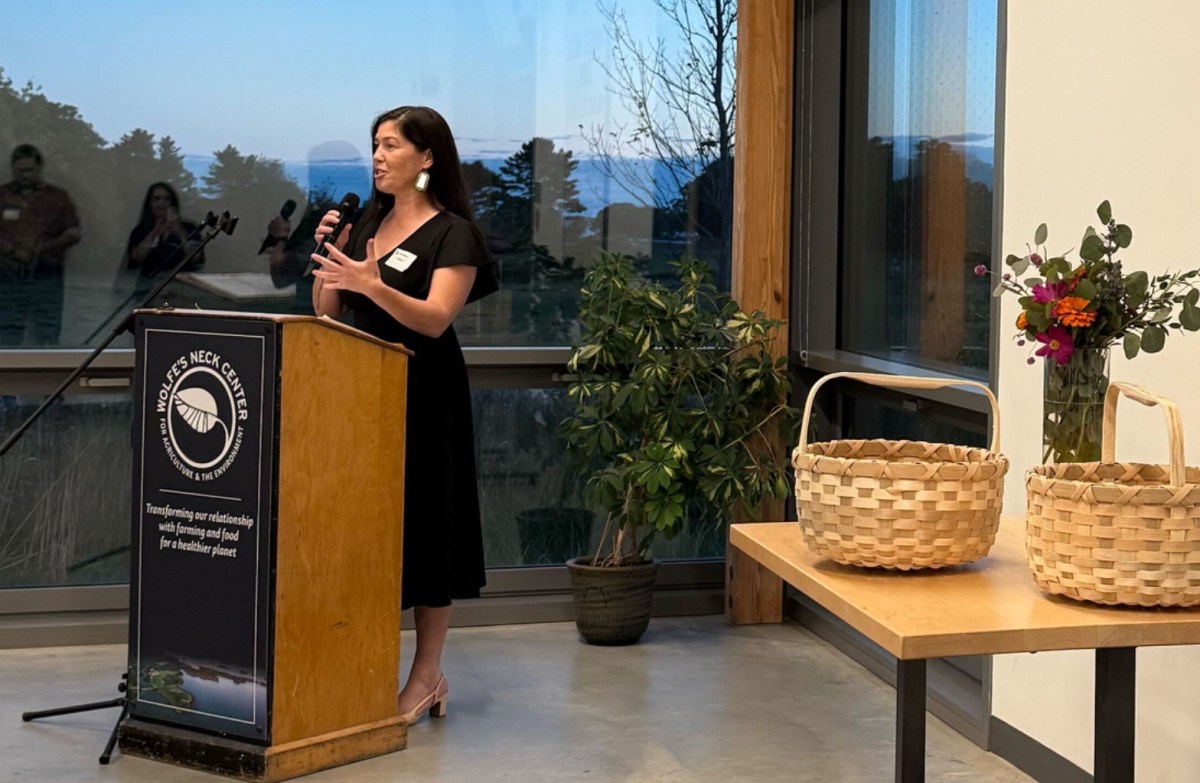
She shared these reflections with Maine Morning Star in light of the alliance’s third celebration of “Nihkaniyane: Let’s Go Forward Together” last week, when members and allies came together to recognize the coalition’s work and the relationships that make it possible.
Noting the current political instability in the United States, Bryant said it is a precarious time for tribal rights, “but also, I see a lot of people turning to us and asking what they can do and I think that a lot of people want to work in their one little corner of the world.”
Since its founding in 2020, the Wabanaki Alliance has expanded, physically — with a coalition of more than 300 organizations across Maine and the addition of staff members — but also in the reach of its cause.
The Wabanaki Alliance was formed to advocate for changes to the 1980 Maine Indian Claims Settlement Act. That land agreement has resulted in the Wabanaki Nations — the Houlton Band of Maliseet Indians, Mi’kmaq Nation, Passamaquoddy Tribe and Penobscot Nation — being treated differently than other federally recognized tribes, with a relationship to the state more akin to municipalities than sovereign nations.
Since the organization’s creation, progress has been made. For example, the state expanded tribal authority to prosecute crimes. But Gov. Janet Mills vetoed the latest proposed change this year, bipartisan legislation that would have prevented the state from being able to seize tribal land for public use. Mills has rejected sweeping reform and instead approached changing the relationship on a case-by-case basis.
Though, already fairly widespread gubernatorial candidate support for tribal sovereignty suggests the state’s approach could change when Mills is termed out in 2026.

“I think it’s hard for tribal people sometimes to be widely accepted in the state,” Bryant said. “It’s such a weird line to walk sometimes, of being set in your stances of tribal sovereignty and having people accept you. There’s few people that do that very well.”
One of those people, she said, is John Banks, a citizen of the Penobscot Nation who has dedicated his life to environmental stewardship.
Banks, one of the Nihkaniyane honorees, was the longest serving member of the Maine-Indian State Tribal Commission, which is tasked with continually reviewing the effectiveness of the Settlement Act as well as the relationship between the Wabanaki Nations and state. He was also the first natural resources director for the Penobscot Nation, a role he served in for 41 years until his retirement in 2021.
Banks received the Lifetime Achievement Award from the Natural Resources Council of Maine in 2021 and a Lifetime Achievement Award from the U.S. Environmental Protection Agency in 2019.
One of his many contributions to the protection of natural resources was his role in the Penobscot River Restoration Project that was completed in 2016. The project, which removed two dams and created a bypass around a third to open nearly 2,000 miles of habitat, led to millions of river herring, Atlantic salmon and other species returning in numbers not seen for two centuries.
Laura Rose Day, executive director of the Penobscot River Restoration Trust, has credited Banks with saving the negotiations between environmental groups and the hydro company to allow the project to move forward. She said Banks reminded everyone of the concept of “all my relations,” the Indigenous idea that everything is interconnected, in explaining the shared responsibility for the river.
Banks and the two other honorees this year represent the passing on of generational wisdom in several respects.

Brianne Lolar, the Wabanaki Studies specialist for the Maine Department of Education, is a former teacher who has been working to help other educators include Wabanaki studies in their curricula. While it has been required teaching under state law since 2001, a 2022 report found it had not been meaningfully implemented across the state.
The author of that 2001 law, Donna Loring, suggested Lolar as an honoree, which Bryant said speaks volumes about how everyone is in this work together.
“Instead of feeling any kind of complicated feelings about it not landing perfectly or being supported, she wants to really push forward Brie’s work,” Bryant said of Loring, who formerly served as Mills’ senior advisor on tribal affairs and on behalf of Penobscot Nation as a nonvoting member of the Maine Legislature, among other positions.
The Legislature has attempted several times to pass a new law to allocate resources to ensure that this required curriculum is adequately taught, however such efforts have so far failed. The latest bill that sought to do this wasn’t funded last session and is being carried over to the coming year for further consideration.
When talking about Passamoquoddy citizen Emma Soctomah, who is being honored for her academic achievements, Bryant highlighted the foundation for change laid by her father, Donald Soctomah.
As a state representative for the Passamaqoddy Tribe, he got a law passed to remove the sq-slur from place names in Maine. That was the first bill Bryant had ever testified on as a teenager, so she also personally credits Soctomah for sparking her desire to fight for legislative change.
(Similar to the implementation of the Wabanaki studies law, there are continuing efforts to rectify noncompliance with Maine laws prohibiting racial slurs in the names of municipalities and other landmarks. But earlier this year a senator withdrew a bill that sought to do that because of the current political realities at the federal level.)

Soctomah’s mother, Elizabeth Neptune, is also a prominent name in public health work, having served for more than 13 years as director of health and human services for the Passamaquoddy Tribe at Indian Township.
So Emma Soctomah, too, exemplifies the kind of generational echoes seen between Loring and Lolar, Bryant said.
“I’m familiar with the work of her parents,” Bryant said, “and then she gets to step in, educate, learn and be an example.”
This year, Soctomah was the valedictorian at the University of Maine at Machias.
“My late grandmother always said the proudest moment of her life was when her children and grandchildren were to graduate,” Soctomah said in her valedictorian address. “I never truly understood why that was the case until fairly recently. Of course, she was happy to see us succeed but the pride went deeper than that. It comes from the obstacles that we, as Indigenous peoples, have to overcome.”
One in seven people in her Passamaquoddy community graduate with a bachelor’s degree, she said, compared to one in three people for the overall population.
