
Pauly Denetclaw
ICT
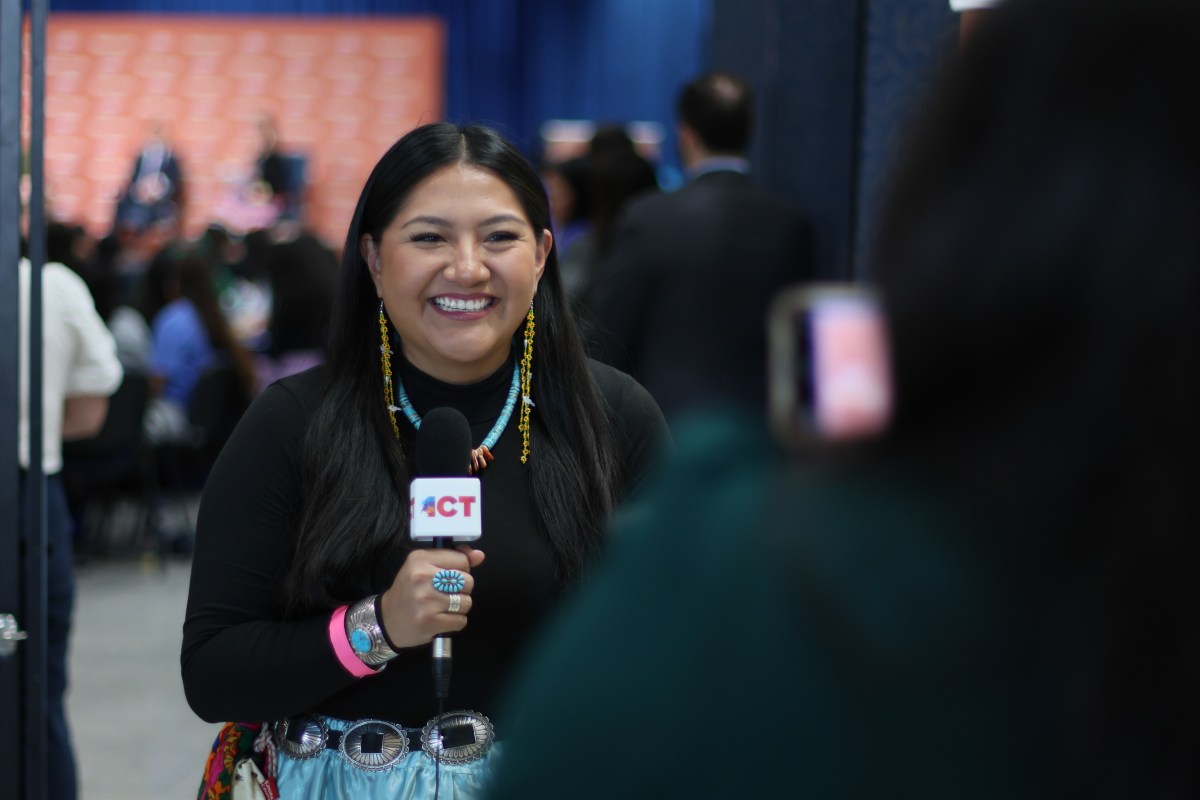
WASHINGTON — I wish I could explain in depth what it felt like to be an Indigenous political correspondent during the Biden administration, but you just had to have been there to witness the juxtaposition of a young government and the millennia stitched into our regalia, representing nations more vibrant than people outside our communities will ever understand.
At every event I covered, our Indigenous leaders — who work for state, federal and tribal governments — made it clear that this place was meant for me too. Their presence alone made me feel more confident and comfortable in sterile buildings where others often stared at me because I was dressed in my traditional clothes. My moccasins landed on cold, smooth marble as I searched for hearing rooms in the Longworth or Rayburn buildings. My three tiered Navajo skirt flared out while I tried to get people for interviews before they left to catch their planes back home.
Our leaders, especially those from my own nation, made every federal hearing room, the Department of the Interior, Hubert H. Humphrey’s Building, the East Wing of the White House, the courtyard of the Pentagon, Capitol Hill and Treasury feel like home. I never felt like an outsider here, and I certainly never felt alone.
As Elizabeth Rule wrote in her book, “Washington, DC, exists as the political capital of Indian Country.”
I’ve been blessed to connect with Native people just walking around this city. The first week I got here a woman from Kickapoo said hi to me and Jourdan as we crossed the street near the White House. On another day, a group of people from Jemez Pueblo in New Mexico stopped me on the street in front of the Capitol to ask me where I was from. After interviewing Chris James, executive director for the National Center for American Indian Enterprise Development, a couple weeks earlier, I met him in-person on the corner outside my office building on I and 18th Street NW. I couldn’t believe it.
Holly Cook Macarro, Red Lake Nation, first came to Washington, D.C., as an intern for the White House in the 90s. She told me that I was lucky to have been here at a time when so many people I reported on looked like me. She told me about how it wasn’t always, or really ever like this. I didn’t truly understand how lucky I was until I thought of Richard LaCourse, Mark Trahant and Jourdan Bennett-Begaye who reported from the District during times that the federal government didn’t center or even include Indigenous people.
I had an experience as a political correspondent in Washington, D.C., like no one else before me.
Former President Joe Biden, made it possible for me to meet and interview the first Indigenous cabinet member and first Indigenous U.S. Treasurer. Nothing can prepare you for the feeling of seeing Indigenous women in such powerful roles. The pull of awe and respect was heavy in my chest, the feelings eventually pooled in my eyes, and spilled over with tears of joy when I got to witness their leadership. I get emotional just thinking about it now.
Former Interior Sec. Deb Haaland, Laguna Pueblo, and former U.S. Treasurer Chief Lynn Malerba, Mohegan, meant so much to me personally. Like the rest of Indian Country, I got to see myself reflected in them and their accomplishments. They are proof to me that anything is possible.
The DC Native community is small but thriving. Again, I was lucky to have three friends all from back home here in DC, and was able to make two more Diné friends while I was here. Yes, all my friends are Diné and from the southwest. (I can confirm, Navajos are everywhere, naye.)
I’m so grateful that for the almost three years I was able to call this place home. Like so many other Indigenous people before me, I came here because I wanted to make a difference, and I wanted to be of service to my nation and others. I’m just another person carrying on this legacy in the hopes that someone decides to pick up where I left off and carry it further. Hopefully, further than I ever dreamed possible.
To the next Indigenous political correspondent based in Wáshindoon, you’re not alone, nothing is more important than eating, and we’re all so proud of you. You’re going to do great! I believe in you.
This was a long-winded ndn way of saying, I will no longer be the political correspondent for ICT and next week will step into my new role as a climate correspondent. I will be based in Missoula, Montana. Big Sky gained one new Indigenous journalist.
Skoden!

Our stories are worth telling. Our stories are worth sharing. Our stories are worth your support. Contribute $5 or $10 today to help ICT carry out its critical mission. Sign up for ICT’s free newsletter.

