News Release
Model United Nations Indigenous
Model United Nations Indigenous (MUNI), founded by Sicangu Lakota student Nathan Balk King, is entering its third year with a Call for Delegates (application here) to attend the largest and most prestigious Model UN conference in the world, the National High School Model United Nations Conference (NHSMUN) in New York City, March 15th-18th. The deadline for application is January 24th. Model United Nations (MUN) is a student simulation of the proceedings of the United Nations*, and NHSMUN typically has over 5000 students from 74 countries in attendance (NHSMUN.nyc).
MUN Indigenous Student Delegates will meet weekly via Zoom, January 28 – March 10, to prepare for the NHSMUN Conference. MUNI is a 501c3 non-profit project under the fiscal sponsorship of the Provincetown Community Compact and actively fundraises for the costs of the conference and travel (to donate, click here); Delegates participate in fundraising for the travel and conferences fees, and need-based scholarships are available through MUNI fundraising efforts.
MUNI’s goals are 1) to offer Native youth training in international diplomacy, human rights and public policy and host a delegation at the annual NHSMUN Conference, and 2) facilitate and support the creation of MUN Indigenous clubs at high schools across the country. MUNI club creation is open to tribal and non-tribal, public and private schools, and a group of Native American students at any school may form an independent MUNI club. (for more information, click here)
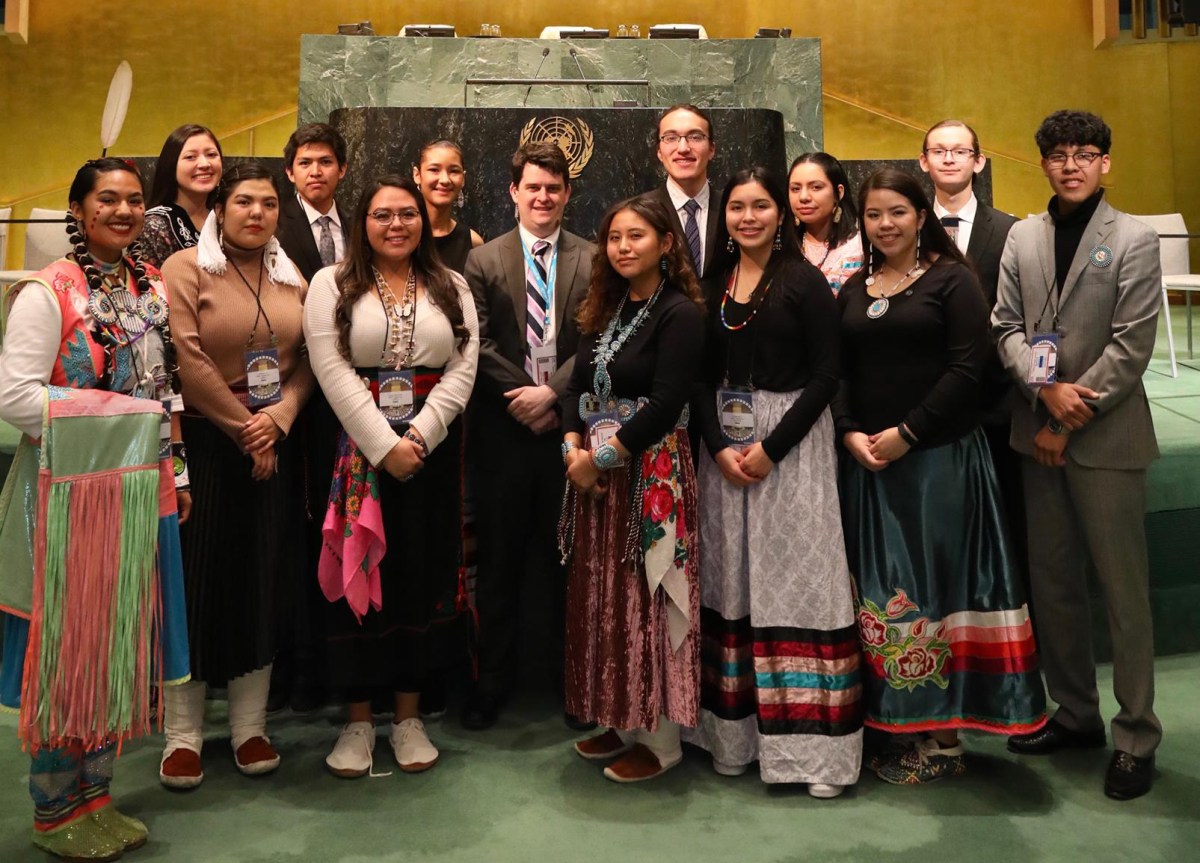
MUNI successfully launched at the 2019 NHSMUN conference with a group of 13 outstanding Native American student scholars hailing from across the United States, being the first-ever indigenous delegation in the Conference’s 45-year history. In addition, IMUNA, the host organization, endorsed MUNI (see letter of endorsement below) and included the UN Permanent Forum on Indigenous Issues (UNPFII) as part of their program in 2019 also for the first time.
“MUNI was the first-ever group to represent the voices of Indian Country at NHSMUN,” said Balk King, “and I am especially proud that we had four delegates in the UNPFII simulation. Our delegation not only learned about human rights diplomacy, but also had the opportunity to represent indigenous peoples to the global youth community. We were honored to represent our communities and our tribes at this largest Model United Nations gathering in the world.”
Model United Nations Indigenous has been granted Consultative Status with the United Nations, and two of the MUNI 2019 NHSMUN Delegates went on to attend the 2019 UN Permanent Forum on Indigenous Issues (UNPFII). 2023 Delegates may also be granted the opportunity to participate at the 2023 UNPFII Session at the United Nations Headquarters in NYC April 17-23.
King, currently a senior majoring in Physics at the University of Massachusetts Commonwealth Honors College, attended the NHSMUN Conference in 2018 with the MUN Club from Sturgis Charter Public High School West, and noted that “It was amazing to meet students from all over the world…but about two days into the conference, I noticed that there were no other Native American youth there.” In response, he created MUN Indigenous, a startup non-profit organization to support Native youth experiential leadership education through the Model UN program.
Chris Talamo, Executive Director of the International Model United Nations Association, endorses and continues to support MUN Indigenous: “Because of the various costs involved, Model UN, the world’s most popular debate activity, is largely dominated by students from wealthy, privileged schools. Many schools in lower-income communities may only be able to afford short conferences in their area, or they may not have a MUN program at all. This dramatically skews the voices that are heard at the world’s leading MUN conferences. When only the world’s most privileged kids are discussing the issues that affect some of the world’s most marginalized, including indigenous peoples, those living in extreme poverty, international refugees, and labor rights, the simulation is inherently skewed. There are no authentic voices that can relate to the challenges experienced by the people they are trying to help.”
* “Model United Nations (MUN) is a student simulation of the proceedings of the United Nations. Students, referred to as Delegates, are assigned a country to represent in one of the UN’s numerous committees with pre-set topics to debate. They research the background of their country, their country’s position on the topics at hand, and prepare notes on possible solutions to the problems faced. Students then convene at Model UN conferences, which range in size from 100 to 5,000 delegates, to debate their assigned topics with students representing the other UN member states. Much like the real UN, the goal is to identify solutions, by negotiation and consensus, on which many countries can agree.” (NHSMUN.nyc)