News Release
Central Council Tlingit and Haida Indian Tribes of Alaska
Nine objects of cultural patrimony removed from Wrangell, Alaska in the 1940s are now back home in the hands of the Naanya.aayí clan after a years-long process.
These objects include a Killerwhale Hat from the original Chief Shakes House Flotilla of Killerwhale Hats (pictured right); Killerwhale Flotilla Chilkat Robe; Killerwhale Stranded on a Rock Robe; Mudshark Hat; three Mudshark Shirts; Killerwhale with a Hole Fin; and a Storm Headdress.
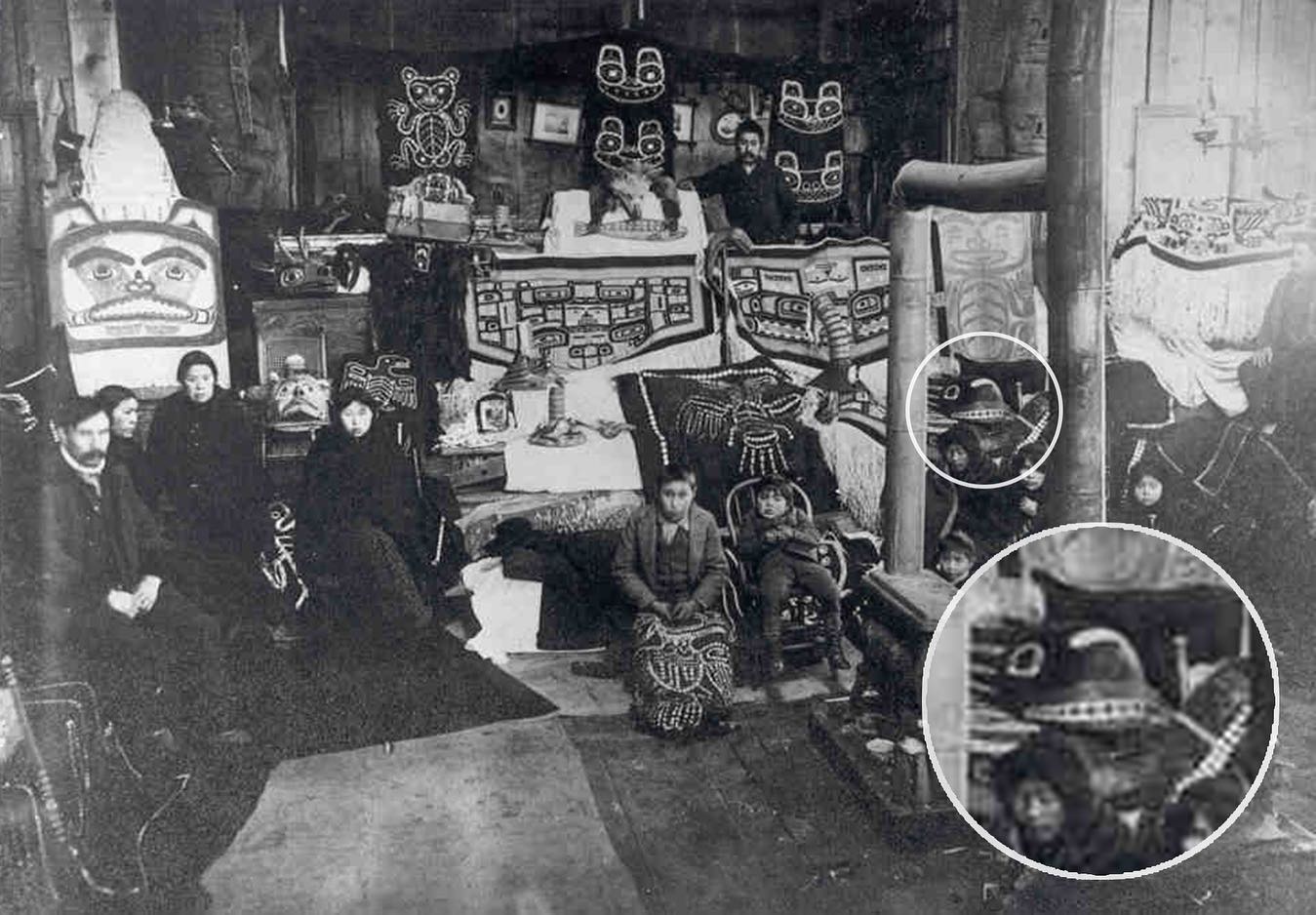
The Sxh’at Kwaan (Wrangell People) once had 31 clan houses, 7 of which were from the Naanya.aayí clan. These objects are from X’átgu Naas’i Hít (Mudshark Intestines House), one of the Naanya.aayí’s clan houses which once stood on Shakes Island in Wrangell.
The late Arnie Dalton (1944-2001), Yaxhgoos, shared that his mother Betty Carlstrom (1925-1994) remembered as a child when several of these objects were taken away. “She was six years old when her great-grandma died and she remembered the Wrangell police coming in the house and just grabbing the trunks with the objects,” he shared during an interview in 1986.
Arnie was a carver and refurbished the totem pole at Auke Rec in Juneau, Alaska in 1993 after it was burned by vandals. He often talked about how the objects should be returned.
The Portland Art Museum acquired these objects and five others when it purchased the Axel Rasmussen Collection of more than 800 objects in 1948. Rasmussen had been the superintendent of schools in Wrangell (1921-1937) and in Skagway, Alaska (1937-1944).
Following extensive research and documentation, Tlingit & Haida submitted a repatriation claim to the Portland Art Museum on behalf of the Naanya.aayí clan under the Native American Graves Protection and Repatriation Act (NAGPRA) in 2002. After years of staff changes at the museum and other issues, including delays caused by COVID-19 restrictions, the claim was approved and the objects were formally deaccessioned from the museum’s collection and repatriated to the Naanya.aayí clan.
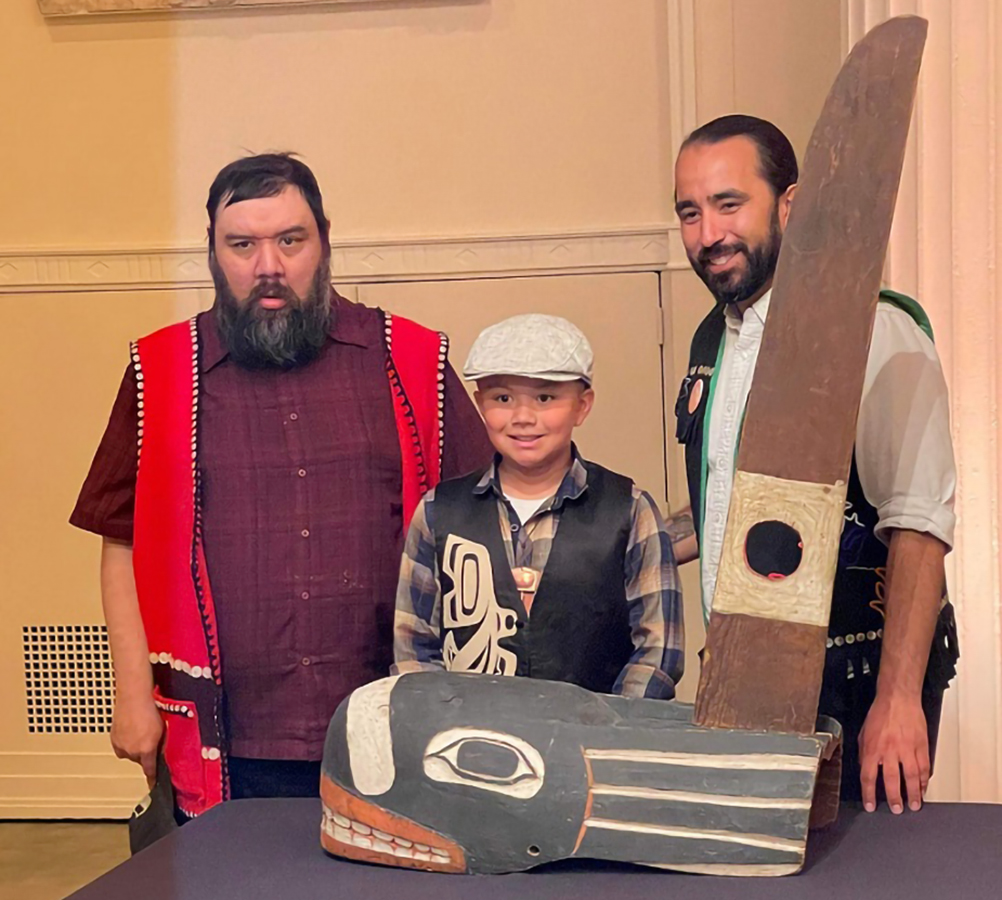
On May 27th, a reception was held at the museum and attended by museum staff, lineal descendants of X’átgu Naas’i Hít, and Tlingit & Haida representatives. A closed ceremony with lineal descendants and clan leaders of the Wrangell Kiks.ádi and Teeyhítaan clans was held just before that with Tlingit & Haida and museum staff to clear a path home for the objects.
Arnie’s great nephew, Kevin Callahan, attended the event and shared, “I am forever grateful to Tlingit & Haida’s Native Lands & Resources division for everything that was done to make this happen. It’s as if lost orphans have finally been allowed to come home after being lost for so long.”
Luella Knapp of the Naanya.aayí clan and member of the Wrangell Cooperative Association is caretaker of some clan objects and shared, “We are so grateful for all of the work that was done to return the Naanya.aayí clan’s atóow. As a caretaker of these clan items, it is an honor. Receiving them back, one by one, brings back the spirit of the person who wore them. We are so happy to have them returned to Wrangell’s Naanya.aayí.”
“The Tribe shares its deep passion and commitment to support our clans — today the Naanya.aayí — to bring our ancestors home,” said Tlingit & Haida’s Chief Operating Officer Roald Helgesen. “Háw’aa, Gunalchéesh to the Portland Art Museum for their recent efforts to repatriate our ancestors. Our clans and our people know our ancestors through song and story. Reuniting our ancestors with our people is a humbling honor.”
Kathleen Ash-Milby, who is a member of the Navajo nation, is the Curator of Native American Art for the Portland Art Museum. She said repatriation was one of her top priorities when she took the position three years ago.
“I understand that these objects shouldn’t have been collected in the first place. These objects are of cultural patrimony and that’s meaningful. They never should have been sold,” Ash-Milby said. “By returning these ancestral objects to their communities, we can begin to repair a complicated history between Indigenous people and museums. It has been an honor to help with the final steps of this repatriation and see these ancestors finally swim home.”
The repatriated objects were expected to arrive today. However, due to delayed shipping with Alaska Airlines, the objects are now expected to arrive June 8th. Clan members will use the objects as the Wrangell dance groups lead the Grand Entrance for Celebration, a biennial event hosted by Sealaska Heritage Institute that will be livestreamed on Sealaska Heritage Institute’s YouTube channel.
For more information on the repatriated items, contact Native Lands & Resources Director Desiree Duncan at dduncan@ccthita-nsn.gov or 907.463.7183.
Our Mission
“Preserve our sovereignty, enhance our economic and cultural resources, and promote self-sufficiency and self-governance for our citizens.”