
María Verza
Associated Press
SIMOJOVEL, Mexico — At a recent service in the remote southern Mexican community of Simojovel, Catholic and Mayan symbolism mingled at the altar as the deacon — his wife beside him — read the gospel in his native Tsotsil and recalled Pope Francis’ teachings: work together for human rights, justice and Mother Earth.
The scene in the small church in Mexico’s poorest state, Chiapas, conveyed much of the message Francis delivered during his 2016 trip to the region and his other visits to far-flung locales, including the Amazon, Congo and the jungles of Papua New Guinea.
It also illustrated what the world’s Indigenous Catholics don’t want to lose with the death of the first pontiff from the Southern Hemisphere: their relatively newfound voice in an institution that once debated whether “Indians” had souls while backing European powers as they plundered the Americas and Africa.
“We ask God that the work (Francis) did for us not be in vain,” Deacon Juan Pérez Gómez told his small congregation. “We ask you to choose a new pope, a new servant, who hopefully Lord thinks the same way.”
Empowering Indigenous believers
Francis was the first Latin American pope and the first from the order of the Jesuits, who are known for, among other things, their frontline work with society’s most marginalized groups. Although some feel Francis could have done more for their people during his 12 years as pontiff, Indigenous Catholics widely praise him for championing their causes, asking forgiveness for the church’s historical wrongs, and allowing them to incorporate aspects of their Native cultures into practicing their faith.
Among the places where his death has hit particularly hard are the lowlands of the Bolivian Amazon, which was home to Jesuit missions centuries ago that Francis praised for bringing Christianity and European-style education and economic organization to Indigenous people in a more humane way.
Marcial Fabricano, a 73-year-old leader of the Indigenous Mojeño people, remembers crying during Francis’ 2015 visit to Bolivia when the pope sought forgiveness for crimes the church committed against Indigenous people during the colonial-era conquest of the Americas. Before the visit, his and other Indigenous groups sent Francis a message asking him to push the authorities to respect them.
“I believe that Pope Francis read our message and it moved him,” he said. “We are the last bastion of the missions. … We can’t be ignored.”
That South American tour came shortly after the publication of one of Francis’ most important encyclicals in which he called for a revolution to fix a “structurally perverse” global economic system that allows the rich to exploit the poor and turns the Earth into “immense pile of filth.” He also encouraged the church to support movements defending the territory of marginalized people and financing their initiatives.
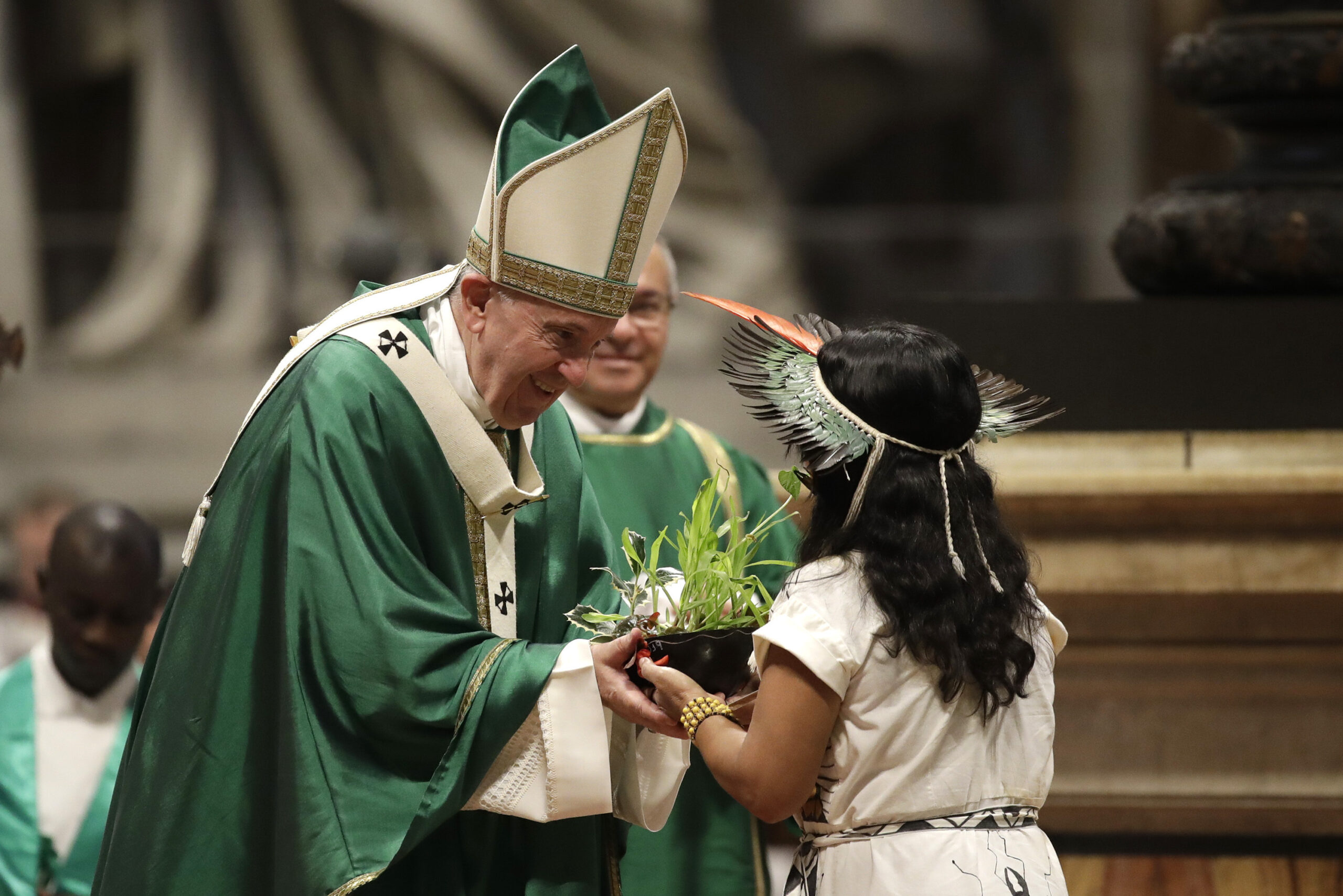
“For the first time, (a pope) felt like us, thought like us and was our great ally,” said Anitalia Pijachi Kuyuedo, a Colombian member of the Okaira-Muina Murui people who participated in the 2019 Amazon Synod in Rome, where Francis showed interest in everything related to the Amazon, including the roles of women.
Pijachi Kuyuendo, 45, said she hopes the next pope also works closely with Native people. “With his death, we face huge challenges.”
A wider path for the church
Pérez Gómez, 57, is able to help tend to his small Tsotsil Catholic community in Mexico because the church restarted a deaconship program under Francis.
Facing a priest shortage in the 1960s, the church pushed the idea of deacons — married men who can perform some priestly rituals, such as baptisms, but not others, such as conducting Mass and hearing confession.
Samuel Ruiz, who spent four decades as bishop of San Cristóbal de las Casas trying to improve the lives of Chiapas’ Indigenous people, saw deaconships as a way to promote the faith among them and form what he called a “Native church.” The deaconship initiative was such a hit in Ruiz’s diocese, though, that the Vatican halted it there in 2002, worried that Ruiz was using it as a step toward allowing married priests and female deacons. The halt was lifted in 2014.
Pérez Gómez, who waited 20 years before he was finally ordained a deacon in 2022, said he was inspired by Ruiz’s vision for a “Native church.” He said Francis reminded him of Ruiz, who died in 2011 and whom he credits with explaining the church’s true purpose to him as “liberator and evangelizer.”
“Francis also talked about liberation,” Pérez Gómez said, adding that he hopes the next pope shares that view.
New ways to celebrate Mass
It had been a half-century since the Vatican allowed Mass to be held in languages other than Latin when Francis visited Chiapas in 2016 and went a step further.
During a Mass that was the highlight of his visit, the Lord’s Prayer was sung in Tsotsil, readings were conducted in two other Mayan languages, Tseltal and Ch’ol, congregants danced while praying and Indigenous women stood at the altar.
Chiapas was a politically sensitive choice for the Pope’s visit, which wasn’t easily negotiated with the Vatican or Mexican government, according to Cardinal Felipe Arizmendi, who was then bishop of San Cristobal. In 1994, it saw an armed uprising by the Zapatistas, who demanded rights for Indigenous peoples.
Getting the Vatican to allow Mayan rituals in the Mass was also tricky, but Arizmendi recalled that there was a helpful precedent: Congo.
In 1988, the Vatican approved the first cultural innovation in a Mass, the so-called Zaire rite, which is a source of national pride and continental inclusion, said the Rev. Abbé Paul Agustin Madimba, a priest in Kinshasa. “It shows the value the church gives Africans.”
Francis cited the Zaire rite, which allowed some local music and dance to be incorporated into Mass, to argue for such accommodations with other Indigenous Catholics around the world.
The decision was made not only to expand Catholicism, which is in retreat in many places, “but also a theological act of deep listening and conversion, where the church recognizes that it is not the owner of cultural truth, but rather servant of the gospel for each people,” said Arturo Lomelí, a Mexican social anthropologist.
It was the Vatican’s way to see Indigenous rituals not as “threats, but rather as legitimate ways to express and live the faith,” he said.
‘No longer objects’
On the Saturday after Francis’ death, Pérez Gómez stopped by a church in the town near his village to pick up the Communion wafers he would give out during his service the next day. Because he’s a deacon, he needs a priest to consecrate them for him ahead of time.
He and his wife, Crecencia López, don’t know who the next pope will be, but they hope he’s someone who shares Francis’ respect for Indigenous people. And they smile at the thought that perhaps one day, he could become a priest and she a deacon.
“We are no longer objects, but rather people” and that is thanks to God and his envoys, “jtatik Samuel (Ruiz)” and “jtatik Francis,” Pérez Gómez said, using a paternal term of great respect in Tseltal.
Associated Press writers Carlos Valdez in La Paz, Bolivia, Fabiano Maisonnave in Brasilia, Brazil, and Jen-Yves Kamale in Kinshasa, Congo contributed to this report.
