
Renata Birkenbuel
Special to ICT
For many new high school graduates, a key question remains: What kind of fields exist for those who don’t necessarily want to go to college?
For a growing number of graduates, trade and technical schools are the obvious choice, with demand increasing for skilled workers in a number of fields, including construction, health care and energy.
Two-year public institutions with a focus on vocational programs saw double-digit growth for the second year in a row in 2024, and now make up nearly 20 percent of the enrollment in two-year programs, up from about 15 percent in 2019, according to the National Student Clearinghouse Research Center.
Jerlynn Henry, the student services dean at Navajo Technical University in Crownpoint, New Mexico, sees first hand the advantage to a vocational trades program.
“It’s something that our students can come in and go out right away within just three semesters and they can find a job,” Henry told ICT.
“A lot of the things that they do, it’s all hands-on and they get all the materials that they need in a bundle from the beginning,” she said. “And then they utilize all that and then they do all the hands-on work, and toward their last semester, they go out into the field and they actually do the work.”
The vocational or trade schools have far out-paced post-secondary education. The national clearinghouse reported in January that student postsecondary enrollment in the fall of 2024 had increased nearly 5 percent since pre-COVID levels, including undergraduate and graduate studies.
But at two-year institutions with a vocational focus, enrollment soared 16 percent from 2022 to 2023, and nearly 14 percent in 2024, according to the report. Among Native students, enrollment in two-year schools climbed nearly 17 percent from 2020 to 2024.
The highest enrollment in all post-secondary institutions for Native Americans was among those, perhaps predictably, 18-20 years old, though the number of students 30 years old and older ranked second, the report found. Enrollment among both age groups had also continued to increase the last several years.
“Among trade-focused programs, Mechanic and Repair Technologies at undergraduate 2-year institutions logged a second year of double-digit growth, gaining 16,000 students [in fall 2024],” the report concluded. “Construction trades saw double-digit growth for the first time,” up nearly 21 percent.
Fast-track options
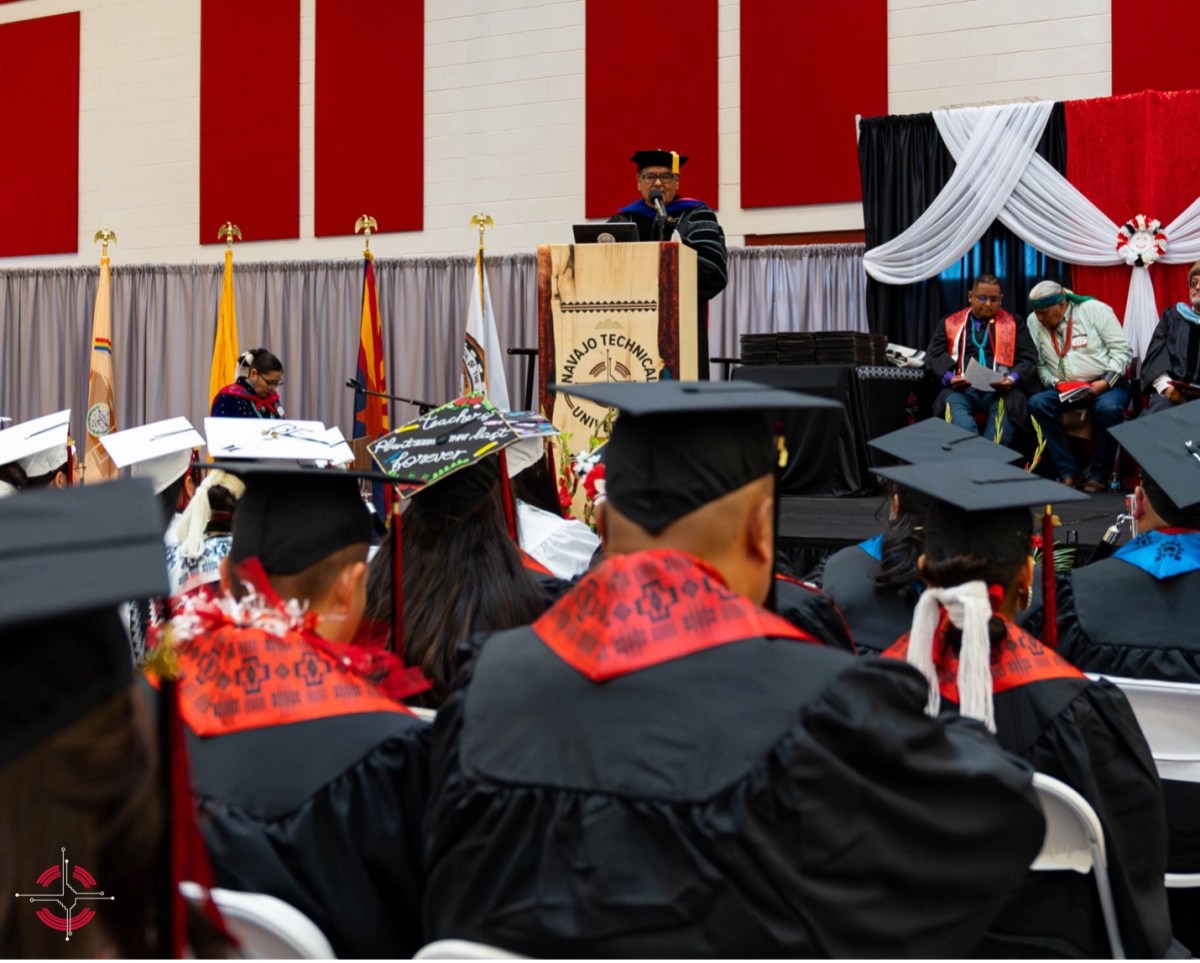
The Navajo Technical Institute, or Navajo Tech as it’s called, is a full-on university, but it’s also a hands-on trade school for students who want to learn a fast-track trade certificate.
Henry, the student services dean, oversees 16 departments, so she possesses a bird’s eye view of the varied opportunities at the institute for those who forgo a strictly academic track.
With practicality at its core, the trades offer vital experience that will help students immediately in the working world. But they can also help students complete general academic requirements while studying a specific trade, according to Dolores Becenti, Navajo, the dual credit enrollment director at Navajo Tech.
“They still take the general education, like math, English and so forth,” Becenti said. “And those are [for] the electrical trades, construction tech, automotive and welding.”
Several trades are offered at Navajo Tech for those planning for the future, including electrician, carpentry, welding, automotive technician, electrician and commercial truck driver.
The length of time to earn a certificate depends on the program, but two or three semesters remains the norm.
“The only one that’s short is a six-to-eight week [program for] the commercial driver’s license and usually they only take three or four students,” Becenti said.
As a dual credit expert, she guides public, parochial, Bureau of Indian Education and private high school students across two states in jump-starting their college careers.
“We enroll an average of 500 [dual credit] students every semester,” Becenti said. “So I work with 28 high schools in Arizona and New Mexico.”
For high school students who seek to become first-generation college graduates and who may be daunted by the demands of college, dual credit can build confidence.
“We go based on each state’s terminology, but in general it is a high school student who is taking a college course simultaneously,” Becenti said. “So they earn the college credit. They also earn their high school credit.”
Award winners
Every year students from around the country — including Navajo Tech students — compete in serious competitions at the American Indian Higher Education Consortium, a large unifying collective of tribal colleges and universities.
Navajo Tech students placed in at least nine wide-ranging categories at the most recent consortium, which met in Rapid City, South Dakota, in March.
Among the first-place Navajo Tech finishes were teams in hand games; Wyatt Billey in oral science presentations; volleyball champs; and film festival champs Dylan Dale, Rayferd Livington, Tevielyn Yazzie, Hailey Mae, Jeremy Hosteen and Antonio Velencia, for “Dream Walk.” Della Wilson finished second-place in oral science presentations.
Navajo Tech students placed in other competitions as well, including robotics, tribal college journal-writing presentations, photography, cybersecurity and archery.
Business students brought home gold in another recent competition, as Navajo Tech’s American Indigenous Business Leaders Club captured the Tribal College Division Chapter of the Year award during the National Business and Leadership Student Conference in Las Vegas in March.
Regional options
Navajo Tech’s main campus is on the Navajo Nation in northwest New Mexico, but satellite campuses and instructional sites exist in Kirtland and Zuni near Gallup, plus Arizona locations in Chinle and Teec Nos Pos.
Navajo Tech also offers transportation, among other advantages.
“We are right in their backyard,” Becenti said. “If you’re talking about the Navajo Nation, that’s our primary population. Ninety percent of our students are of the Navajo tribe.”
Other advantages to enrolling in Navajo Tech include low tuition, plenty of faculty, a wide variety of services and a place to live, with housing offering at the main campus.
“We provide what is called the Opportunity Scholarship of New Mexico,” said Becenti. “So a lot of students who end up enrolling with us, their tuition is paid, especially the first-year students.”
Students will also get personalized attention.
“We have a small student-to-faculty ratio,” Becenti said. “So they’re not just a number … we also have wrap-around services for the students. And at the main campus we have housing for students … We also have transportation that goes to local communities to pick up students and also take them back.”
The New Mexico Opportunity Scholarship provides tuition and fee assistance for New Mexico residents who meet eligibility and pursue a training certificate, associate degree or bachelor’s degree at a New Mexico public college or university.
Navajo Tech also offers a library, cafeteria, child care, a student union building, tutoring services, counseling and financial aid experts.
Academics co-exist with trades
Overall enrollment in the fall semester of 2024 at Navajo Tech was 1,488 students.
That includes the academic track side, too, including a new one-of-a-kind doctoral program in the Diné Culture and Language Sustainability, started in 2023. It is the first accredited doctoral program of its kind at a tribal college or university.
The inaugural doctoral program is designed to produce scholars who can conduct research, teach and lead efforts to retain the culture, language and leadership of the Navajo people.
Mary Whitehair-Frazier, Diné, is set to graduate in 2028 with her language doctorate. She deftly explains the connections among the stories, teachings, prayer, culture, history and language revitalization systems for new generations considering pure academics.
“As a speaker, it’s my responsibility,” she told ICT. “I see this academic journey as a way to sustain Diné Bizaad (the Navajo language) for future generations.”
Both traditional and academic tools are key, she added. Hands-on learning — not unlike technical trade requirements — plays a big role.
“A big part of my program is rooted in real-world, community-based learning,” said Whitehair-Frazier. “My work as a language warrior must not be limited to classrooms or academic papers. The knowledge is grounded in lived experience.”
She studies with elders and fluent speakers to build relationships, learn protocols and honor traditional ways of sharing knowledge. She leads language immersion camps for young people, who delve into traditional activities such as land-based learning, weaving, singing and storytelling – all while speaking Navajo.
“These experiences help the language live outside of a textbook,” Whitehair-Frazier said. “For me, that’s the most powerful kind of learning.”

