
Nika Bartoo-Smith
Underscore Native News + ICT
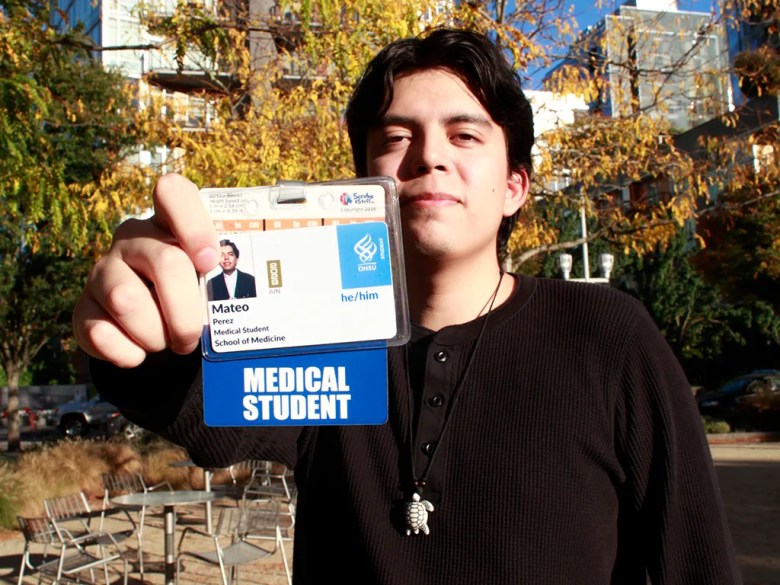
For 23-year-old Mateo Perez, Picuris Pueblo, Santa Clara Pueblo and Cochiti Pueblo, school has always been a main focus of his life. That love for learning came from his family, particularly his paternal Grandma, Ellen Perez, who was an educator in Santa Fe, New Mexico for decades, while also raising a family of three.
Ellen Perez was an educator for over 40 years, teaching for decades and eventually becoming a principal at Larragoite Elementary School. She also served as a District Coordinator for Early Childhood and After School Programs in Santa Fe Public Schools for some time. She eventually retired from Santa Fe Indian School, where she worked as an administrator until retiring in 2024.
“She made sure my dad had a good education and then that value has been instilled in my family,” Perez said.
Perez is now in his first year of a four-year medical program at Oregon Health & Sciences University (OHSU), leaning toward a track in psychiatry. His goal is to blend Indigenous knowledge and Western teachings into the medicine he decides to practice.
“Something about [the blending] is really fascinating to me,” Perez said. “As a person, I’m already a blend of a lot of different Pueblos.”
Discovering a love of medicine
A self-described urban Native, Perez grew up in Santa Fe, New Mexico with his mom, dad, younger brother and grandparents all playing influential roles in his life. Some of his favorite memories from childhood are dancing during Feast Days for both Picuris Pueblo and Santa Clara Pueblo.

“I learned that I loved it a lot during practice, because of the drums and being with other people,” Perez said. “It feels very powerful, feels very soothing, relaxing, to me.”
Since he began undergrad at Dartmouth in 2020, Perez hasn’t been back home for Feast Days due to classes beginning in August. But he plans to return as soon as he can.
Perez’s dream to attend an Ivy League College in New Hampshire, began with a bumper sticker. He remembers staring at a weather-worn Dartmouth sticker on the bumper of the red family Jeep before realizing what it was. As he got older, he remembers his dad, Matthew Perez, talking about his own experience going to undergrad at Dartmouth and graduating in 2001.
Following in his father’s footsteps, Perez started at Dartmouth in 2020. He graduated in 2024 with a degree in biology, modified to add psychology coursework.
Perez’s interest in science, which first sparked a dream of med school, hit him when he did a project about CRISPR-Cas9 gene editing for a high school class. That research led him down a rabbit hole of curiosity, fascinated with learning more about new scientific breakthroughs in medicine.
The summer between Perez’s junior and senior year, he took part in the Native American Summer Research Internship, a 10-week long program in Salt Lake City Utah. He came back the following year.
During the summer internship, each student was paired with a mentor. That first summer, Perez’s mentor was a Native anesthesiologist, Aaron Smith, Navajo, who helped further inspire Perez’s interest in medicine.
“I thought it was really cool, what he was doing,” Perez said, describing conversations about the kind of work he was able to do in anesthesiology. “He was also the first Native doctor I met, like, ever.”
That left a lasting impression on Perez, who hopes to return home after finishing medical school and work as a psychiatrist, supporting other Indigenous people on their mental health journeys.
Finding a path through programs and mentorships for Native youth
The year after graduating from Dartmouth, Perez flew to Portland, Oregon to join the Wy’east Medicine pathway. The pathway is a 10 month post-baccalaureate health education program for American Indian and Alaska Native students. Students are paid a monthly stipend so that they can focus on school. They spend the 10 months taking classes that prepare them for the MCAT and then medical school. At the end of the program, students from the cohort also get conditional acceptance to OHSU, as long as they pass the MCAT, which the program pays for.

“The goal is that you go through a year-long post-bac program that prepares you for starting medical school,” Perez said, explaining his time with the program. “Then you do a year of foundational science classes and population health classes, that’s the core of it.”
Allison Empey, MD, citizen of the Confederated Tribes of Grand Ronde, wishes the program had existed when she was going through med school. Empey is the director of the Wy’east Medicine Pathway and has been with the program since the first cohort of students came onboard in 2017. Since she started, 82 scholars, representing 40 different Native nations, have gone through the program.
“Our students bring a wealth of knowledge that I think is important for everyone’s health care,” Empey said. “It’s not just elevating the health of American Indian and Alaska Natives, but it’s elevating the health of everyone, and it’s elevating the medical education of everyone who gets to be in the school with them.”
Since graduating from the program this summer and starting med school at OHSU this fall, Perez has begun mentoring a student from New Mexico through the Wy’east program.
That continued mentorship is exactly in-line with another goal of Perez’s, that came out of his involvement with the We Are Healers Program that he began in January. The goal of the 12-month program is to help young Native medical students engage in the community and amplify Native voices in medicine.

As one of the 15 students in this year’s Healers Community Cohort, the biggest cohort thus far, Perez is required to work on a project that will reimagine community health. He chose to document his own journey into medicine. He is hoping to inspire other Pueblo youth back home to pursue a future in a medical field.
“I had never even heard of a Pueblo person thinking about medicine or becoming a doctor,” Perez said. “I didn’t know any Native doctors at all. I want to at least have something where other Pueblo students can be like, ‘Okay, there was someone from my Pueblo who did that.’”
Perez’s biggest piece of advice for Indigenous students interested in medicine is to apply to as many programs for Native students as possible.
With three and a half years to go of med school, Perez is still on the beginning of his journey but he already spends time reflecting on all the programs that helped get him to where he is. And the importance of mentorship from Indigenous medical providers.
“Find where your community is at, especially in college,” Perez said. “Apply for programs that can help you during one section of your journey.”

