
Petala Ironcloud
Special to ICT
LENAPE LANDS — Mainstream fashion funding sources continue to ice out the Indigenous fashion world. The latest example was Indigenous New York Fashion Week.
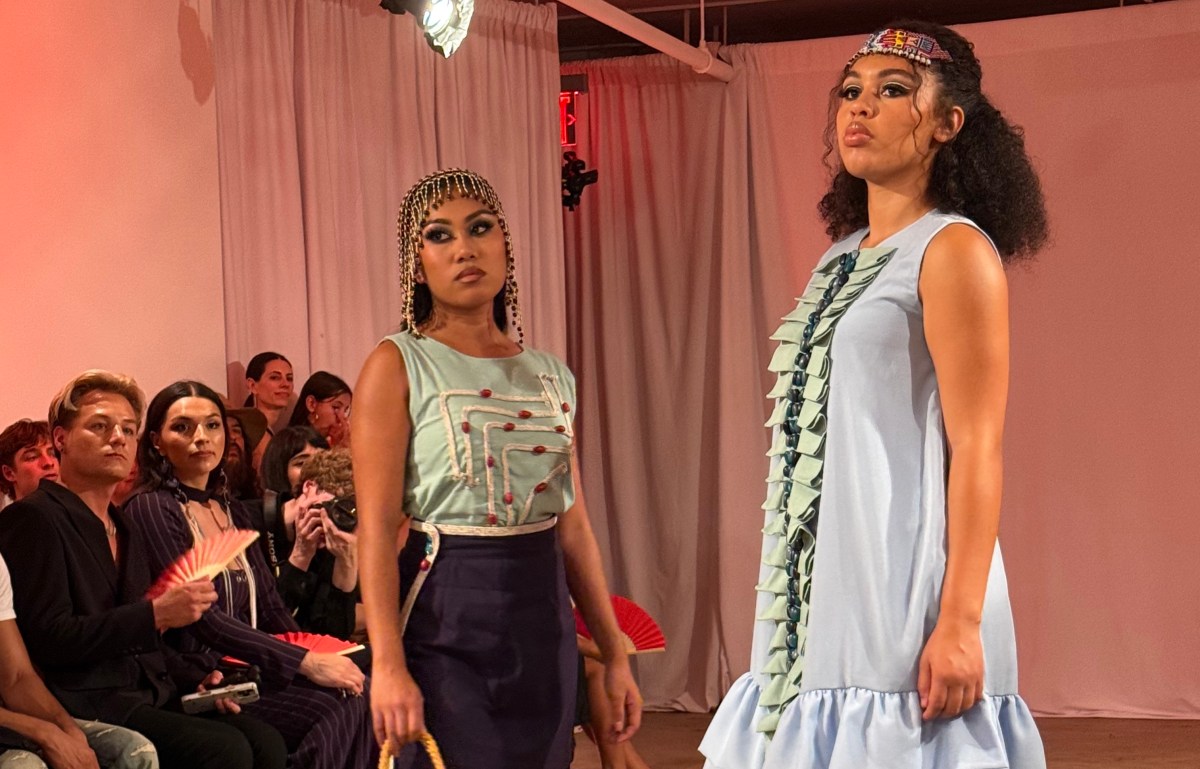
Indigenous New York Fashion Week just completed its second annual event in September, a major accomplishment and feat in one of the fashion capitals of the world.
Organizers Korina Emmerich, Puyallup, and Liana Shewey, Muscogee (Creek), had convinced the Council of Fashion Designers of America to list the three-day event’s 30 designers on its official New York Fashion Week calendar, which is a mark of industry legitimacy that – this time as last – came with no financial backing.
The Council of Fashion Designers of America, a nonprofit trade organization, doesn’t automatically fund New York Fashion Week-listed designers, rather, it runs a mixed grant program: some are application-based, others are curated selections by the organization. In the past, the organization also offered crisis interventions for COVID-19, and domestic manufacturing initiatives. All opportunities that Indigenous New York Fashion Week qualified for as a slate of Indigenous designers producing on Native land. However, none of these funding avenues were offered, according to Emmerich and Shewey.
No one approached the organizers with money opportunities, Emmerich said.
“Our relationship with the CFDA (the trade organization) was purely based on continually putting pressure on New York Fashion Week… to include Indigenous designers,” Emmerich said. “So, while we were listed on the New York Fashion Week calendar, we were not in partnership with the CFDA, nor did they give us any money.”
She adds: “These things that look fancy – they’re not giving us money.”
The trade organization declined to comment on the financing gap after multiple requests from ICT.
Community members, family, and Lumbee founder of Decolonizing Wealth Project Edgar Villanueva led financial support once again and increased his contribution.
Last year, he gifted Emmerich and Shewey $5,000 and dedicated his New York Fashion Week party, previously featured in The Hollywood Reporter, to the duo.
Villanueva ended his five-year run of the party this year and offered $10,000 to Indigenous New York Fashion Week. He stated that Emmerich and Shewey had found visibility and their footing.
Plus Decolonizing Wealth Project’s priorities, which never included fashion before, had changed.
“I don’t hear people supporting fashion [within philanthropy]… fashion has not been an area that I’ve heard of,” Villanueva said. “It’s easy to dismiss fashion as some personal interest thing or some flashy thing that doesn’t actually have real meaning for communities.”
Other funding that came through arrived from a small set of sources: Sherman Foundation gave $20,000 a year for two years via Pratt; Teton Trade Cloth contributed $5,000; Decolonizing Wealth Project’s gift rounds out the total. “It was all in people who knew and supported and wanted to be part of it,” Emmerich said.
“Runway shows are not funded by federal or provincial funding — period,” says Amber-Dawn Bear-Robe, assistant professor of Native and Indigenous Art History and Material Culture at Parsons School of Design in New York City.
For comparison, Fashion Trust is a not-for-profit organization founded by Tania Fares. The organization distributes $500,000 annually to 16 individual designers, which is approximately $31,250 for each designer’s collection.
Emmerich and Shewey, with no comparable backer, gathered a patchwork of funding of roughly $35,000 to produce a three-day event featuring 30 designers.
Fashion Trust funded one designer’s entire season while the other funded an entire week.
“To have an actual good, high-quality, high-production show you need at least a quarter of $1 million and a full-time staff running the programming all year round — this isn’t a put-together-in-a-couple-of-months project,” Bear-Robe told ICT.
Bear-Robe’s background is in art curation. She lent this expertise to the Southwestern Association for Indian Arts in Santa Fe, New Mexico, for more than a decade before moving to New York to work alongside Taos Pueblo designer and “Project Runway” finalist Patricia Michaels in Parsons new Indigenous design faculty group.
Emmerich and Shewey mirror Bear-Robe in terms of a shared refusal of the exploitation of Indigenous design without credit or compensation.
Bear-Robe’s structured approach in Santa Fe was a forward-leaning vision that didn’t materialize for the myriad Native designers she collaborated with there, but it may carry over to New York.
“You need an artistic director, a director of development, a program director, a model director — you need a huge institutional infrastructure that nobody has yet, and Indigenous New York Fashion Week can become that because it’s in the right place … being located in New York City.”
Indigenous designers aren’t the only people critical of the fashion industry’s extractive practices.
Days after Indigenous New York Fashion Week, activists from the People for the Ethical Treatment of Animals disrupted the COS New York Fashion Week show, protesting the brand’s use of wool.
Longtime president and chief executive officer of the Council of Fashion Designers of America, Steven Kolb, was filmed physically retraining two of the activists. The footage led to his resignation days later.
“Steven Kolb just resigned from the CFDA — imagine if the new person stepping in was an Indigenous person, or someone had an Indigenous connection or someone who truly sees value in Indigenous fashion, to make institutional change,” Bear-Robe said. “Institutional change comes when people take leadership positions in non-institutional structures … when Indigenous educators in institutions, such as Parsons, make institutional structural change for generations to come.”

