Greetings, relatives.
A lot of news out there. Thanks for stopping by ICT’s digital platform.
Each day we do our best to gather the latest news for you. Remember to scroll to the bottom to see what’s popping out to us on social media and what we’re reading.
Also, if you like our daily digest, sign up for The Weekly, our newsletter emailed to you on Thursdays. If you like what we do and want us to keep going, support and donate here.
Okay, here’s what you need to know today:
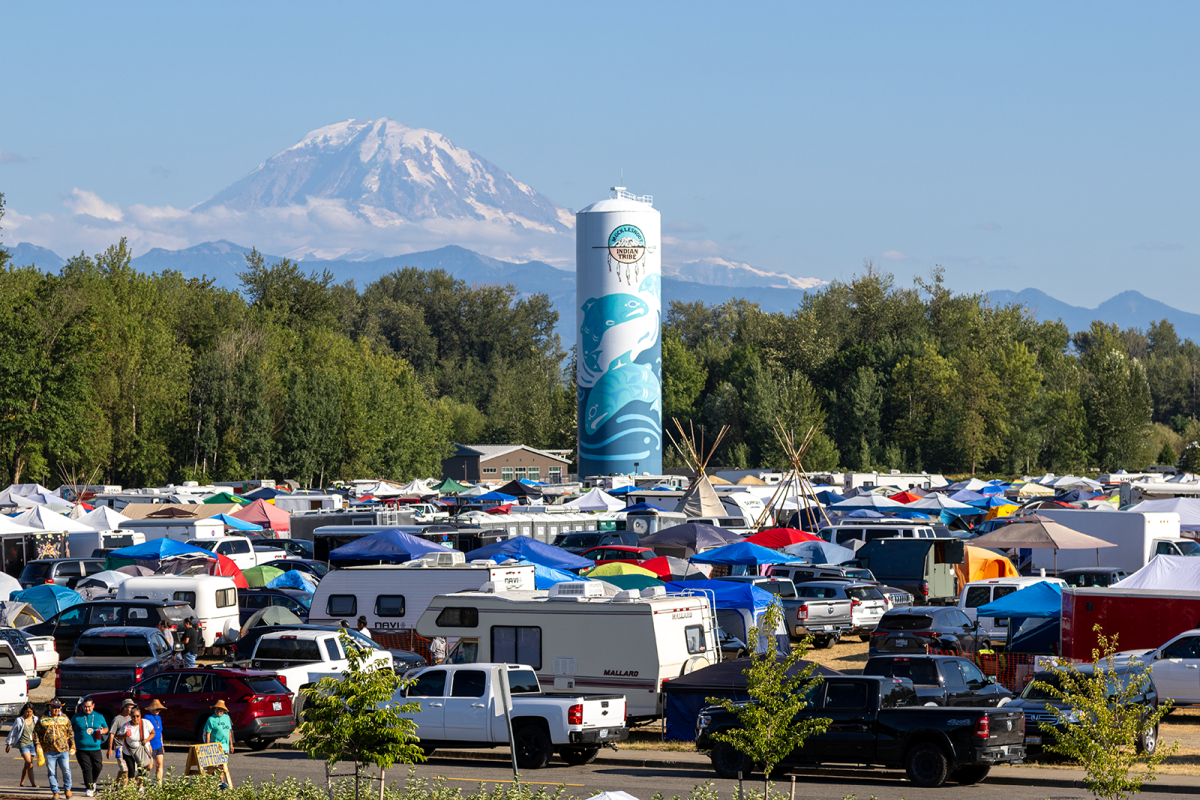
A sea of tents, RVs, vans and cars covered the grass in front of the newly constructed Muckleshoot Community Center on Monday morning. Outside, a ring of vendors sell their wares — huckleberry lemonade, beadwork, fry bread, turquoise, colorful scarves and more.
Inside, bleachers in the auditorium were packed as Canoe Journey protocol officially began.
As hosts, representatives from the Muckleshoot Indian Tribe welcomed hundreds of canoe pullers and thousands of tribal community members into their home.
“For me, I feel a lot of pride because we know that these traditions, these teachings — like mutual respect for other tribes — are going to carry on,” said John Daniels Jr., Muckleshoot tribal council member, treasurer and chairman of the culture committee. “There were ancestors that put their lives on the line.
They could have just assimilated but they said ‘I’ll die before I let them take our culture, our traditions.’”
Indigenous languages, songs, the chiming of bells, the rhythm of drums and the pounding of feet mid-dance filled the enormous community center. The sounds carried outside, broadcast on speakers.
In total, 120 canoe families made the journey from their home nations around the Pacific Northwest and beyond. After paddling for days or weeks to the canoe landing at Alki Beach, most took turns sharing their songs and dances in a multiple day ceremony called protocol. READ MORE — Nika Bartoo-Smith, ICT and Underscore News
SUPPORT INDIGENOUS JOURNALISM. CONTRIBUTE TODAY.
A widespread Medicaid scam that left an unknown number of Native Americans homeless in metro Phoenix is being declared a public health state of emergency by the Blackfeet Nation of Montana after the Navajo Nation took similar action in June.
The scam left an unknown number of Native Americans without shelter in the greater Phoenix area after Arizona’s Medicaid program suspended scores of programs suspected of fraud. The declarations allow the tribes to get staffing and other resources to help people hurt by the scam.
Those affected are from numerous tribes around the West, including the Blackfeet Nation. They were lured to the Phoenix area with promises of addiction treatment that was never delivered, then pushed into the streets when the facilities abruptly closed.
The emergency declaration was drawn up last month on behalf of the Blackfeet Tribal Business Council, the tribe’s governing body. Because several council members were traveling, it took several weeks to round up the necessary signatures before the document became public this week.
The Arizona Health Care Cost Containment system, which manages Medicaid payments for the state, in June announced changes aimed at stopping stop payments to deceptive organizations that have billed for services never provided.
Payments have been cut off to more than 100 providers suspected of fraudulent billing. — Associated Press
Department of Interior regulations ban tribes from re-applying for federal recognition if they were once denied. The rule is in the process of getting changed but too slowly in the view of a Washington D.C. District Court judge. Judge Amy Berman Jackson has told the department it has until the end of August to move on to the next step in rule-making.
Three years ago, Jackson said the rule banning re-petitions was not justified. She called it “arbitrary and capricious” and told the Department of Interior to review it for needed changes. She was the second judge to issue similar findings.
In April 2022, the department published notification that it was seeking public comment and would begin tribal consultations on its decision to maintain the ban.
At a July 18 hearing, Jackson asked the department about its progress in the rule-making. The agency “failed to convey any sense of urgency about issuing the rule, was vague in its responses, and lacked even an estimated timetable for when the final rule would be issued.” On July 19, she set a deadline of Aug. 31 for the department to submit its rule for review by the Office of Information and Regulatory Affairs, the next step toward publishing the final rule.
Jackson issued the decision in a lawsuit against the department filed by the Burt Lake Band of Ottawa and Chippewa Indians. The Michigan-based band said the agency had delayed the rule-making for years. READ MORE — Joaqlin Estus, ICT
One person was killed in a tour bus rollover involving over 50 people Tuesday in northern Arizona near the Grand Canyon West Skywalk, authorities said.
The bus rolled over just before 10 a.m. Tuesday at Grand Canyon West on the Hualapai Indian Reservation, according to the tribal police department.
Grand Canyon West is run by the tribe but has no operational ties to Grand Canyon National Park, which is managed by the National Park Service.
The rollover involved 57 people; one person died and eight others were flown to hospitals. An undisclosed number of others with less critical injuries were driven for treatment, tribal emergency officials said in a statement.
The name of the person who died and details on the injured were not immediately released.
A private tour operator and a visitor’s personal vehicle collided near the Grand Canyon West parking lot, tribal officials confirmed. They declined further comment, citing their ongoing investigation.
The Arizona Department of Public Safety assisted tribal police with the crash.
Grand Canyon West is in northern Mohave County at the West Rim of the Grand Canyon. — Associated Press
To fill the gap in broadband service among tribal nations, the Department of Commerce’s National Telecommunications and Information Administration launched the second round of grant funding to expand Internet access and adoption on tribal lands.
Approximately $980 million in funding is available through the Internet for All initiative’s Tribal Broadband Connectivity Program for Native American, Alaska Native and Native Hawaiian communities, to develop internet infrastructure on tribal lands, affordability programs, telehealth and distance learning initiatives.
“These investments will provide new opportunities for Tribal communities to participate in telehealth, online education, remote work and countless other benefits that Internet access can bring,” Commerce Secretary Gina Raimondo said. READ MORE. — AZ Mirror
Sign up here to get ICT’s newsletter
Coverage around the world on Indigenous issues for the week ending July 30, 2023. READ MORE — Deusdedit Ruhangariyo, Special to ICT
- Barbie goes to fish camp: ‘I want people, especially young people, to see themselves represented’
- Keller George left lasting impact on Indian Country: The former Oneida Indian Nation leader leaves behind an Indigenous business and policy legacy. He died at age 85
- Cooking with culture, Oyul Fusion: Two Lakota and Laotian sisters are launching a new food business to combine cultural foods and flavors
- Nottawaseppi Huron Supreme Court gains new court justice: ‘I wanted to see how I could make a contribution to the world in addressing some of the inequities that I saw around me’
- Tribes call for feds to ban chemical in car tires that is linked to salmon deaths
- How one chef is cooking up curiosity about Indigenous cuisine and causes
- Minnesota implements new Native American history requirement for K-12 teachers

We want your tips, but we also want your feedback. What should we be covering that we’re not? What are we getting wrong? Please let us know. dalton@ictnews.org.