
Greetings, relatives.
A lot of news out there. Thanks for stopping by ICT’s digital platform.
Each day we do our best to gather the latest news for you. Remember to scroll to the bottom to see what’s popping out to us on social media and what we’re reading.
Also, if you like our daily digest, sign up for The Weekly, our newsletter emailed to you on Thursdays. If you like what we do and want us to keep going, support and donate here.
Okay, here’s what you need to know today:
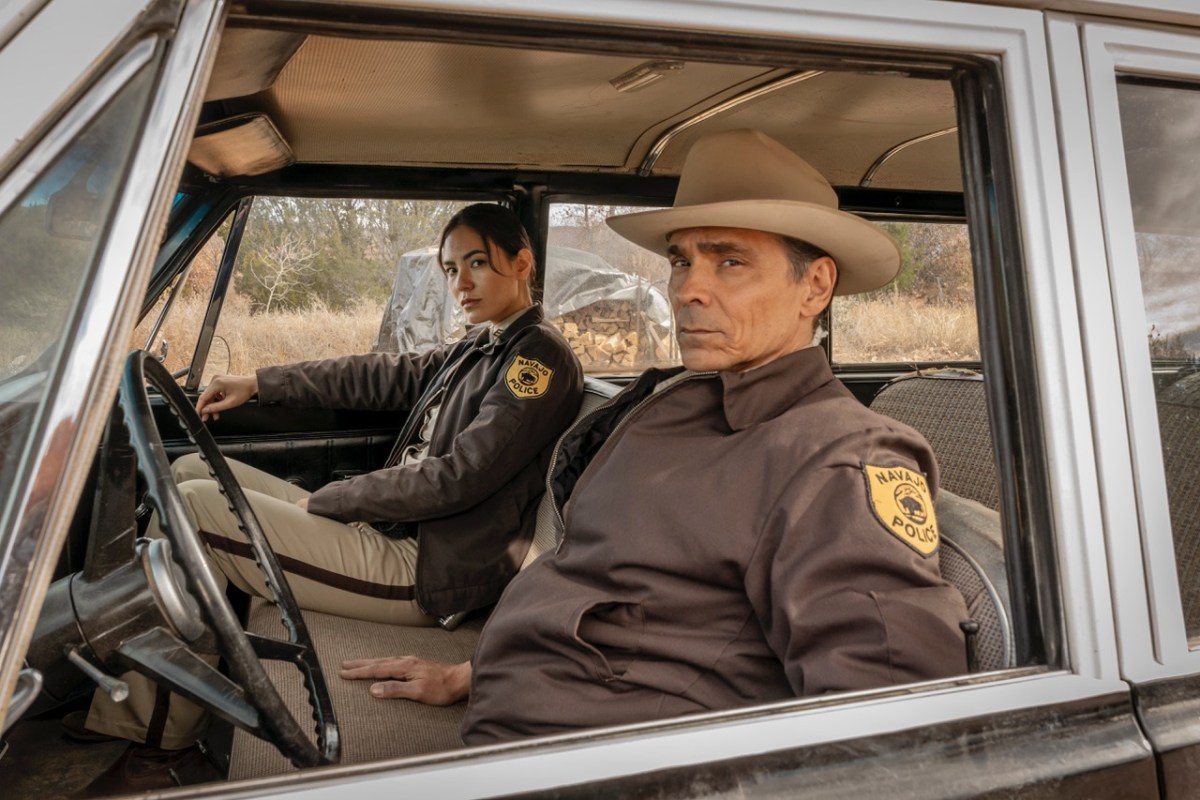
If last season blew some “Dark Winds” through the res, this season may be even darker.
Returning to AMC on July 30, Season 2 of the hit series, “Dark Winds,” finds Navajo detective Lt. Joe Leaphorn, played by Zahn McClarnon, Hunkpapa and Sihasapa Lakota, reuniting with Jim Chee, played by Kiowa Gordon, Hulapai, his former deputy turned private eye.
The series, based on the novels by Tony Hillerman, brings the two together for the new season when their seemingly separate cases put them in pursuit of the same mysterious suspect.
Deaths begin to occur in the Navajo Nation, and Leaphorn is bent on unraveling the mystery. But the deeper he investigates the more sinister it becomes, and when he finds a belt buckle his son was wearing when he died, it begins to appear it is a personal vendetta against him.
The plot twists go beyond the physical and become surreal, shaking the characters’ spiritual beliefs and pushing them to question and rediscover themselves.
“There’s more levity within the show and with these characters,” McClarnon said in a Zoom call with ICT before the actors guild went on strike. “It’s so difficult not to spoil the show to tell you exactly what has happened, but I think you’ll see more levity. I mentioned Joe finds some evidence regarding his child. I think that this season, Leaphorn’s moral code is in question, is challenged by his morality and what he does with that evidence and the situations he finds himself in.” READ MORE — Sandra Hale Schulman, Special to ICT
SUPPORT INDIGENOUS JOURNALISM. CONTRIBUTE TODAY.
If “Reservation Dogs” tells a comedic, myth- and spirit-filled story of life on the reservation, the debut film, “War Pony,” from Elvis Presley’s granddaughter, Riley Keough, is the dramatic version, telling a darker story.
The feature debut from the directing partnership of Keough and Gina Gammell, “War Pony” won the Caméra d’Or for best first feature at the 2022 Cannes Film Festival. It is set for release by Momentum Pictures in the United States starting July 28.
“I feel like the movie itself built up organically,” executive producer Pte Cante Win Poor Bear, Oglala Lakota, told ICT in a Zoom call with cast members. “It’s the same with the script. It was a gradual, organic process. Plus we had an amazing casting director … Most of the crew and the cast is from Pine Ridge, except for one from Rosebud.”
Keough, who is the daughter of the late Lisa Marie Presley, served as co-producer and director with Gammell. The two also served as co-writers along with Franklin Sioux Bob and Bill Reddy.
A collaborative work, Keough heard the stories of life on the rez from Sioux Bob and Reddy, who served as extras in the film, “American Honey,” she was making. Fascinated by their first-hand experiences, she went to Pine Ridge and developed the movie from there. READ MORE — Sandra Hale Schulman, Special to ICT
We’re only halfway through 2023, and it feels already like the year of alien contact.
In February, President Joe Biden gave orders to shoot down three unidentified aerial phenomena – NASA’s title for UFOs. Then, the alleged leaked footage from a Navy pilot of a UFO, and then news of a whistleblower’s report on a possible U.S. government cover-up about UFO research. Most recently, an independent analysis published in June suggests that UFOs might have been collected by a clandestine agency of the U.S. government.
If any actual evidence of extraterrestrial life emerges, whether from whistleblower testimony or an admission of a cover-up, humans would face a historic paradigm shift.
As members of an Indigenous studies working group who were asked to lend our disciplinary expertise to a workshop affiliated with the Berkeley SETI Research Center, we have studied centuries of culture contacts and their outcomes from around the globe. Our collaborative preparations for the workshop drew from transdisciplinary research in Australia, New Zealand, Africa and across the Americas.
In its final form, our group statement illustrated the need for diverse perspectives on the ethics of listening for alien life and a broadening of what defines “intelligence” and “life.” Based on our findings, we consider first contact less as an event and more as a long process that has already begun. READ MORE — The Conversation
Sign up here to get ICT’s newsletter
PAJARO, California — It was half past midnight on March 11 when a cacophony of sirens and shouting jolted Emilio Vasquez and his family from a sound sleep. “Get out of your houses immediately!” a voice barked in Spanish through a bullhorn. “The water is coming!”
Vasquez and his wife, undocumented Indigenous Mexican immigrants who speak Mixteco, understood just enough Spanish to bolt out of bed, grab their two young children and race to their car. They headed south out of town, wondering why water was threatening their rental in Pajaro, an impoverished, unincorporated farmworker community, about 95 miles south of San Francisco, that helps power Monterey County’s $4 billion agriculture industry.
Vasquez, who asked not to use his real name for fear of retaliation, did not learn until the next morning that the storm-swollen Pajaro River — which forms the border between Monterey and Santa Cruz County to the north — had demolished a section of the levee on its long-neglected southern side. The levee’s deficiency was clear soon after it was built in 1949. It failed twice in the 1950s, prompting Congress to authorize millions of dollars to fix it, then again several times in the 1990s, when a catastrophic flood killed two.
The poorly maintained levee proved no match for a waterway transformed by winter’s relentless succession of monsoon-like atmospheric rivers. The breach sent a tidal wave of mud and water through Pajaro, stranding cars, damaging hundreds of homes and small businesses and forcing the town’s 3,000-some residents to evacuate, just as it had nearly to the day, in 1995.
The March floods inundated more than 8,700 acres of crops worth $264 million, according to the Monterey County Agricultural Commissioner’s Office, bringing total damages from winter storms to $600 million. READ MORE — Inside Climate News
Other top stories:
- Mentoring the next generation: Coming up on the Thursday edition of the ICT Newscast, a new tribal judge didn’t always dream of the law … he first wanted to be a journalist. We have a feel good “fish story” from the Columbia River basin. And the writer’s strike continues in California
- Pacific Northwest canoe journey underway: The Muckleshoot Indian Tribe will host this year, with the theme ‘honoring our warriors, past and present.’ ICT’s partner Underscore News will be there to provide live coverage
- Lakota artists gather for Night Market: Fifteen Lakota artists gathered at Racing Magpie in Rapid City to sell their creations during the first summertime Night Market
- President Joe Biden appoints new trustees to IAIA: New board members include Indigenous artists, designers and directors
What we’re reading:
- ‘Welcome to Princeton’ sign changed to acknowledge Indigenous people
- Jeffrey Gibson will be the first Indigenous artist to represent the U.S. at the 60th Venice Biennalein a solo capacity
- Tribal nation with over $100M of land on the Strip faces criticism back home

We want your tips, but we also want your feedback. What should we be covering that we’re not? What are we getting wrong? Please let us know. dalton@ictnews.org.

