Greetings, relatives.
A lot of news out there. Thanks for stopping by ICT’s digital platform.
Each day we do our best to gather the latest news for you. Remember to scroll to the bottom to see what’s popping out to us on social media and what we’re reading.
Also, if you like our daily digest, sign up for The Weekly, our newsletter emailed to you on Thursdays. If you like what we do and want us to keep going, support and donate here.
Okay, here’s what you need to know today:
SIOUX CITY, Iowa – Paulette Walker left her home in the 1980s, bound for Riverside, California with her husband.
When she got there, the 20-something-year-old Winnebago woman sent a postcard to her father. She was never heard from again.
Some time later, a police officer investigating a car accident in Riverside happened upon her body. She had been strangled. No one was ever held accountable for her death, and her family has never stopped looking for answers.
“We are in the process of exhuming her body and bringing her back,” said Trisha Rivers, Paulette’s niece.
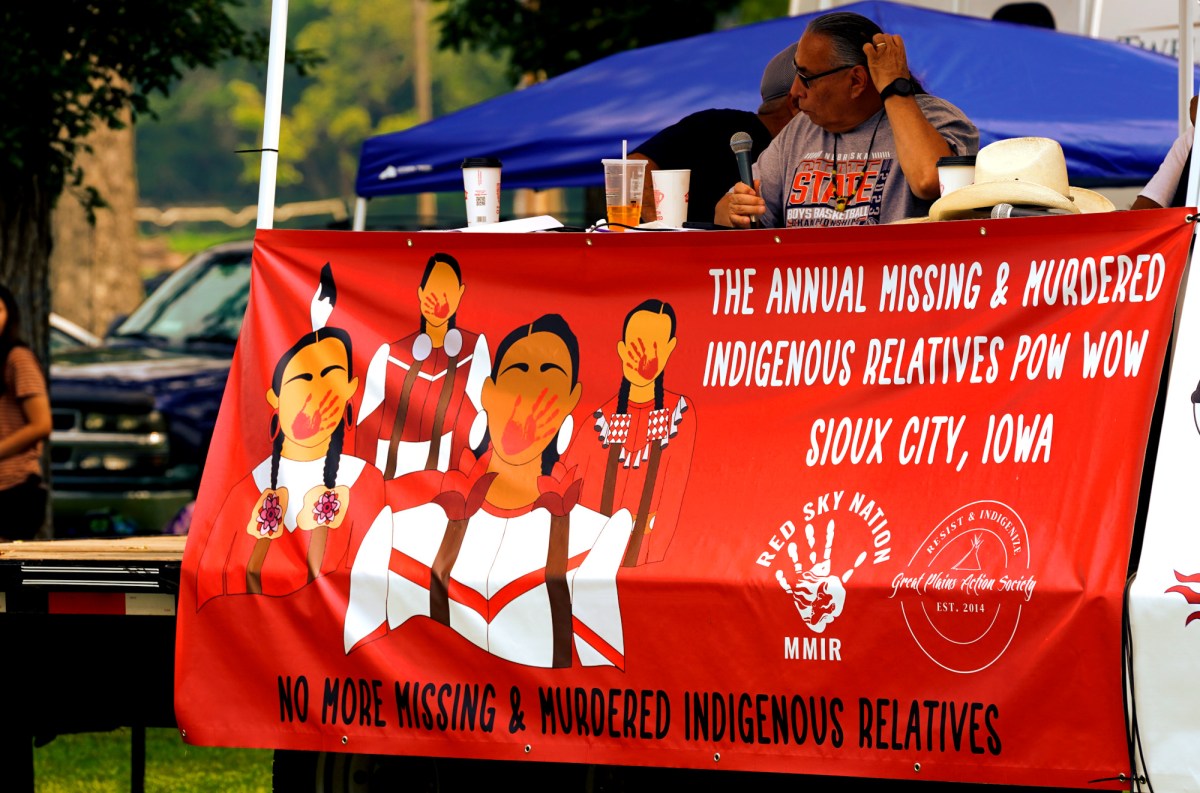
Paulette’s story was one of several told this weekend during the second annual Missing and Murdered Indigenous Relatives Pow Wow held in Sioux City, Iowa. The event drew hundreds of singers, dancers, vendors and visitors to Riverside Park. READ MORE — Kevin Abourezk, ICT
SUPPORT INDIGENOUS JOURNALISM. CONTRIBUTE TODAY
The Charles Mix County sheriff’s deputy who arrested Robert “Berta” Enoch before his death by overdose in a Lake Andes, South Dakota jail will not be reprimanded for his actions.
That was the decision of the South Dakota Law Enforcement Officers Standards Commission on Thursday, July 13 in Pierre during a hearing for 31-year-old Jon Werkmeister.
Enoch, a 35-year-old Native man, was found unresponsive in his cell on April 3. Werkmeister lacked the training to identify signs of a drug overdose, and the Charles Mix County Jail lacked a drug overdose policy, which left him unprepared to respond when Enoch began to show signs of medical distress, commissioners found. The commission also found that Werkmeister had not acted with racist intent or treated Enoch differently than other inmates because of previous encounters or bad blood.
It was disclosed during the hearing that Werkmeister has two adopted Native children, and he’d never met Enoch – who was staying in Charles Mix County but did not live there – before taking him to the jail. READ MORE — South Dakota Searchlight
Around the world: Indigenous villagers remain without safe land, water, and food years after a dam rupture in Brazil, philanthropic organizations are helping the Uyghurs and Aboriginal people, and Canada will keep a close eye on upcoming lobster fishery
BRAZIL: Villagers still struggle after 2019 tailings dam failure
More than four years after the rupture of a tailings dam in Brumadinho Valley, Brazil, the Indigenous Pataxó and Pataxó Hã-hã-hãe people still suffer from the lack of secure land, water, and food, Mongabay reported on July 12.
A portion of the community within the original village of Naõ Xohã, continues to reside amidst an unfishable river and soil contaminated with heavy metals, and altered dietary patterns have resulted in a surge of diabetes, intoxication, and allergies, Mongabay reported.
“We just want to live where we were meant to live: in the forest, in our way, according to our culture,” said Célia Angohó, who lived in Naô Xohã at the time and today is chief of Katurãma village. READ MORE — Deusdedit Ruhangariyo, Special to ICT
My small turboprop plane whirred low through thick clouds. Below me, St. Paul Island cut a golden, angular shape in the shadow-dark Bering Sea. I saw a lone island village — a grid of houses, a small harbor, and a road that followed a black ribbon of coast.
Some 330 people, most of them Indigenous, live in the village of St. Paul, about 800 miles west of Anchorage, where the local economy depends almost entirely on the commercial snow crab business. Over the last few years, 10 billion snow crabs have unexpectedly vanished from the Bering Sea. I was traveling there to find out what the villagers might do next.
The arc of St. Paul’s recent story has become a familiar one — so familiar, in fact, I couldn’t blame you if you missed it. Alaska news is full of climate elegies now — every one linked to wrenching changes caused by burning fossil fuels. I grew up in Alaska, as my parents did before me, and I’ve been writing about the state’s culture for more than 20 years. Some Alaskans’ connections go far deeper than mine. Alaska Native people have inhabited this place for more than 10,000 years.
As I’ve reported in Indigenous communities, people remind me that my sense of history is short and that the natural world moves in cycles. People in Alaska have always had to adapt. READ MORE — Grist
Sign up here to get ICT’s newsletter
In Montana, a Showtime documentary is taking a look at the deaths of three Native women, we speak with its creator Razelle Bennaly.
In New Mexico, the Pueblo Cultural Center is investing in agriculture. ICT’s McKenzie Allen-Charmley spoke with the center’s special project manager.
U.S. Rep. Mary Peltola takes a look back at her first hundred days in office with ICT’s McKenzie Allen-Charmley.
In Arizona, a little known sport is taking the Native senior citizens by storm. ICT’s Aliyah Chavez takes a look.
WATCH HERE:
Two Indigenous men were acquitted of 50-year-old murder convictions Tuesday with the help of Innocence Canada and Manitoba’s top judge.
Chief Justice Glenn Joyal told a packed courtroom in Winnipeg that Brian Anderson and Allan (A.J.) Woodhouse were wrongly convicted in 1974 of killing restaurant worker Ting Fong Chan.
Not only that, said Joyal of Manitoba Court of King’s Bench, but the men are not guilty.
“You are innocent and you deserve the acquittals,” said the judge. “I’m happy to offer an apology on behalf of the institution and system that failed you.
“You are heroes in every sense of the word.” READ MORE — APTN National News
- Native artists travel new paths to prosperity: A beer store that robbed talent now invests in it
- Judge dismisses suit over sales tax, tribe agrees: The suit also alleged the sales tax was a form of discrimination against the tribe
- National Endowment for the Arts chair visits Native communities: Chair Maria Rosario Jackson visited western South Dakota to learn about the evolution of art and the role of art in Indigenous communities
- Good News File: Oldest living member of Santa Clara Pueblo turns 100
- Justice Brett Kavanaugh seeks to dispel the notion that court is partisan
- What residuals are — and why Hollywood actors and writers are striking over them
We want your tips, but we also want your feedback. What should we be covering that we’re not? What are we getting wrong? Please let us know. dalton@ictnews.org.

Our stories are worth telling. Our stories are worth sharing. Our stories are worth your support. Contribute $5 or $10 today to help ICT carry out its critical mission. Sign up for ICT’s free newsletter