Miles Morrisseau
ICT
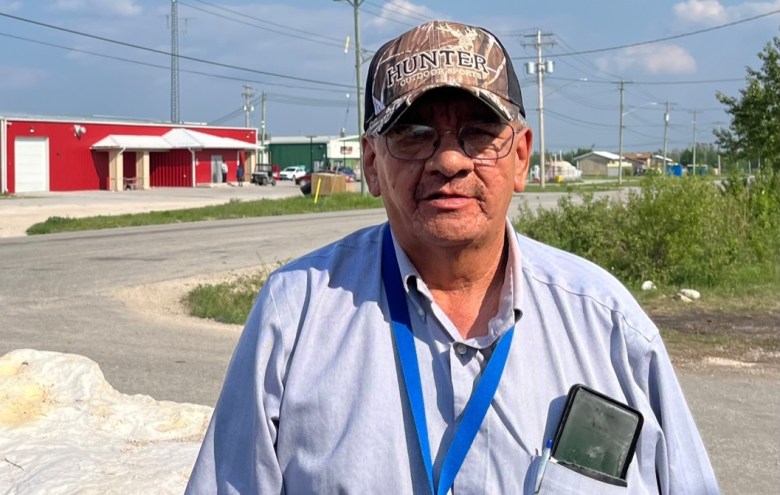
CHEMAWAWIN CREE NATION, Manitoba, Canada — Michael Chartrand had largely given up the cross. He thought his days of service were over. He still believed, but that deep commitment — day after day, hour after hour — as an Anglican minister in Cree communities in northern Manitoba was behind him.
He was still a man of prayer, but he found the work to be heavy, especially when consoling people who had lost loved ones.
“That was a heavy job,” Chartrand, Sapotaweyak Cree Nation, told ICT recently. “I thought I was retired.”
SUPPORT INDIGENOUS JOURNALISM. CONTRIBUTE TODAY.
He was wrong. For nearly two weeks in late May and early June, Chartrand joined the search to find a Cree teen with medical issues who had gone missing from the remote community of Chemawawin Cree Nation in Manitoba, volunteering where needed and leading prayer circles in the evenings to ask for strength, direction and guidance.
He was part of a regional effort that united a local community often divided by history and politics, led by the Royal Canadian Mounted Police with help from other agencies, search dogs, drones and dozens of volunteers to comb residential areas and the nearby forests and lake.
And when the time finally came, it was Chartrand who made the discovery that the entire community had long-awaited. The teen was found alive, in mostly good condition, in an unexpected location.
In the process, Chartrand restored the sense of faith that he had begun to question.
Panic sets in
Temperatures had already reached 80 degrees in Manitoba when the 17-year-old youth was last seen wearing all-black clothing on the evening of May 23 on Sesame Street in Chemawawin Cree First Nation.
He’s small for his age — about 5 feet tall and 130 pounds — with what his adoptive mother told CBC News was a weakened immune system and developmental issues.
By the next day, in the midst of an unseasonably warm spring throughout northwestern Canada that spurred wildfires across the country, whispers of concern and an early panic had already spread throughout the tight-knit community.
A full-scale search was under way. Family and friends had begun searching immediately and soon the whole community was looking, with word reaching familial communities in other First Nations through social media.
On May 25, the youth was officially reported missing, and the Royal Canadian Mounted Police detachment in Easterville issued an all-points bulletin.
“On May 25, 2023, at approximately 4:30 p.m., Chemawawin RCMP received a report of a missing 17-year-old male from the community,” according to the dispatch. “Police and family are concerned for his well-being.”
Searchers looked in every house in the community, and the RCMP launched a significant investment of human and technical resources. The forest is dense in the area, and the Cedar River was still cold and rife with underwater dangers prevalent in man-made lakes created by flooding a forest. The environmental dangers are real in the tiny community even when the temperatures are not inclement.
In addition to search dogs on the ground, the RCMP had drones in the air, as well as support from the Canadian Rangers and the Office of the Fire Commissioner. Searches were conducted by helicopter, boat, ATVs and on foot. Underwater radar and an infrared camera were brought in to help.
Hours turned into days. Days into weeks. With heat that was growing insufferable, the story of the missing teen spread across social media, with people sending prayers and other communities sending search parties.
“These kinds of incidents that happen in our communities, you know, it’s really draining — losing one of our own and assisting the family,” Chemawawin elected Councilor Quentin Mink told ICT in his office at the Chemawawin Band office.
“Our community came together,” Mink said. “And we saw such a really strong community spirit during this time and everybody put together what they could. Taking the clothes off their back, giving it to the searchers, and water, donations coming in from the greater community.”
Leading the local effort was Robert Walker of the Chemawawin Cree Nation.
The community quickly became exhausted, however, with the physical and emotional burdens of the missing youth, exacerbated by the unrelenting heat and humidity. When asked what it was like, one woman told ICT simply, “It was a nightmare.”
Chartrand was among those who stepped in to help, working as hard and in the most difficult ways he could have imagined. In addition to searching, he got up early each morning to drive search groups to designated areas, and led prayer circles in the evening.
He said he obsessed every waking hour over where to look next.
“I started going here and there,” he said. “You just drive around. I started around 8 [a.m.] to drive around the community to look around where I could see this boy. I got to helping out, saying prayers with the men and women, helping with the visitors that came from Pukatawagon, Moose Lake and Ontario on the other side of Kenora.”
His efforts increased as time wore on.
“I kept going with the searchers,” Chartrand said. “I was carrying the Moose Lakers in my truck, taking them here and there, wherever Robert was saying, [as well as] the people from Pukatawagon [First Nation].”
Communities divided
Originally from Sapotaweyak Cree Nation, Chartrand served all over northern Manitoba, Canada, as an Anglican minister in Cree Communities like Chemawawin that share the Swampy Cree dialect, which he also speaks.
These days, he drives a medical van, taking people to their appointments, treatments and surgeries, usually to the town of The Pas, 125 miles west of the community, or nearly 300 miles south of Winnipeg.
Like many Indigenous communities in Manitoba, the area features a First Nation and a Métis community side-by-side — the Chemawawin Cree Nation and the historic Métis community of Easterville.
The communities are historically and culturally connected, but divided by bureaucratic definitions of status and non-status Indians imposed upon the Métis and First Nations in Canada by the Indian Act of 1876.
Unseen lines were drawn between people who lived together for generations and who shared the land, the waters and the language, making for a troubled modern history for the communities.
In the early 1960s, the province began its scheme to turn northern rivers into hydro power to feed the south and eventually ship power to the United States. The original dam for the Grand Rapids Hydroelectric Generating Station turned the original Cedar Lake into a reservoir that inundated its original community.
Referred to as “the Old Post,” community members can still visit the old graveyard, which is now underwater, and touch the headstones with canoe paddles.
Easterville and Chemawawin were devastated by the impacts of the Grand Rapids Hydroelectric Dam, which flooded their communities in 1962. The Manitoba government promised them fully electrified homes in a new territory, and instead dumped them on the rocky shores where penetrating the ground in order to put in proper foundation is difficult, if not impossible.
Many homes today are built up with a so-called pony wall, a three-foot wooden wall that serves as the foundation.
But those issues took a back seat when the communities were faced with finding the missing teen.
‘We found him’
It was Wednesday, June 7, when local coordinator Walker reached out to Chartrand, asking him to join him at the home of the missing youth.
“Robert said, ‘Let’s go and visit the family at the house,’” Chartrand said. “I was heavy, too, thinking every night, ‘Where should I go look next? Where should we look?’”
An idea had been forming for Chartrand, however, and he asked the mother if there was a crawlspace in the house. She said there was, by the washer and dryer, but that it had never been opened.
He expected the door in the floor to be difficult to open, but it wasn’t.
“I grabbed the handle and slowly opened it,” he said. “It was easy. Then I saw it — a blue water bottle.”
He quickly shut the door and sought out Walker in the living room.
“I said, ‘Robert, come here,’” he said. “I opened up that crawlspace door and he saw that water bottle, and he said, ‘Get down there.’”
Chartrand got a flashlight and went into the hole.
“It was dark and hot,” he said. “l saw clues, so I crawled to my right …. but Robert said, ‘Don’t touch them. Go this way.’”
To his left, Chartrand saw a clump of blankets. He crawled closer to get a better look and saw human hair. He immediately thought the worst.
“I [shined the] light on the blanket,” he said, “and then I saw hair. I went, ‘Ahh, I don’t want to go there … I got scared.”
He decided to push forward.
“I kept on going and said, ‘Little boy. Hey, boy. Get up, my boy. Are you okay?’ And he got up. I cried a little bit. Robert started shouting, ‘We found him. We found him.’”
Joy and relief
The teen was reunited with his parents in the home, and the Mounties arrived soon after to take the boy and his family to a nursing station and then to a hospital in The Pas.
The boy’s condition has not been disclosed, and it is not known how he survived the two weeks. RCMP officials did not respond to requests from ICT for updated information about the boy and his condition.
But the discovery brought relief and joy to the region.
“A large number of RCMP officers and resources were deployed to the community over the last week and half to help with search efforts. Every officer was committed to locating the teen and we are very pleased that he was found safely,” Superintendent Ryan Mitchell, district commander of the RCMP’s North District in Manitoba, said in a statement. “I also recognize and thank all of the community members and others who devoted their time and energy to the search.”
Mink said the combined efforts kept the local searchers going.
“If it wasn’t for all the efforts of everyone that came together from the greater community, we would not have been able to do this,” Mink told ICT. “I commend the leadership of Chemawawin and all leaderships that came together to assist us during this time. From the bottom of our hearts, we are eternally grateful. And that the Indigenous community is one — we’ve seen that during these efforts. And I’m just blown away at the fact that we’re strong and we’re a strong knitted family in the Indigenous society.”
Chartrand said he and Walker spread the word the best way they knew how.
“Me and Robert came here and told all the people who were here, and Robert was yelling, ‘We found him, we found him.’ Everybody was happy. That was something. That was an experience for me,” Chartrand said, with a nod and a tired smile.
“So, that’s my story about this little boy that was lost.”

Our stories are worth telling. Our stories are worth sharing. Our stories are worth your support. Contribute $5 or $10 today to help ICT carry out its critical mission. Sign up for ICT’s free