
This is a joint announcement released by the Asian Pacific Policy and Planning Council (A3PCON) Environmental Justice Committee, a coalition of community-based organizations that advocates for the rights and needs of the Asian and Pacific Islander American community, and the Progressive Asian Network for Action, an organization of Asian Pacific Islanders.
Vowing to continue the struggle against the “black snake” of the Dakota Access Pipeline in North Dakota, 50 Asian Pacific Islanders gathered Sunday December 11 in Los Angeles to hear eyewitness accounts of recent peaceful protests against armed security forces.
Those who traveled 1,500 miles to the Standing Rock Sioux Reservation said they joined thousands of other peaceful protesters—known as water protectors—to follow the courageous leadership of Native Americans who were determined to save their tribal water, land, sacred sites and sovereignty without violence. On December 4, the U.S. Department of the Army halted the pipeline construction until it completes an environmental review of alternative routes with full tribal and public input.
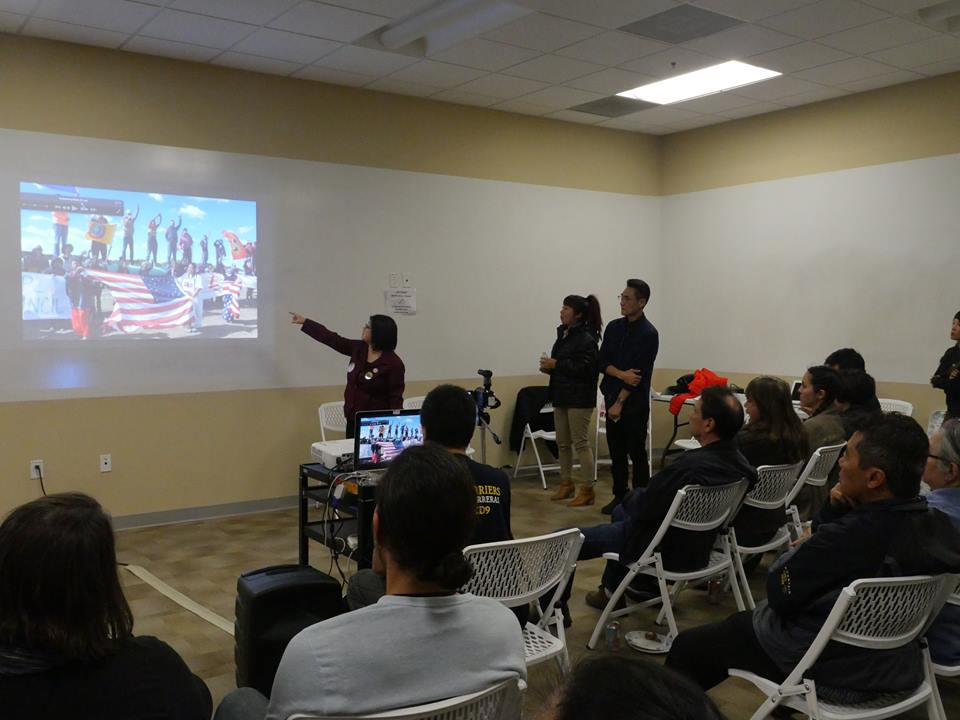
“It takes a tremendous amount of strength to not act out toward the Dakota Access Pipeline and their allies,” said Hsingii Bird, 35, a Taiwanese immigrant who took part in the protests. “I believe the indigenous people are the guardian of Mother Earth, and we must be their best allies. That is what Standing Rock taught me.”
After a long cross-country drive from Long Beach, Alex Montances, 32, said he and other protesters were warmly welcomed by Native American women who recounted generations of violence and oppression against them. Yet when it came time for an all-women march toward the pipeline security forces, they stood strong and calm.
[text_ad]
“Women were on the front lines. They marched up to the barbed wire and the armored vehicles,” recalled Montances, a Filipino-American. “They asked the security officers to join them to protect water.”
That didn’t happen, so the 150 women—elderly grandmothers, mothers with babies and small children, teens—retreated, but returned again another time for an all-female march.
“The strength of the Native Americans and the Native American women—I have never seen that in my life,” Montances said.
Mato Means, 34, a member of the Lakota tribe and a military veteran who lives on the Pine Ridge Indian Reservation in South Dakota, said he was appreciative of the efforts by Los Angeles-area Asian Pacific Islanders.
“You are all part of the great turtle island,” said Means, referring to the American Indian creation story of how the world first formed as one land mass on a turtle’s back.
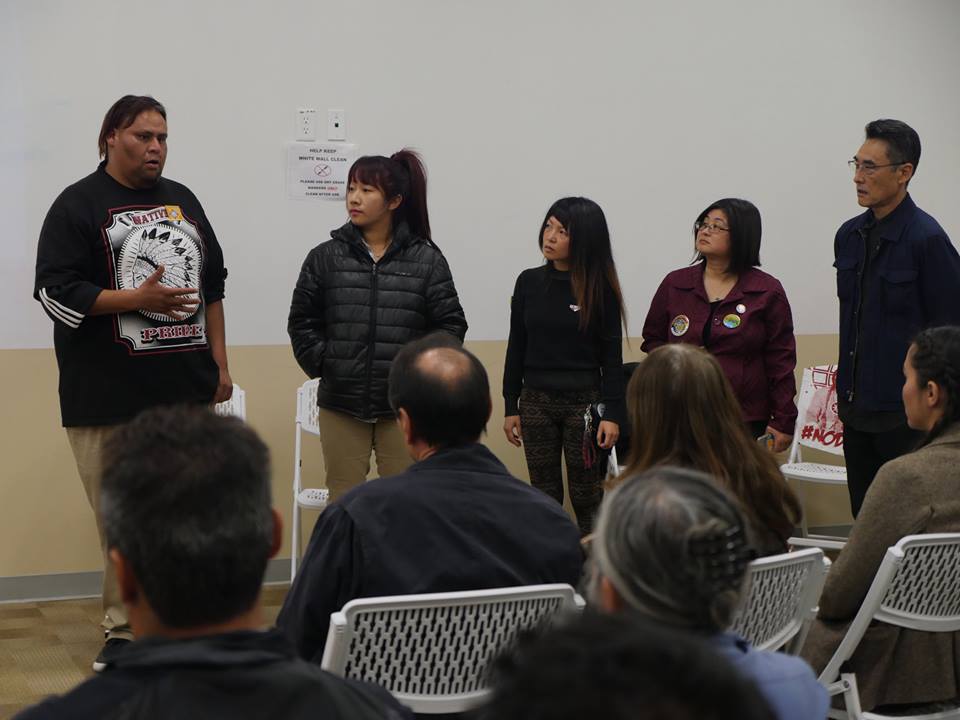
More than $1,000 was collected to help the Standing Rock Sioux tribal nation and to send future water protectors when needed. Speakers said they foresee a long struggle because they expect incoming president Donald Trump will attempt to force pipeline construction to resume.
A colorful banner, to be shared with the Standing Rock community of camps and shelters that now face a harsh winter, was also signed by the group. The December 11 event was co-organized by the Asian Pacific Policy and Planning Council (A3PCON) Environmental Justice Committee and the Progressive Asian Network for Action.
Asian Pacific Islanders joining in solidarity with Native American causes is a long history, said Kathy Masaoka, of Los Angeles. She recounted the struggle more than 40 years ago when she and other activists traveled to Wounded Knee in South Dakota and were met by armed federal officers, marshals and the FBI.
“There was no Facebook, no video, no news coming out,” Masaoka said. “Wounded Knee was the site of the massacre in the 1800s. And treaties were long broken there.”
Looking ahead, many participants said they will travel back to Standing Rock when the call for help comes. Several supporting organizations are also planning support activities in the Los Angeles area.
“We have to continue standing as allies with our Native American brothers and sisters both in Standing Rock and locally,” said Nancy Kim, a water protector who is ready to return. “And that means educating ourselves regarding the battles and issues they are facing.”