The American Revolution lasted eight years, from 1775 to 1783. It took about twice that long to conceive and build the Museum of the American Revolution. But now the $120 million, 118,000-square- foot museum, which opened on April 19 in Philadelphia, is a reality.
Much of the credit goes to the 11,000 donors. Among them is an important ally of the fledgling country—the Oneida Indian Nation, which gave $10 million in part to convey its vital role in the war.
“The Oneida Nation was one of the first allies to support the fledgling United States,” noted Vice President of Collections, Exhibitions, and Programming R. Scott Stephenson. “ e Oneida people endured many hardships and lost lives during America’s War for Independence, yet their role in the founding of our nation is unknown to many.”
“There is an American Indian proverb that says, ‘Tell me the facts, and I’ll learn; tell me the truth, and I’ll believe; tell me a story, and it will live in my heart forever,” said Ray Halbritter, Oneida Indian Nation Representative and Nation Enterprises CEO. The museum, said Halbritter, the publisher of Indian Country magazine, “will allow us to share our story with the world.”

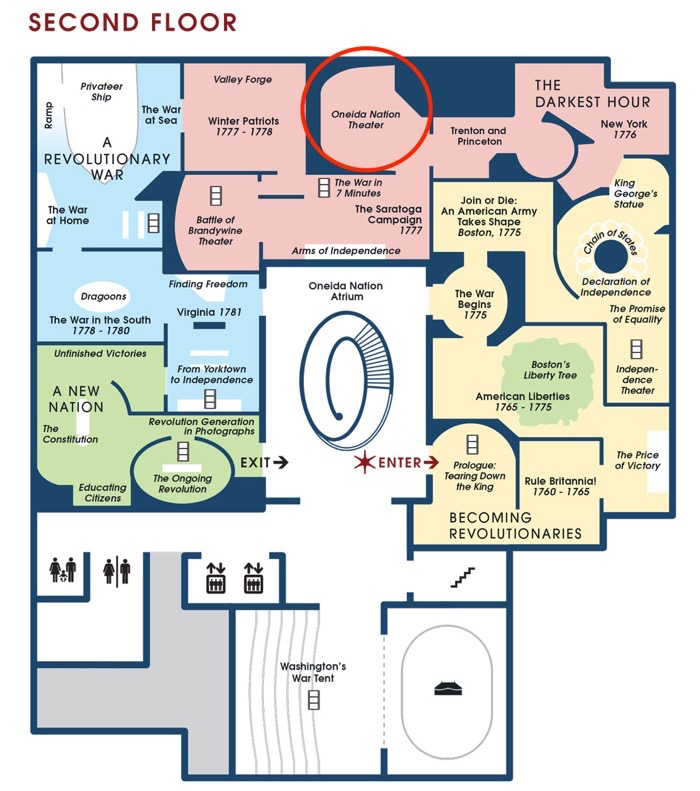
Walking into the Oneida Indian Nation theater, visitors first see a quote from Oneida veteran Keller George: “I often wish that I could look back through time and hear the words of my ancestors as they sat around the council res deliberating on whether to join the colonists in battle. I wish I could listen to the wisdom of their arguments to join the United States and become its first allies.”
A striking fulfillment of that wish greets you in the form of six life-size—and quite life-like—models created by New York City’s ATTA, Inc. Visitors can even touch the effigies as they listen to a six-minute council discussion of how the Oneida Indian Nation made the di cult decision to go against their brothers of the Iroquois Confederacy and join the Revolution.
“Our Confederacy is divided,” states a narrator. “Some wish to stay neutral. Some want to support the British. Some want to support the United States. e Oneida Nation has to decide. Where do we stand?” As each member states his or her case, their representative figure lights up so visitors know who is speaking.
“ e colonists are our neighbors. We have created a path that leads from them to us, and we have taken them by the hand in friendship,” says the representation of Oneida Chief Warrior Han Yerry. “We must honor our word and stand together with the United States to defend our lands.”
Halbritter, who spoke at the dedication ceremonies, is pleased with the final product. “It is exciting to see a little known but important part of American history come to life in such a unique way,” he said.
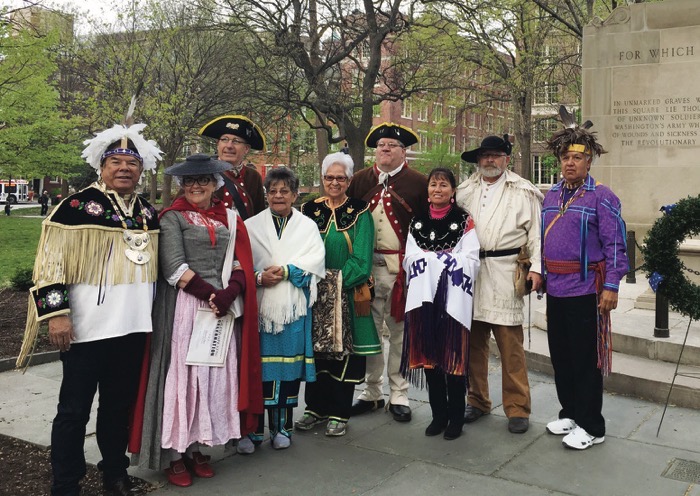
“We are honored that the Oneida Nation’s role as First Al- lies of America will be part of this unparalleled, historic museum for generations to come.”
As the Pulitzer-prize winning author David McCullough pointed out during the dedication, the “opportunity to innovate in museums is wide open.” Museums, he said, need not be rooms filled with static portraits hung on a wall.
“What I like best is the human scale. All these re-creations of human beings are all in real scale. You’re not seeing giant statues, you’re not seeing anything to make them seem god-like and that’s important.”
This up-close-and-personal approach is not limited to the six statues. Visitors can be flies on the wall as they listen to the Oneida carrying on their debate. They can also see a full-scale replica of Boston’s Liberty Tree, where revolt was first debated; experience Battlefield Theater to get a sense of being on the Continental Army’s front line; and see a re-creation of Independence Hall in its incarnation as a prison for American soldiers during the British occupation of Philadelphia.
Audio abounds. There are narrations that describe everything from the Oneidas’ struggle to the journey of George Washington’s actual “Headquarters Tent”—one of the most iconic surviving artifacts of the American Revolution—to the museum itself.
Washington’s tent—which some historians have called the “First Oval Office”—was created as a mobile headquarters for the general’s use from mid-1778 to 1783. The tent had three small chambers including a central office, a half-circle sleeping chamber, and a small area for luggage and his valet, a slave named William Lee.
At the museum, the tent has its own timed theater entrance with a 10-minute multimedia presentation that describes how it passed from Martha Washington’s grandson to its current locale. e tent resides in a cli- mate-controlled, 300-square-foot object case in front of a realistic scenic wall, making for a dramatic impression.

“The most important part of this museum,” said Philadelphia Mayor Jim Kenney on opening day, “is it acknowledges fully and totally the contributions of other folks who make this country great—African Americans, Native Americans, women and all others besides those who signed the Declaration of Independence. Without all of them, this would never have happened. And they are finally and fully acknowledged in this space.”
Former Vice President Joseph Biden agreed. Invoking the national motto—E pluribus unum—he said, “That’s who the hell we are. We’re so different. But so similar in our aspirations.”