
Summer Peters is known for her contemporary beadwork and fashion created with traditional Ojibwe techniques. Drawing on the traditions handed down by her grandmother, mother and family and with a body of work that encompasses both tradition and popular culture, Peters says, “I want to tell the story of what it means to be a Native American woman today.”
Peters, an Ojibwe whose home community is the Saginaw Chippewa Indian Tribe in Michigan, recalls watching her mother, a single parent, creating beadwork to help feed her family. “We were on welfare and on food stamps, so she used the money to supplement her income while she was in college.”
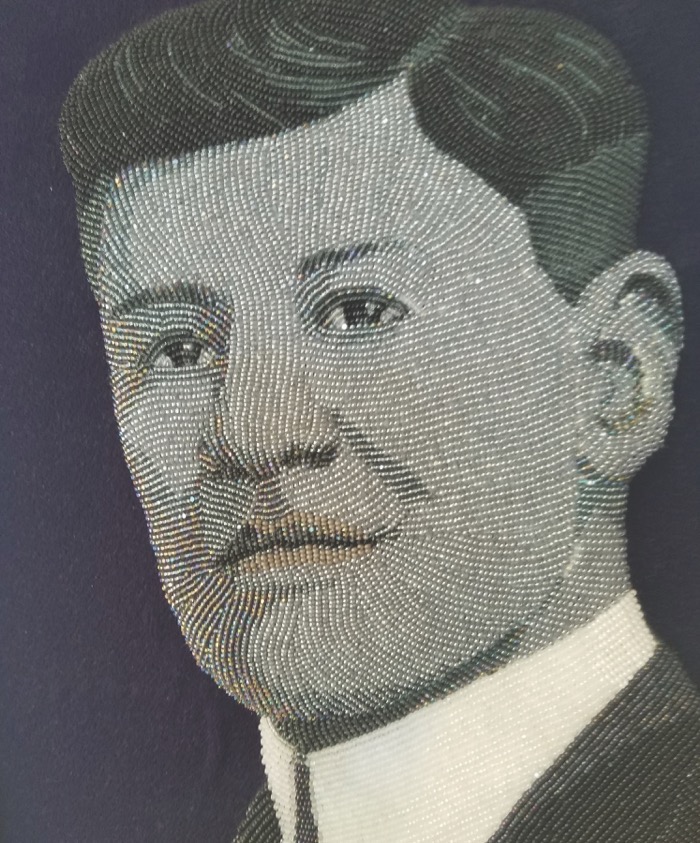
Summer Peters spends her life navigating a sea of beads. Sitting in a Tempe coffee shop, she pulls out a project she’s working on for her frequent collaborator, Kiowa/Choctaw artist Steven Paul Judd. “I’m still working on the eyes some,” she says. Made of tiny seed beads, the image of a Plains man from the 19th century seems to leap from the beading sheet. That dedication to intricate detail, combined with the commitment to keeping cultural ways strong in herself and her family while residing in the midst of urban Phoenix, is a hallmark of this remarkable artist.
During a multimedia collaboration with Judd, she beaded the headpiece and cuffs on Judd’s portrait of a Native American Wonder Woman. “Instead of just straight rows, I used traditional Ojibwe floral patterns,” Peters says. She’s also created grayscale portraits of athletes Jim Thorpe and Billy Mills, and a portrait of Osage ballerina Maria Tallchief in her Firebird role. Her Billy Mills portrait was chosen for an exhibit at the Heard Museum in Phoenix.
Peters is careful to not tread on other traditions. Her regard for other tribal cultures factored into a recent commission from the Salt River Pima-Maricopa Indian Community. “I created their pow wow crowns,” Peters says. “I met with the tribe’s cultural department and worked closely with them to ensure that I respected all their ways.” Peters, a former pow wow princess, also creates pow wow regalia for other dancers, such as an Ojibwe cape she’s making for a friend to replace a Northern Plains-style cape the friend is currently using. “I’m drawn to floral motifs,” Peters says. “It’s reflective of our environment; the grass, bushes, leaves, trees and acorns that are part of our homeland.”
Peters, who attended fashion school and took coursework in architectural drafting, is applying those seemingly disparate disciplines for her next round of work. She shows off a bra, part of a lingerie set she’s creating for the Heard Indian Fair; the beadwork sports traditional Ojibwe floral designs that will pop against a background of the same hue as blueprint paper. “It’s not just beautiful, there’s a story behind it,” she says. “There are Native architects out there!” She’s also creating a dress made from utility duck cloth for the Heard Indian Fair’s fashion show. It’s a decidedly unsafe choice for the self-described unsafe artist.
“I’d rather be ridiculous than be normal,” Peters says. “I don’t like playing on the safe side.”
