
The Associated Press
A political scientist who studies what helps people connect across differences. An Indigenous novelist whose books about Native communities in Oakland, California, sparked a passionate following. A photographer whose black-and-white images investigate poverty in America.
The trio – Hahrie Han, Tommy Orange and Matt Black – are among the 22 fellows selected this year by the John D. and Catherine T. MacArthur Foundation, a recognition that comes with an $800,000 prize paid over five years that fellows can spend however they choose, officials announced Wednesday, Oct. 8.
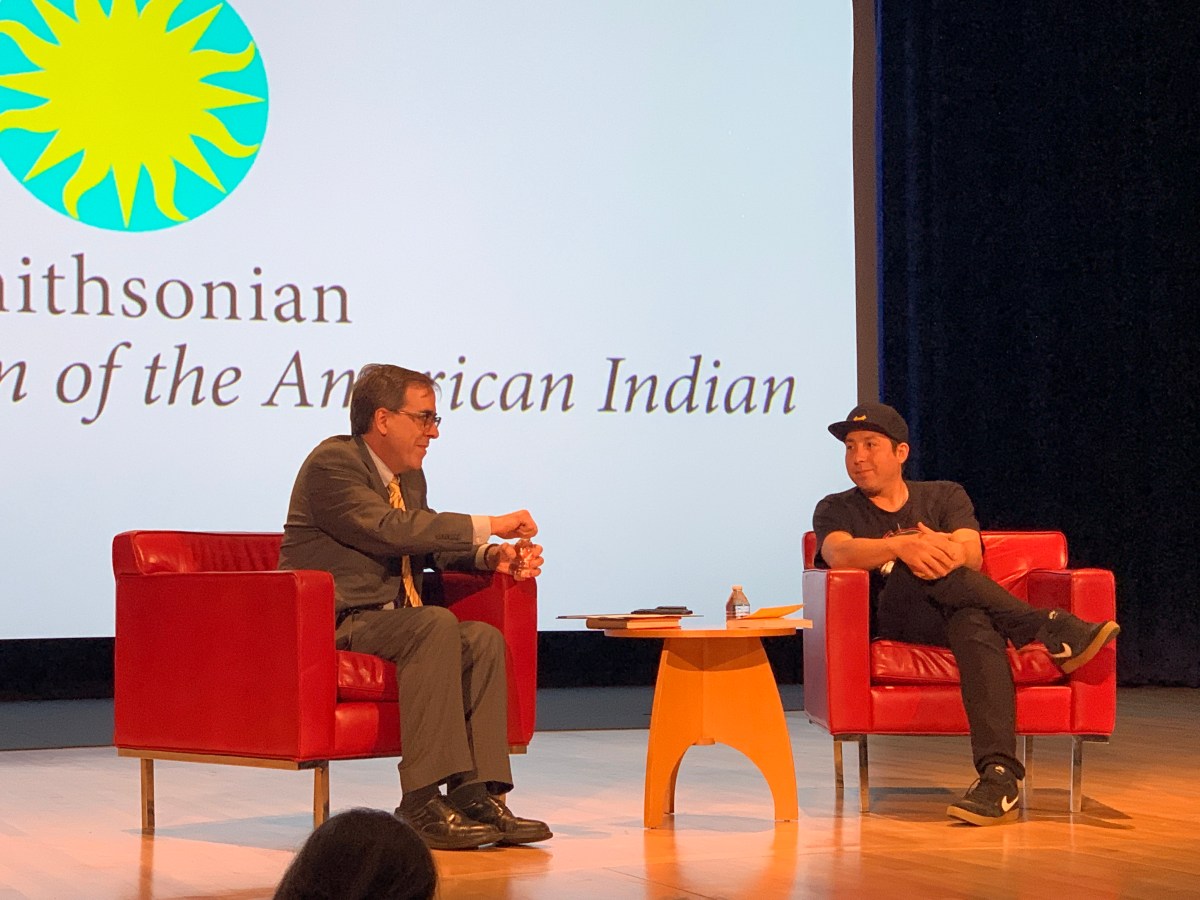
Orange, 43, a citizen of the Cheyenne and Arapaho Tribes of Oklahoma, was cited for his two novels, which explore Native lives and experiences.
HIs 2018 debut first novel, “There There,” told the stories of 12 Native people on their way to a big powwow. It was a finalist for a Pulitzer Prize in Fiction. His second novel, “Wandering Stars,” released in 2024, explores the generational traumas that the characters in his first novel carried with them.
“In both of Orange’s novels, hope is subtle yet persistent,” the MacArthur Foundation noted. “It is buried under the weight of history in his characters’ search for connection, meaning, and a way forward. Through sweeping storytelling married to an intimate focus on interiority, Orange illuminates the richness and depth of contemporary Native American life.”

The foundation selects fellows over the course of years, considering a vast range of recommendations, largely from their peers.
“Each class doesn’t have a theme and we’re not creating a cohort around a certain idea,” said Marlies Carruth, director of the MacArthur Fellows program. “But I think this year, we see empathy and deep engagement with community figures prominently in this class.”
Through different methodologies, many of the fellows “boldly and unflinchingly” reflect what they see and hear from deep engagement with their communities, she said.
Because fellows don’t apply or participate in any way in their selection, the award often comes as a shock and sometimes coincides with difficult moments.
Nabarun Dasgupta, an epidemiologist at the University of North Carolina, had just left a team meeting where he shared that a longtime collaborator in harm reduction work had died when he saw multiple missed calls from a Chicago number, which then called again. It was the MacArthur Foundation.
They were awarding him the fellowship in recognition of his work, which includes helping to start a testing program for street drugs to identify unregulated substances and helping to overcome a shortage of naloxone, which reverses an opioid overdose.
To make sense of the intense moment that mixed deep loss and recognition, Dasgupta wrote the following in a journal.
“We are surrounded by death every day,” Dasgupta wrote. “Sometimes, you have to give yourself a pep talk to get out of bed. Other mornings, the universe yells in your ear and tells you to keep going because what we’re doing is working.”
In an interview with The Associated Press, he added, “I feel like this couldn’t have been any clearer of a signal that the work has to go on.”
Other fellows were contacted by the foundation through email asking to speak with them about potential projects. Tonika Lewis Johnson, a Chicago-based artist, planned to take the call in the car. The foundation representatives tried to get her to pull over before breaking the news, but she declined.
“They were definitely worried about my safety,” she said laughing, and she did then stop driving.
Johnson’s projects are rooted in her neighborhood of Englewood, located on Chicago’s South Side. She has photographed the same addresses in north and south Chicago, beautified residents’ homes and made predatory housing practices visible. All together, her work reveals the very specific people and places impacted by racial segregation.
“This award is validation and recognition that my neighborhood, this little Black neighborhood in Chicago that everyone gets told to, ‘Don’t go to because it’s dangerous,’ this award means there are geniuses here,” Johnson said.
For Ángel F. Adames Corraliza, an atmospheric scientist at the University of Wisconsin–Madison, the award is also a recognition of the talent and grit coming from Puerto Rico, where he is from, despite the hardships his community has endured. His research has uncovered many new findings about what drives weather patterns in the tropics, which may eventually help improve forecasting in those regions.
Adames said usually one of his classes would be ending right when the foundation would publish the new class of fellows, so he was planning to end the lecture early to come back to his office. He said he’s having trouble fathoming what it will be like.
“I am low-key expecting that a few people are just going to show up in my office, like right at 11:02 a.m. or something like that,” he said.
Before getting news of the award, Adames said he was anticipating having to scale down his research in the coming years as government funding for climate and weather research has been significantly cut back or changed. He said he had been questioning what was next for his career.
The prize from MacArthur may allow him to pursue some new theoretical ideas that are harder to get funded, he said.
“I think people do care and it does matter for the general public, regardless of what the political landscape is, which right now is fairly negative on this,” he said about climate and weather science.
MacArthur Foundation 2025 Fellows
Here are the 22 fellows named by the John D. and Catherine T. MacArthur Foundation on Wednesday, Oct. 8:
*Angel F. Adames Corraliza, atmospheric scientist, Madison, Wisconsin
*Matt Black, photographer, Exeter, California
*Garrett Bradley, artist and filmmaker, New Orleans, Louisiana
*Heather Christian, composer, lyricist, playwright and vocalist, Beacon, New York
*Nabarun Dasgupta, epidemiologist and harm reduction advocate, Chapel Hill, North Carolina
*Kristina Douglass, archaeologist, New York, New York
*Kareem El-Badry, astrophysicist, Pasadena, California
*Jeremy Frey, artist, Eddington, Maine
*Hahrie Han, political scientist, Baltimore, Maryland
*Tonika Lewis Johnson, photographer and social justice artist, Chicago, Illinois
*Ieva Jusionyte, cultural anthropologist, Providence, Rhode Island
*Toby Kiers, evolutionary biologist, Amsterdam, Netherlands
*Jason McClellan, structural biologist, Austin, Texas
*Tuan Andrew Nguyen, multidisciplinary artist, Ho Chi Minh City, Vietnam
*Tommy Orange, fiction writer, Oakland, California
*Margaret Wickens Pearce, cartographer, Rockland Maine
*Sebastien Philippe, nuclear security specialist, Madison, Wisconsin
*Gala Porras-Kim, interdisciplinary artist, Los Angeles, California and London, United Kingdom
*Teresa Puthussery, neurobiologist and optometrist, Berkeley, California
*Craig Taborn, improvising musician and composer, Brooklyn, New York
*William Tarpeh, chemical engineer, Stanford, California
*Lauren K. Williams, mathematician, Cambridge, Massachusetts
ICT Staff contributed to this report.
Associated Press coverage of philanthropy and nonprofits receives support through the AP’s collaboration with The Conversation US, with funding from Lilly Endowment Inc. The AP is responsible for the content.
