Pauly Denetclaw
ICT
Nearly one year ago, Jonathan Nez wasn’t so optimistic about a Democrat running for Arizona’s second congressional district, though he said he would consider it along with other options after he wasn’t reelected as Navajo Nation president in 2022.
During a break at the 2022 White House Tribal Nations Summit, he spoke about how challenging it would be to run against a Republican candidate.
“There’s just a different party that’s in control in terms of votes for that district,” Nez said to ICT last November. “I hate to say it, but it’s going to be very difficult for any Democrat to run for that position.”
Monday, he struck a different tone.
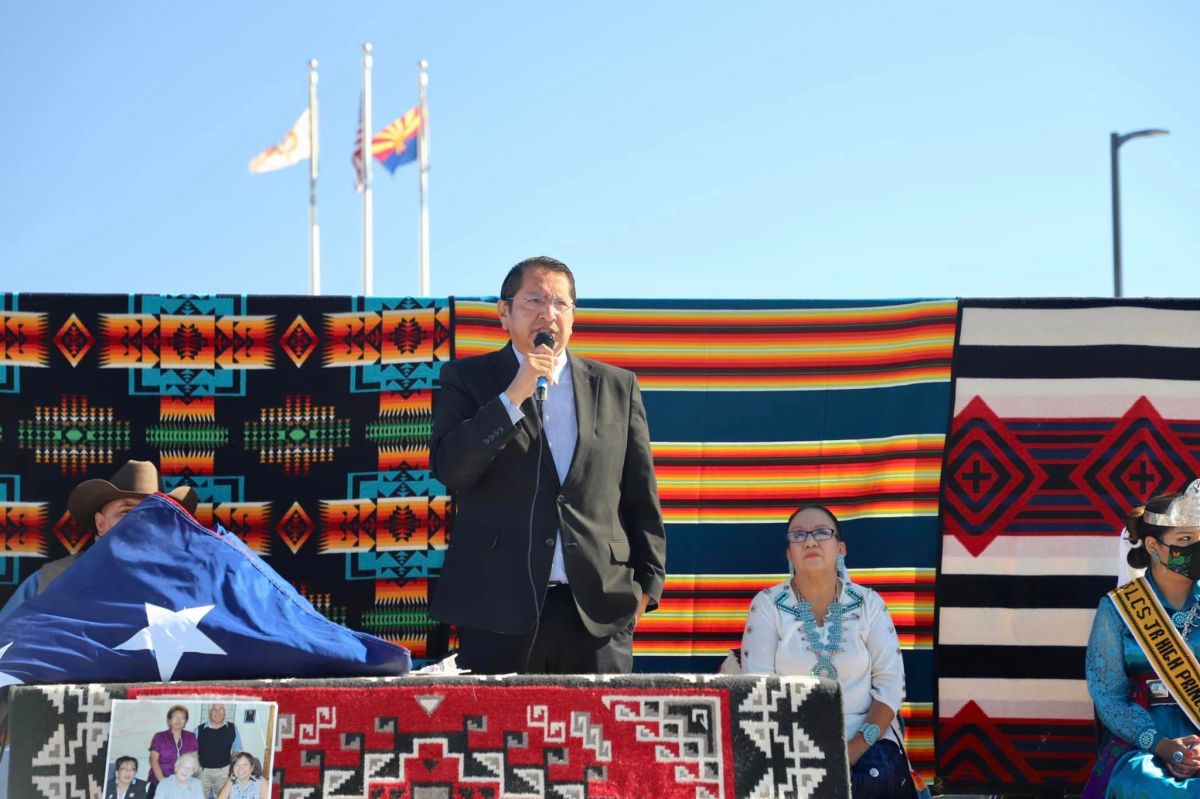
“We have an opportunity to put someone in office that will listen to the people and not just lean in one direction and listen to just a few,” Nez said alluding to his opponent. “What I would bring to Congress is a different viewpoint, a different perspective on issues on how to tackle the problems that are in this district.”
Nez is running for Arizona’s second congressional district against far-right incumbent Rep. Eli Crane, who is a member of the Freedom Caucus. Crane and Nez are the only two who have formally announced their intent to run. The primary is next August. If elected to Congress, Nez would be the first Indigenous person to represent the state in the U.S. House of Representatives.
After the 2020 census, this district was redrawn and some accuse it of being gerrymandered to decrease the influence of Native American voters in the state, around 80 percent are registered Democrats.
“It’s going to be a tough race,” said Jaynie Parrish, executive director for Arizona Native Vote. “That’s not a surprise for many of us that are in this work because of what happened with redistricting. Native voters had a lot more say prior to this round of redistricting, in terms of being able to vote for the candidate of their choice. Now, it’s a little bit harder.”
District two was pulled seven points to the right and that’s exactly what former U.S. Rep. Tom O’Halleran lost by in 2022. As Nez acknowledged last year, it’s going to be a challenging race, especially when it comes to garnering White, rural, conservative voters. A presidential election year increases voter turnout which could help the Nez campaign.
“Our constituents, the people in district two, have seen the division that’s happening and it’s one because of our representative,” Nez said. “The people have spoken to me saying that they want better representation, a person that can reach across the aisle and bring people together.”
As president of the Navajo Nation, Nez has worked with both Democrats and Republicans to support issues and legislation important to the citizens he represented. He also selected a very conservative vice-president in Myron Lizer, who was often pictured with former president Donald Trump and his son Donald Trump Jr.
“I mean, that there should show you that I’m willing to work with everyone, all parties in Congress, and not to shut anyone out, but to keep them a part of the plans that we have for our constituents in terms of bettering the quality of life,” Nez said.
It’s very early on but the issues he is most concerned about are the impacts of inflation, affordable housing, childcare and improving the healthcare system for the state.
“These are topics that our congressmen should be talking about and not being divisive in Washington, D.C.,” Nez said. “I think that just shows you the inexperience of our congressmen. For me, it’s not about on the job training, it’s about hitting the ground running and to assist our folks in the district and the greater state of Arizona.”
Rep. Crane is a freshman member of Congress and has never held any public office. There were claims early on that he didn’t actually reside within the district and instead lived in Tucson where he was born and raised.
“I am a Native Arizonan. I’m a Native from the district. My family has been here since time immemorial,” Nez said. “What I would bring to Congress is a different viewpoint, a different perspective on issues on how to tackle the problems that are in this district. And I think it’s time for Congress to hear a different perspective.”
The power of the Native vote in Arizona and many other states cannot be understated. U.S. Sen. Lisa Murkowski often credits her win as a write-in candidate in 2010 to the Alaska Native vote. The Native vote worked in favor of U.S. Rep. Mary Peltola, U.S Sens. Jon Tester in Montana, and Heidi Heitkamp in North Dakota.
“We can have that here too,” Parrish said. “Having a Native congressional person. Someone like Congresswoman Sharice Davids or Congresswoman Mary Peltola. We in Arizona have that strength and that power to do the same thing.”
There are 22 sovereign Native nations in what is now Arizona and they make up six percent of the state’s population. American Indian and Alaska Native population alone or in combination make up 73 percent of Apache County; 47 percent of Navajo County; and 28 percent of Coconino County. They’re the second largest population in Gila County at 19 percent. In Graham County, 16 percent are American Indian and Alaska Native according to the U.S. Census.
“Native voters have always been powerful,” Parrish said. “Some of the other groups are finally catching up, non-Native voters and non-Native candidates and campaigns.”

ICT is a nonprofit news organization. Will you support our work? All of our content is free. There are no subscriptions or costs. And we have hired more Native journalists in the past year than any news organization ─ and with your help we will continue to grow and create career paths for our people. Support ICT for as little as $10. Sign up for ICT’s free newsletter.