
Joaqlin Estus
ICT
A decades-long battle over a proposed massive open-pit copper and gold mine in the headwaters of Bristol Bay, home to Alaska’s most productive sockeye salmon fishery, has landed at the U.S. Supreme Court.
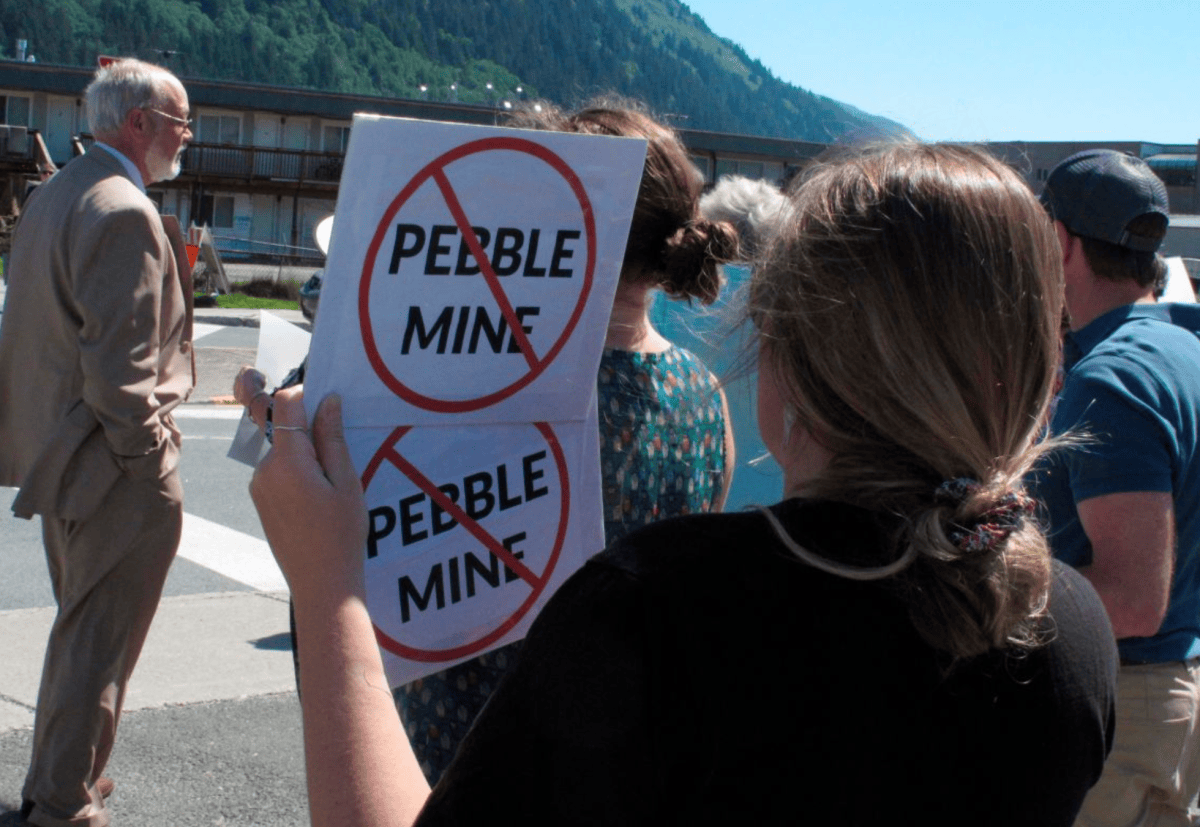
Bristol Bay Alaska Natives filed an amicus brief opposing a state of Alaska complaint that the Environmental Protection Agency overstepped its authority when it denied a Clean Water permit for the proposed mine in January.
The Bristol Bay Native Corporation and United Tribes of Bristol Bay said the state is leap-frogging over lower courts by going straight to the Supreme Court, and should be denied on that basis.
United Tribes and the regional Native corporation filed their advisory “friend of the court” brief on Nov. 9.
“In our research, we have not found a single case in which a state has sued the United States directly in the Supreme Court to challenge an agency action like the EPA’s 404(c) determination,” Daniel Cheyette, vice president for lands and resources for the Bristol Bay Native Corporation, said speaking at a press conference Thursday.
“Our main argument is that Alaska is improperly… attempting to invoke the jurisdiction of the Supreme Court,” Cheyette said.
So, before anything else, the U.S. Supreme Court must decide whether to hear the case at all.
Making the case
The state of Alaska’s motion contends Alaska’s sovereign authority was violated by the EPA’s decision, and that economic impacts merit the case going directly to the Supreme Court for fast, definitive action. The state said the EPA decision also goes against a 1976 land exchange agreement transferring title to the proposed mining site from the federal government to the state.
Alaska said the Pebble deposit is the most important resource development project in the state in recent memory.
“It would generate billions of dollars in revenue for the state and tens of thousands of jobs for Alaskans, many of whom are rural residents with limited economic opportunities,” the state said.
Related:
– EPA ruling: No permits for Pebble Mine – ICT News
– Alaska asks Supreme Court for reversal of Pebble Mine EPA ban – ICT News
Canadian mining developer Northern Dynasty Minerals, Ltd. and the Pebble Limited Partnership filed an amicus brief as well, saying the Supreme Court should take up the case.
“The world is facing a looming copper shortage against the rapidly growing demand for the metal … yet EPA has single handedly taken off the table the world’s single largest known undeveloped copper deposit,” according to the brief. “During decades when the United States will be stretching for every last pound of copper, 38 million tonnes of it will remain underground because of EPA’s decision.”
Pebble goes on to say it seems “impossible” but that the EPA made its decision without weighing the value of the salmon spawning streams “against the enormity of the economic consequences of forgoing this copper resource.”
Pebble also cited an earlier Supreme Court case involving the EPA, in which the court explained repeatedly “how unusual and unreasonable it is for an agency to refuse to consider the economic fallout from its actions.”
The Alaska Industrial Development and Export Authority, the state’s development financing entity, filed a brief on Sept. 25 supporting the state’s position. The authority said the EPA is undermining decades of federal-state agreements, including the Statehood Act, which promised the state 103 million acres to help the state become economically self-sufficient.
In a prepared statement, AIDEA said, “Alaskans relied on the offer by Congress of ownership and control of state lands and voted to accept statehood in 1958.”
Alaska Department of Law spokesperson Patty Sullivan emailed a response to the announcement that united tribes and the regional corporation had filed an amicus brief.
“We understand there are many strong opinions regarding whether this particular mine should occur in this particular area — but focusing on that misses the point of the state’s concerns and the legal arguments,” Sullivan said in the statement.
“We have robust environmental laws both at the state and federal level to which any mine has to comply. Here, however, the EPA exercised a veto of any development, no matter if it meets environmental standards, over an area that is much larger than the particular mine site at issue,” she said. “Instead, the EPA effectively took away a few hundred square miles of state land that was specifically given to the state for its resource potential. Whether or not this particular mine is a good idea is irrelevant. That can be decided in the normal course of state and federal permitting. What is at issue is whether the EPA can broadly take away lands from the state or any private citizen for responsible development, and the state believes the answer is firmly, no.”
‘Ignored and disregarded’
The EPA announced earlier this year it would use a provision of section 404(c) of the Clean Water Act, to prohibit development of the mine or any metal mining in the area.
“After extensive review of scientific and technical research spanning two decades, and robust stakeholder engagement, EPA has determined that certain discharges [of dredged or fill material] associated with developing the Pebble deposit will have unacceptable adverse effects on certain salmon fishery areas in the Bristol Bay watershed,” the EPA concluded in its final decision on the project.
Cheyette, with the Bristol Bay Native Corporation, said the EPA and U.S. Army Corps of Engineers “amassed a voluminous administrative record, definitively cataloging the damage Pebble would cause the region’s waters, hundreds of miles of stream lost, thousands of acres of wetlands lost.”
He continued, “This is simply unfathomable at the headwaters of one of the world’s most productive wild salmon fisheries, a fishery that has fed the people of the region for thousands of years, and that supports a $2 billion commercial fishery, one that many of our shareholders directly or indirectly participate in. Defending this place, defending our way of life, that’s why we’re here today.”
Cheyette said, “to the extent the state of Alaska wants to press its claims, it should be doing so in the district court or the court of claims. The state of Alaska has done so before. It knows how to do so, and the Supreme Court should force it to do so here.”
Alannah Hurley, Yup’ik, executive director of the United Tribes of Bristol Bay, said the consortium of 15 tribes represents 80 percent of the region’s population and originally petitioned EPA to use its authority under the Clean Water Act.
“We did this because we were desperate for help after being ignored and disregarded continually by the state of Alaska,” Hurley said. “Unfortunately, after 20 years, we’re here still fighting a hostile governor trying to transform our home into a toxic mining district. Governor [Mike] Dunleavy refuses to acknowledge the facts, the law, the science, and is disregarding not only Alaskans, but … the millions of people in this country who use their voices in support of protecting Bristol Bay.”
She went on to say, “[The governor’s] lawsuit ignores that the EPAs work and action in Bristol Bay has spanned three presidential administrations, multiple lawsuits, and is grounded in years of sound science.”
Hurley said with 20 other mines being proposed, it’s “clear” that broad, permanent watershed protections are needed from Congressional action or other legislation, “to help us ensure that our grandchildren are not fighting these projects piecemeal from now into eternity.”
Trout Unlimited also filed an amicus brief on Nov. 9, saying the issue is premature for Supreme Court consideration. Trout Unlimited said it would be speculative to weigh economic impacts, which are unknown.
The nonprofit advocacy organization said in its brief the state’s “alleged injury from the EPA’s determination would only be real if the State one day permitted the mining project, which it has not done and may never do. Even then, Alaska would see no economic benefits until the mine actually becomes operational and profitable – which is projected to be decades after it is permitted.”
David Frederick, an attorney for the Bristol Bay Native Corporation and United Tribes of Bristol Bay, said the Supreme Court will likely decide in January whether to take up the state’s complaint.

ICT is a nonprofit news organization. Will you support our work? All of our content is free. There are no subscriptions or costs. And we have hired more Native journalists in the past year than any news organization ─ and with your help we will continue to grow and create career paths for our people. Support ICT for as little as $10.
