
Miles Morrisseau
ICT
When Ellery Ingersoll-McNeely, Rama First Nation, was struggling with her homework at Queen’s University she couldn’t go to her parents and ask for help. She did, however, have the support of the STEMina program.
“In my program, specifically, Life Sci at Queen’s, there’s a lot of people who are legacy students, their parents went there, their grandparents went there, their parents are doctors,” Ingersoll-McNeely told ICT. “I had some people in my groups that would be like, ‘Well, I’m going to go home and my dad’s going to help me with my calculus,’ and I was like, ‘What? Like, that’s insane.’”
Ingersoll-McNeely graduated with a bachelor’s degree in life sciences and a minor in Indigenous knowledge and perspectives.
“Knowing that there isn’t a huge demographic for Indigenous students in STEM at many universities, I was a bit daunted going. So knowing that this program was there, it connected me with so many people and it was really nice because you just had more people that would connect with you and relate to you about certain things. And you could also just struggle with your STEM homework.”
Melanie Howard, Mohawk Kanehsatake, is the director of Indigenous Futures in Engineering at Queen’s University in Kingston, Ontario. The university has been supporting Indigenous students in STEM programs for a decade and a half. STEM is the acronym for science, technology, engineering and math and covers areas of study that are highly demanding and in demand.
The program is celebrating its 15th anniversary this fall.
“The current student support programs that run springboarded from a model with engineering. So we now have what’s called the STEMinA program or STEM in Indigenous academics,” Howard told ICT. “We expanded the program beyond engineering to include all Indigenous students studying science-based degree programs at Queen. We work with students from three different faculties, those of engineering, the Faculty of Health Science, as well as the Faculty of Arts and Science.”
Connecting students with STEM within the Indigenous knowledge is a part of the program’s goal.
“What we try to do is highlight (to) students that STEM, the concepts and science and technology have always been a part of our cultures too. So our STEM coordinator, Valeri (Pilgrim) has come in. She’s new here with our team and she’s from Inuit background. So as an Inuk, there are some very specific technologies they use to live on the land.”
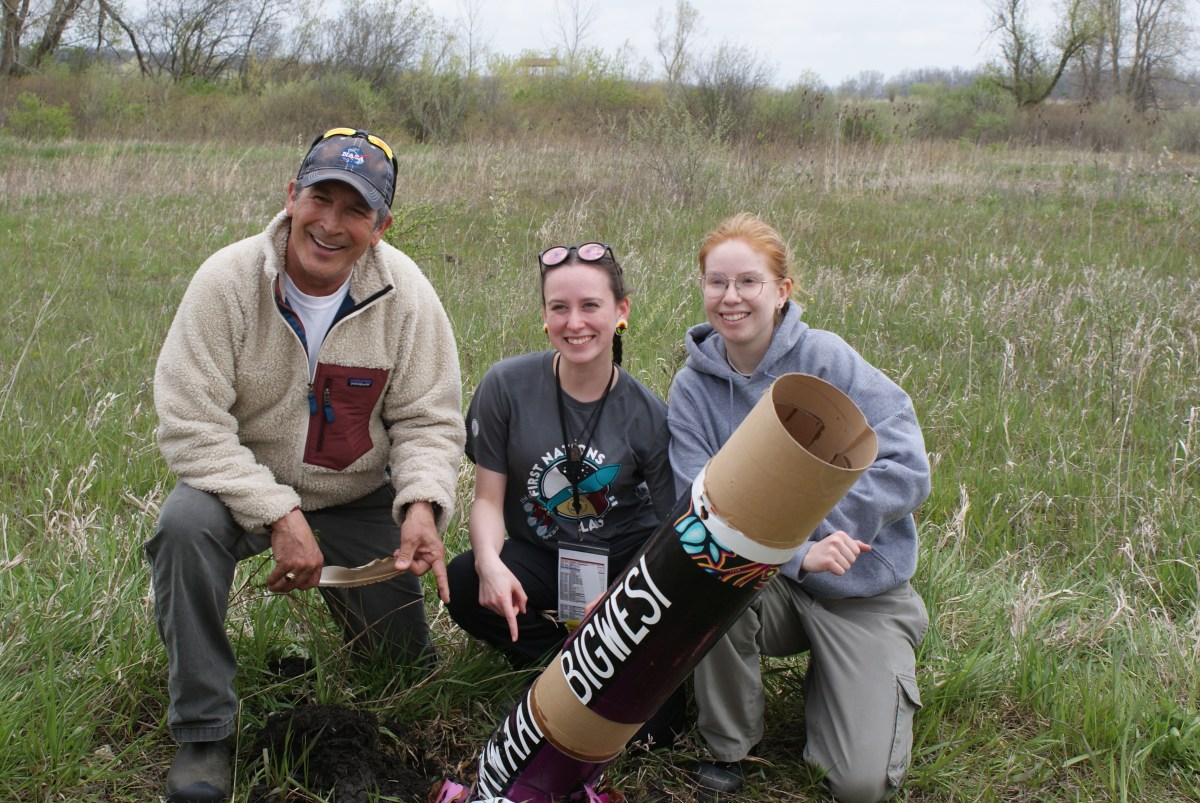
Students in the STEMina program became the first Canadian team to compete in First Launch, a NASA-sponsored rocket launch competition for all Indigenous teams.
“Six years ago in 2019, we were the first university in Canada to put ourselves forward for that competition.”
Madeleine Duncan, Curve Lake First Nation, is graduating with a degree in geological engineering and was a member of a team representing Queen’s University and Canada at First Launch.
“I am so grateful to have been a part of the Queen’s AISES Rocket Team, which was supported by the STEMina program,” Duncan told ICT in an email. “The rocket team allowed me to gain hands-on experience with designing, constructing and testing an engineering project outside of the classroom.”
She credits the program for supporting her from the start.
“The STEMina Transition Week, which ran at the very beginning of my journey at Queen’s, helped me to meet other Indigenous students in STEM fields, who became my closest friends at university,” Duncan said. “Having an opportunity to move into residence early, and learn about the supports available to me, helped me feel more comfortable with the big transition into life as a university student.”
It was through the program that Duncan connected with Indigenous women from across Turtle Island who were engineering students.
“Through the STEMina program, I was able to connect with Indigenous women who were also pursuing degrees in engineering, at events like the ribbon skirt-making workshop,” Duncan said. “I appreciated the chance to connect with people who had a similar background to me, and who made me feel like I belonged at the university, and in my classes.”
Ingersoll plans to take a year off before returning to pursue a master’s degree.
“I want to help make more nutritional health programs and help Indigenous youth who don’t always have access to specialty doctors because me growing up, I struggled with a lot of gastrointestinal issues and allergies that I didn’t necessarily have access to help myself with those. And I didn’t have any sort of contacts to go to or anywhere. And I think that it’s so important, especially for Indigenous youth to not have to miss school and not have to miss out on athletics because of illnesses.”

Students from the engineering department were especially intrigued by the Artemis mission and held watch parties.
“There was a splashdown party that the engineering students had in order to witness that historic moment, to see that real life expression of one of the ultimate uses and the amazing things that can be accomplished in the world of engineering,” Howard said. “How important is that to these young students looking forward to what their future might bring?”
Graduation ceremonies for Queen’s University will be June 22-26.
