
Nika Bartoo-Smith
Underscore News and ICT
As an urgency around climate change continues to grow, so does the recognition of the importance of Indigenous knowledge as a central component of environmental justice.
On a federal level, further recognition was announced in the form of a large sum of funding.
On Monday, the U.S. Environmental Protection Agency announced $177 million in funding to create 17 Environmental Justice Thriving Communities Technical Assistance Centers across the country. In the Pacific Northwest, two centers will work together to serve communities and tribes in Alaska, Idaho, Oregon and Washington.
SUPPORT INDIGENOUS JOURNALISM. CONTRIBUTE TODAY.
The funding was announced during the week leading up to Earth Day, April 22, a day dedicated to raising awareness and action for addressing environmental concerns since its inception in 1970.
Environmental Justice Thriving Communities Technical Assistance Centers
The University of Washington was awarded a $12 million, five-year EPA cooperative agreement to create the new UW Center for Environmental Health Equity, housed in the Department of Environmental & Occupational Sciences in the School of Public Health.

“I think the EPA recognized that there really needed to be these centers to provide ongoing support for communities, not just academic research,” said Edmund Seto, associate professor and center director at the new Center for Environmental Health Equity.
Across the country, all 17 centers will be focused on environmental justice and specifically providing technical assistance to tribes, according to Seto. He hopes to focus on providing funding and resources for tribal and other BIPOC community partners to help identify environmental hazards and solutions.
“Environmental justice isn’t anything new,” Seto said. “To me, it goes beyond just the environment. It is social justice as well.”
Seto will work alongside Clarita Lefthand-Begay, Navajo, an assistant professor in the information school who will serve as deputy director and lead the center’s tribal initiatives.

In her research, Lefthand-Begay focuses on topics including climate change and Indigenous knowledge systems. At the University of Washington, she is the director of the Tribal Water Security Network — much of her recent research has been in partnership with the Akiak’s Indian Environmental General Assistance Program in Alaska, working to establish a water quality program.
At the new center, key issues will be identified in collaboration with tribal leaders, according to Lefthand-Begay.
“Our team will involve tribes from the very beginning and ensure that they guide the process,” Lefthand-Begay said. “By centering Indigenous knowledge systems, environmental justice work can help redress this historical injustice and ensure that Indigenous perspectives and practices are respected and included in decision-making.”
In Oregon, the Willamette Partnership, Portland State University’s Institute for Tribal Governance and Rural Community Assistance Corporation will work together to co-manage the Northwestern Environmental and Energy Justice Thriving Communities Technical Assistance Center, along with a number of tribal and other community partners. The EPA has awarded $10 million, over the course of five years, to fund the center.
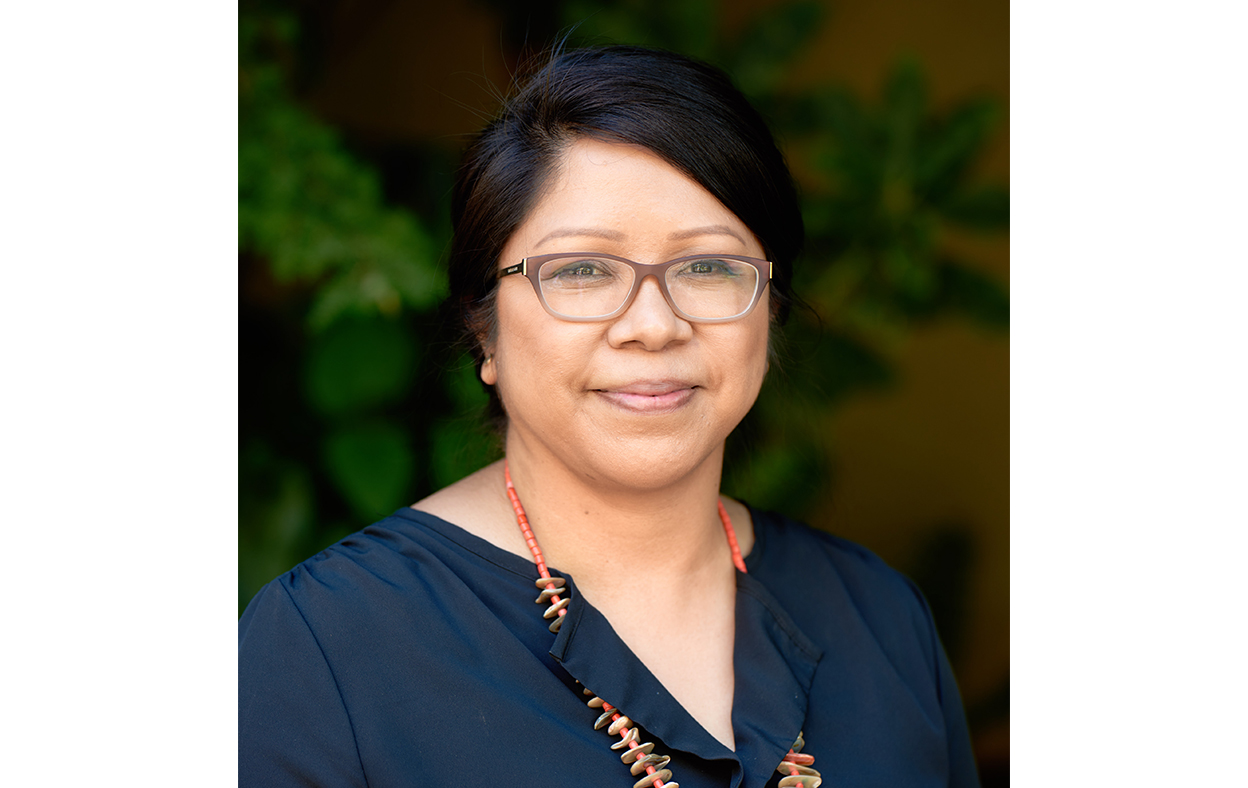
Direlle Calica (Tux’um’shush), citizen of the Confederated Tribes of Warm Springs and a Yakama, Snoqualamie and Tulalip descendant, is the director of the Portland State University Institute for Tribal Governance and will help run the new center.
“Our indigenous knowledge of science — this is an opportunity with this particular grant to validate that,” Calica said. “Our role in this is really looking at the environmental stewardship principles that are inherent in tribal culture.”
Calica sees the center as a chance to ensure that frontline communities most impacted by climate change, namely Indigenous and other BIPOC communities, will have a greater voice in environmental justice.
“We are not seeing these communities at the table participating,” Calica said. “This center will help us address how we start to eliminate some of these barriers.”
One of the key areas that the center will work to address is the growing length and severity of wildfire season in the Pacific Northwest. Increased smoke and heat is impacting vulnerable communities, especially in rural, low-income and communities of color. One way to combat this is to apply Indigenous fire management tools.
“We’re exhausting options that are available through western science,” Calica said. “At a local level if we know what some of our problems are, then we likely know what some of our solutions are.”
Indigenous methods of fire management
In recent years, wildfire season across the Pacific Northwest has lasted longer and with greater intensity than ever before. With the need to fight bigger fires, fire fighting agencies, like the Oregon Department of Wildlife, have been turning to Indigenous methods of fire management.
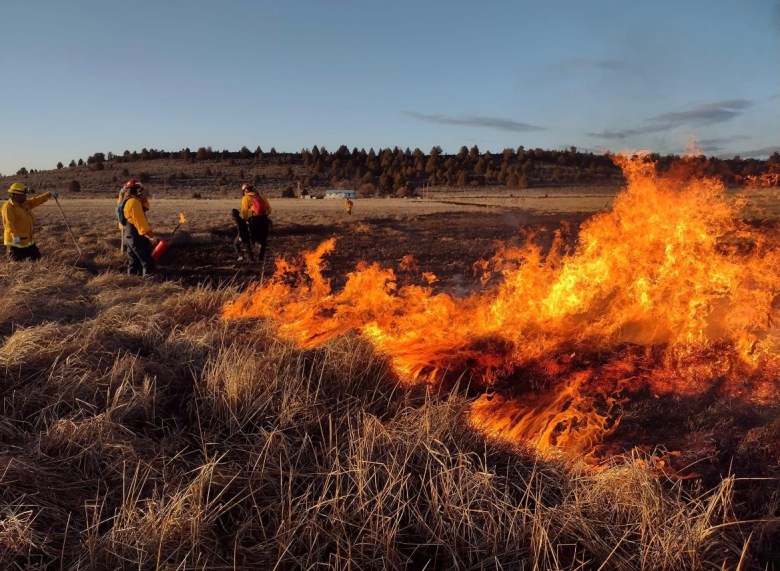
Five years ago, Derek Kimbol, Klamath Modoc tribal citizen, began practicing traditional methods of prescribed burns and teaching those skills to others. Decades ago he worked on fire fighting crews and is now working to incorporate Indigenous fire suppression tools within Western firefighting practices.
SUPPORT INDIGENOUS JOURNALISM. CONTRIBUTE TODAY.
“We’re bringing in traditional ecological knowledge with plants and prescribed fire to manage (the land) traditionally, the way our ancestors did,” Kimbol said. “(We are working to) fix the problems that have come from colonization.”
Kimbol runs the nonprofit group called Maqlaqs Gee’tkni which means “the place on earth where our people are from.” Currently a team of seven, the group not only manage the land through prescribed burns themselves, but also work to train others across the state. So far, the group has provided training and prescribed burn certification for around 30 Native people across Oregon, according to Kimbol.

For the past few years, the Oregon Department of Fish and Wildlife has partnered with local tribes around the state, participating in training about how to correctly implement prescribed burns — until recently, the practice was banned by local and federal fire fighting agencies.
“We (at ODF) are co-stewards of the land, but really we are supportive stewards (to the tribes),” said Deanna Grimstead, deputy tribal liaison and cultural resource steward for the Oregon Department of Wildlife. “With ancestral and descendant knowledge comes a degree of respect that the tribes are the keepers of that ancestral knowledge, they are the keepers of that descended practice.”
As a partner to ODF, Kimbol and his team at Maqlaqs Gee’tkni have helped train firefighters in prescribed burn practices and other Indigenous fire suppression tactics including emphasizing the importance of native plants.
Kimbol’s goal is to restore the entire Klamath National Forest. He envisions a future where the forest is full of old growth trees intertwined with a lush forest floor covered in vibrant native plants.
“Through prescribed fire, you are cleaning the soil. You’re bringing back nutrients, carbon, for the forest floor to be healthy again,” Kimbol said. “This work is just kind of getting going — we’re looking to build a larger crew.”

This story is co-published by Underscore.news and ICT, a news partnership that covers Indigenous communities in the Pacific Northwest. Funding is provided in part by Meyer Memorial Trust.
Our stories are worth telling. Our stories are worth sharing. Our stories are worth your support. Contribute $5 or $10 today to help ICT carry out its critical mission. Sign up for ICT’s free newsletter.

