

Pauly Denetclaw
ICT
WASHINGTON — It was the summer of 2023 and Interior Secretary Deb Haaland was hiking the Bright Angel Trail, the most popular path at Grand Canyon National Park in Arizona.
Later that day she would join President Joe Biden as he signed a proclamation establishing the Baaj Nwaavjo I’tah Kukveni – Ancestral Footprints of the Grand Canyon National Monument that would bring nearly one million acres under federal protection.
SUPPORT INDIGENOUS JOURNALISM. CONTRIBUTE TODAY.
But first, she wanted to get outdoors.
“We woke up really, really early on the morning of the event because I wanted to get in a little hike before we had to go to meet the president,” Haaland recalled in a recent interview with ICT.
It was a crisp 60 degrees in the arid, high desert, and the sun was beginning to bloom over the edges of the colorful canyon walls. There, in the middle of the trail was a bighorn ram. It was the first time she had ever seen a bighorn sheep in its natural habitat, and she beamed with joy as she reminisced about the moment.
“It was right in front of us,” Haaland said. “That’s nature in action, right? It’s waking up early, seeing the sunrise in some place as beautiful as the Grand Canyon, and then having the opportunity to be blessed by a magnificent animal like that. I could tell many more stories about some really awesome things that I experienced, but that stands out as one of them.”
Her appreciation for the importance of nature, the lands and peoples of the United States was at the heart of her four years at the U.S. Department of the Interior, where she served as the first Native American woman to serve in a presidential cabinet and to lead the department.
In the process, Haaland, Laguna Pueblo, left an enduring legacy across Indian Country as a beacon of Indigenous leadership and a role model to many, addressing issues that included Indian boarding schools, missing and murdered people, land stewardship and conservation, climate change and sovereignty.
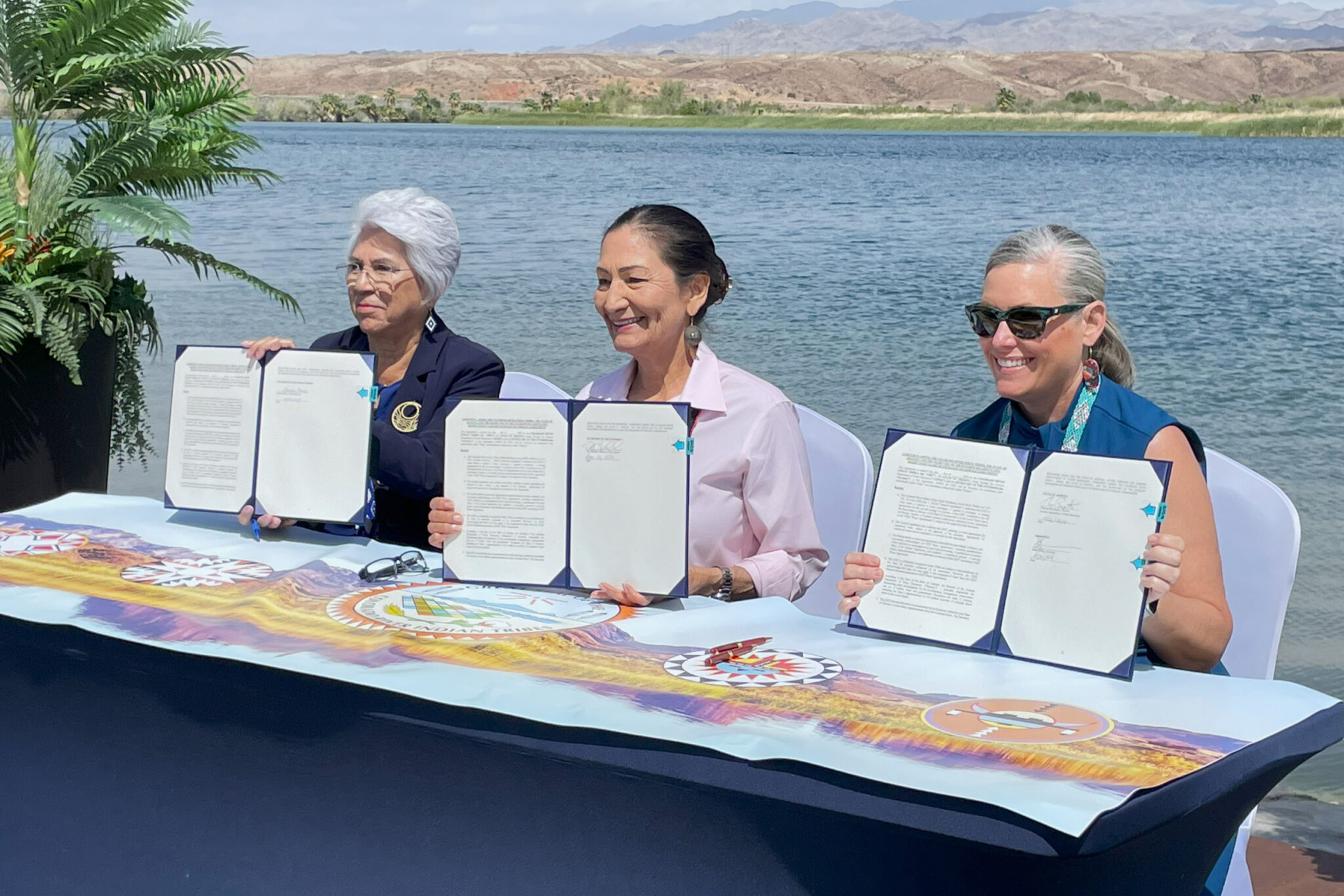
“For so many of us, she has represented our ability to be in places and spaces, that for so long, we were not welcome,” Minnesota Lt. Gov. Peggy Flanagan, White Earth Nation, told ICT. “The power of her being at that decision-making table, being part of the president’s cabinet, is quite powerful. The work that she has done, and everything she’s accomplished, we will feel that for generations to come.”
Haaland has accomplished more for tribal nations and Indigenous communities than any of her predecessors, according to the Center for American Progress, a nonpartisan public policy organization based in Washington, D.C.
“Deb Haaland, the 54th U.S. secretary of the interior, has delivered historic conservation policies and made groundbreaking progress in addressing the treatment of Tribal and Indigenous peoples in the United States,” the center concluded in an article published in June 2024.
Angelique EagleWoman, Sisseton Wahpeton Oyate and a law professor at Hamline University, said Haaland’s leadership has been transformative.
“In my lifetime, I never thought it was possible to see a Native woman head the Department of Interior,” EagleWoman said. “I think that’s lifted up the hopes and dreams throughout Indian Country of what’s available in the relationship with the U.S. government.”
Haaland is now in her final days as Secretary of the Interior. She is set to give a farewell address on at 11 a.m. Eastern on Wednesday, Jan. 15, and will leave office before the inauguration of incoming President Donald Trump on Monday.
“I’m happy and grateful for the opportunity that President Biden has given me,” Haaland told ICT.
Boarding school initiatives
Being Indigenous gave Haaland special advantages in leading the Interior Department.
A former member of Congress from New Mexico, she didn’t have to be briefed on tribal sovereignty, or treaty and trust responsibility. She came in with a vast understanding of the nation-to-nation relationships between the federal government and tribal nations.
And she brought her own lived experiences as a citizen of the Pueblo of Laguna in New Mexico, including her family’s experiences with Indian boarding schools. The government’s ugly history with boarding schools faced a renewed spotlight in May 2021 with the discovery of the remains of 215 children at the Kamloops Indian Residential School in British Columbia, Canada.

“When we heard the news from Kamloops in Canada, and the discoveries… I think if we hadn’t had a Secretary of the Interior who was Native American, who came from our communities, we would have had to spend three years educating a secretary about why we needed to have a study, and why we needed to look into this in the United States,” Holly Cook Macarro, Red Lake Nation, a political strategist and advocate.
“But Secretary Haaland immediately knew what to do,” Macarro said. “She had the power and authority to do so as Secretary of the Interior, and within weeks, announced the (Federal) Boarding School Initiative. That’s the difference.”
Haaland’s grandparents were taken from their families and placed into federal Indian boarding schools, where they experienced the United States’ forced assimilation policy. Native children were punished for speaking their languages or practicing their cultures. Today, the actions would meet the United Nations’ definition of genocide.
Haaland launched the Federal Indian Boarding School Initiative, a first-of-its-kind endeavor, to investigate the government’s history with boarding schools and the enduring impact of its assimilationist policies.
She undertook a Road to Healing tour that made 12 stops across Indian Country to give boarding school survivors the opportunity to share with federal officials their often traumatic experiences for the first time.
The initiative resulted in two reports and an oral history project in collaboration with the National Native American Boarding School Healing Coalition, that will one day be shared through the Smithsonian’s National Museum of American History.
“The boarding school initiative was a very huge undertaking,” Haaland told ICT. “It’s taken us over three years to get where we are.”
The initiative led to an historic apology to Native people from Biden for the government’s long history of Indian boarding schools.
Biden followed up six weeks later with a proclamation designating the Carlisle Federal Indian Boarding School National Monument on the site of the former Carlisle boarding school in Pennsylvania to honor the tens of thousands of students who attended schools across the country.
“I think Deb did all that she could to advance our people, because she had her ear to the ground, and she recognized where our communities were moving, and had been moving for many years on the boarding schools,” said Judith LeBlanc, Caddo, executive director of Native Organizers Alliance.
“She listened to them.”
Missing and Murdered Unit
As a member of Congress, Haaland was able to win passage of the Not Invisible Act, which called for a commission to be created that would address the issue of missing and murdered Indigenous people. The act was signed into law by then-President Trump in 2019.
One of Haaland’s first acts after Biden named her Interior secretary was to create a Missing and Murdered Unit, implementing the very law she helped to pass. The unit works to create interagency collaboration to address cases of missing and murdered American Indians and Alaska Natives. An important partner in the work is the U.S. Bureau of Indian Affairs, which falls under the domain of the Interior Department.
The unit has 26 offices across 15 states with at least one Missing and Murdered Unit agent, and is headquartered in Albuquerque, New Mexico. Each agent is tasked with gathering intelligence and helping to coordinate interagency work to solve cases. It also has six victim specialists nationally.
She personally visited the unit twice during her tenure.
“They’re doing really excellent work,” Haaland said. “Missing and murdered Indigenous people has been happening since colonization. This is something that will take a while to figure out completely. But I was proud to have passed the Not Invisible Act when I was in Congress, and then to implement that act when I got here to the department.”
Land protection and stewardship
Haaland worked to spread the word about one of Biden’s biggest agenda items, addressing climate change.
Biden had a number of ambitious goals, including the protection of 30 percent of America’s water and land by 2030, reducing greenhouse gas emissions by 50 percent by 2030, and deploying 30 gigawatts of offshore wind.
“That was a 10-year plan [and] we surpassed the halfway point in less than four years,” Haaland said. “At the same time that we were working to manage our public lands, we were also transitioning over to a clean energy future for millions and millions of Americans with the offshore wind projects that we were able to permit, and successfully get off the ground.”
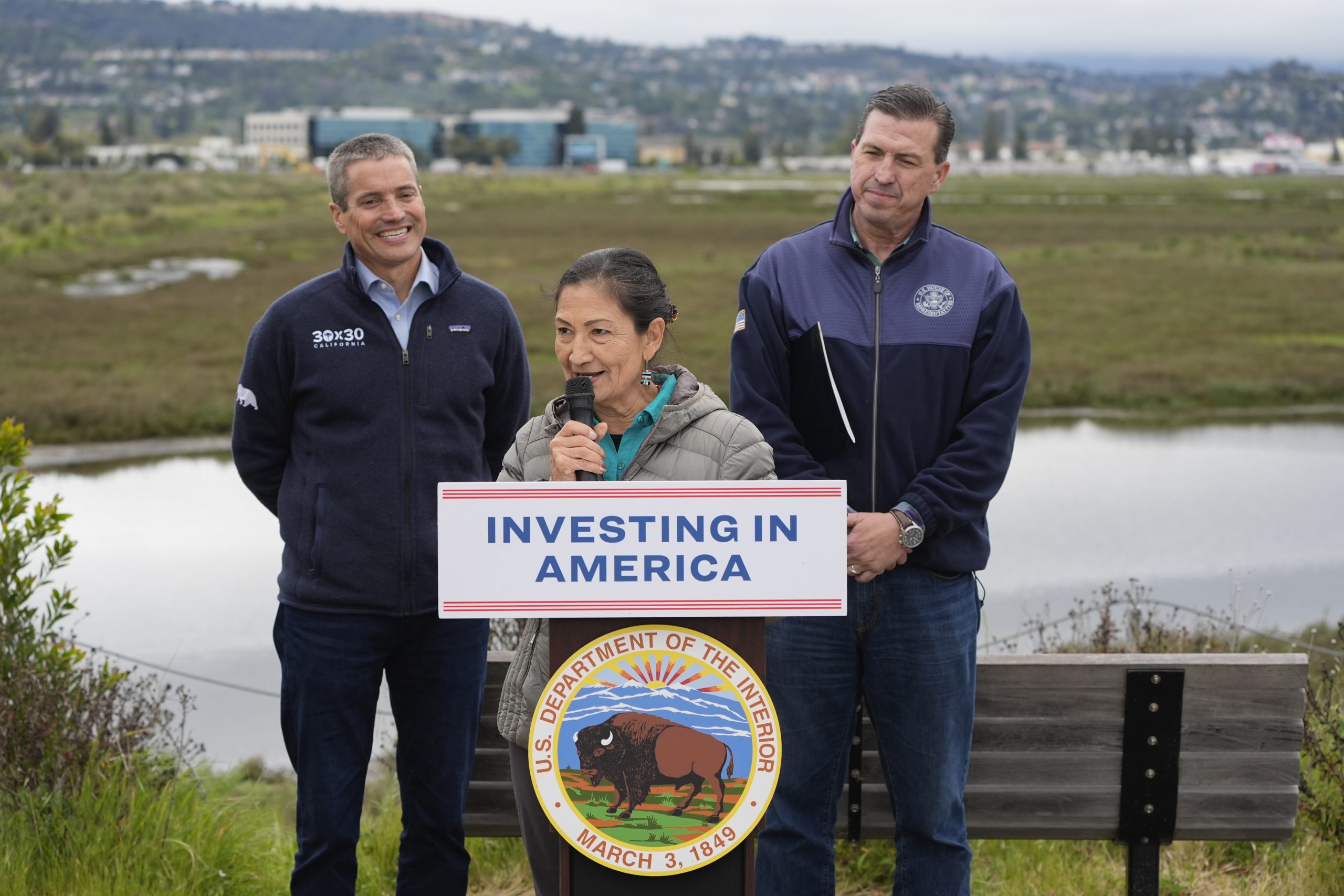
Haaland traveled across the country for Biden’s initiatives and always managed to meet with tribal leaders along the way.
“In almost every one of her trips and travels, she made sure to meet with tribal leaders, just as she did with other governmental leaders throughout the United States and its territories,” Cook Macarro said. “That has been an extraordinary piece. We haven’t ever seen that before, the prioritization of meeting with tribal governments, wherever the Secretary of Interior is, and that is setting the bar.”
Biden has protected more land and waters than any of his predecessors, putting 674 million acres under federal protection. He also created, expanded or restored 15 national monuments.
“This isn’t just the government’s responsibility,” Haaland said. “We should all include Indian Country in the conversations that we’re having with any project that comes close to their ancestral homelands.”
Other conservation projects were also completed under Haaland’s tenure.
“So many tribally-led conservation projects were moved across the finish line,” she said. “Avi Kwa Ame National Monument, President Biden signed that proclamation that was solely led by tribal communities. Tribes really had a voice in this administration, and I’m really super proud of that.”
Over 9 million acres of land and water were protected using the Antiquities Act.
“The movements were so strong to corral and curb the power of the fossil fuel industry, it gave [Haaland] and the Biden administration the strength to push back and to create a buffer zone, to do some things that would not have been done without us and without (Haaland) being aware of what our communities are concerned about,” said LeBlanc, with the Native Organizers Alliance.
Perhaps the crowning achievement of the Interior Department under Haaland was increasing the number of co-stewardship agreements with tribal nations. When Haaland started there were only 20, and as she leaves the position there are 400 agreements signed with tribes, Alaska Native corporations and consortiums.
“These are co-stewardship agreements across the country,” Haaland said. “We’ve had training sessions on how co-stewardship works. We’ve had people learn about the best way to implement these coast stewardship agreements, and making sure that we sign an agreement. We want to make sure that it’s active. Don’t forget about it just because a new administration is coming in.”
In 2022, the administration released government-wide guidance and an implementation memorandum on “federal agencies recognizing and including Indigenous knowledge in federal research, policy, and decision making,” according to a White House press release.
It was the first time Indigenous knowledge had been acknowledged and affirmed by the federal government.
After fighting for decades to be included in conversations around the Colorado River and the federal drought guidelines, tribal nations were also finally at the table for the Post-2026 Operations for the Colorado River. The Bureau of Reclamation “conducted 30 nation-to-nation consultations and held 40 tribal information exchanges to ensure ongoing dialogue and information sharing,” according to an Interior press release. Tribal nations have been stewards for millennia of the waterway that is now known as the Colorado River.
“Quite frankly, I’m incredibly grateful to tribes who have really shared their traditional knowledge with us, as we’re stewarding the lands across the country,” Haaland said. “Just because tribes’ ancestral homelands aren’t within the boundaries of their respective tribal lands, doesn’t mean that they don’t still have an obligation to care for those lands.”
Enduring impact
As Haaland leaves office this week, it’s clear that her legacy will be felt for generations among the Indigenous people who witnessed her ascent and leadership. Her appearance across the country often brought tears to those who turned out to see her speak.
“It makes me choke up a little bit because it’s been so extraordinary to see a friend be able to lead, to have the trust of the president, and to have successfully executed the responsibilities and authority that were put to her,” Cook Macarro said. “ Indian Country saw her remain true to herself, and the tribal communities that she both comes from and represents. It’s been an extraordinary four years to watch.
“Young Native women and girls get to see someone who looks like them in these spots, and the importance of that… it’s hard to overestimate the importance of that sort of visibility.”
What’s next for Haaland has yet to be confirmed by her, but speculation is rampant that she may be eyeing another run for public office.
The impact of her legacy at the Department of the Interior is evident in the daughter of Flanagan, the Minnesota lieutenant governor. The young daughter, Siobhan Hellendrung, attends a school with a large painting of Haaland in one of the hallways. One day, the girl pointed to the painting and told her friends that was her auntie.
They were in disbelief until the girl showed them a photo of her and her Auntie Deb on her cell phone.
“Secretary of the Interior Deb Haaland means so much to me personally,” Flanagan said. “She is a dear friend, a sister, and like many people, we call her auntie.”
Haaland is lovingly called Auntie Deb by many in Indian Country, a title she appreciates.
“Auntie is probably one of my favorite roles aside from mom, because I am a mom as well,” Haaland said. “But when I think about my role here, I’m so grateful that President Biden promised to have a cabinet that looks like America, to have an administration that looks like America, and he followed through on that promise.”

Our stories are worth telling. Our stories are worth sharing. Our stories are worth your support. Contribute today to help ICT carry out its critical mission. Sign up for ICT’s free newsletter.

